
.svg)





%201.avif)
Shopify discount codes remain one of the most powerful tools in an eCommerce merchant's arsenal for driving conversions, rewarding loyal customers, and clearing excess inventory. When used strategically, these promotional mechanisms can significantly boost revenue whilst protecting profit margins. However, poorly planned discount strategies often lead to margin erosion, customer devaluation, and diminished brand perception. This comprehensive guide explores how UK brands can implement shopify discount codes effectively, covering everything from basic setup to advanced promotional strategies that align with commercial objectives.
Understanding Shopify Discount Code Types
Shopify's native discount functionality offers several distinct code types, each serving specific commercial purposes. Understanding the differences between these options is essential for building effective promotional campaigns.
Percentage-based discounts reduce the order total by a fixed percentage, making them ideal for seasonal sales or customer appreciation events. A 15% discount feels more substantial on higher-value orders, encouraging customers to add premium items to their basket.
Fixed amount discounts subtract a specific monetary value from the order total, such as £10 off. These work particularly well for abandoned cart recovery campaigns and first-time customer incentives.
Free shipping codes eliminate delivery costs, which research shows remains one of the primary reasons for cart abandonment. This discount type often converts better than percentage discounts of equivalent value because customers perceive shipping costs as an unnecessary added expense.
Buy X Get Y Promotions
BOGO (Buy One Get One) offers and tiered discounts encourage larger basket sizes whilst maintaining healthier margins than blanket percentage reductions. These promotions work particularly well for:
- Clearing slow-moving inventory
- Introducing new product lines
- Increasing average order value
- Building product bundles naturally
The strategic advantage of BOGO offers lies in their ability to move inventory volume whilst controlling the exact discount applied, unlike percentage codes that scale with order value.

Setting Up Shopify Discount Codes Properly
Creating discount codes in Shopify involves more than simply entering a code and percentage. Strategic configuration ensures your promotions drive results without creating operational headaches or revenue losses.
Navigate to the Discounts section in your Shopify admin panel. When creating a new code, consider these critical configuration elements:
| Setting | Purpose | Best Practice |
|---|---|---|
| Code format | Customer-facing identifier | Keep it memorable, brand-relevant, and easy to type |
| Discount value | Reduction amount | Test different values; 15-20% often outperforms 10% |
| Minimum requirements | Basket threshold | Set minimum spend to protect margins |
| Usage limits | Redemption control | Limit to one use per customer for acquisition codes |
| Active dates | Time-bound urgency | Set clear start and end dates to create scarcity |
| Eligible products | Inventory control | Exclude already-discounted or low-margin items |
The comprehensive guide from Clyro demonstrates step-by-step code creation across all discount types, highlighting configuration options many merchants overlook.
Code Naming Strategy
Your discount code names significantly impact redemption rates. Generic codes like "DISCOUNT10" lack memorability and fail to communicate value clearly.
Strong code names are:
- Concise: Maximum 8-12 characters for easy typing
- Clear: Immediately communicate the benefit (FREESHIP, SAVE20)
- Branded: Include your business name or campaign reference
- Time-specific: Reference seasons or events (SPRING2026, BLACKFRI)
For abandoned cart campaigns, personalised codes increase engagement. Consider dynamic codes that reference the customer's cart contents or browsing behaviour.
Strategic Discount Deployment
The difference between profitable promotions and margin-destroying giveaways lies entirely in strategic deployment. Shopify discount codes should serve specific commercial objectives, not simply exist as a permanent fixture eroding your pricing power.
When to Offer Discounts
Strategic timing transforms discount codes from reactive panic buttons into proactive growth tools. Deploy codes for:
New customer acquisition: First-purchase codes reduce the psychological barrier of trying an unfamiliar brand. Set these at 10-15% with a reasonable minimum spend to ensure profitability.
Cart abandonment recovery: Email sequences triggered 2-4 hours after abandonment, offering 10-15% discounts, recover significant revenue. Ensure these codes expire within 48-72 hours to maintain urgency.
VIP customer retention: Reward repeat customers with exclusive codes offering higher discounts or early access. These strengthen customer lifetime value and reduce acquisition dependency.
Seasonal campaigns: Align discount codes with cultural shopping moments like Black Friday, Boxing Day, or summer sales when customer purchase intent already peaks.
Inventory clearance: Use aggressive discounts (25-40%) on end-of-line products to free warehouse space and generate working capital, but exclude these items from regular promotional codes to maintain perceived value.
The key principle: discount codes should accelerate purchase decisions already forming, not create artificial demand that wouldn't otherwise exist.

Technical Implementation Best Practices
Beyond basic code creation, technical configuration determines whether your shopify discount codes deliver maximum return on investment or create operational challenges.
Setting Appropriate Limitations
Unlimited discount codes expose your business to abuse, affiliate fraud, and margin erosion. Configure these essential limits:
- One use per customer: Prevents individual customers stockpiling orders under multiple email addresses
- Minimum purchase thresholds: Protects margins by ensuring discount percentages apply only to sufficiently large orders
- Product exclusions: Remove already-discounted items, new releases, or low-margin products from code eligibility
- Time-bound expiration: Creates urgency whilst preventing indefinite code circulation
- Usage caps: Limit total redemptions for influencer codes or limited-edition promotions
Best practices for technical execution emphasise the importance of clear terms and automated enforcement to prevent customer service disputes.
Automatic vs Manual Discount Application
Shopify offers both manual code entry at checkout and automatic discount application. Each serves different strategic purposes:
Manual codes work best for:
- Email marketing campaigns
- Influencer partnerships
- VIP customer rewards
- Abandoned cart recovery
Automatic discounts suit:
- Store-wide sales visible to all visitors
- Qualifying threshold promotions (spend £100, save £15)
- Category-specific seasonal discounts
Manual codes provide better tracking and attribution, whilst automatic discounts reduce friction for customers who might abandon rather than search for applicable codes. For most UK brands focused on controlled promotions, manual codes offer superior strategic flexibility.
Protecting Profit Margins
The most common mistake with shopify discount codes is implementing them without understanding their impact on unit economics. A 20% discount might increase conversion rates by 35%, but if it reduces profit margins below operational costs, you're simply buying unprofitable revenue.
Calculating Discount Impact
Before launching any discount code, calculate its effect on contribution margin:
| Metric | No Discount | 15% Discount | 25% Discount |
|---|---|---|---|
| Average order value | £85 | £85 | £85 |
| Revenue per order | £85 | £72.25 | £63.75 |
| COGS (40%) | £34 | £34 | £34 |
| Gross profit | £51 | £38.25 | £29.75 |
| Gross margin % | 60% | 45% | 35% |
This simplified example demonstrates how a 25% discount reduces gross margin by 25 percentage points. If your operational costs (marketing, fulfilment, overheads) consume 30% of revenue, that 25% discount leaves only 5% net margin.
Strategies to protect profit margins whilst using discount codes include minimum purchase thresholds, product exclusions, and tiered discounts that reward larger basket sizes more generously.
Alternative Approaches to Discounting
Many successful Shopify stores achieve equivalent conversion uplifts without margin-destroying discounts:
- Free gifts with purchase: Perceived value often exceeds cost
- Bundle pricing: Increases basket size whilst protecting per-unit margins
- Loyalty points: Defers discount impact whilst building repeat purchase behaviour
- Free shipping thresholds: Encourages larger orders to qualify
These alternatives deliver promotional appeal whilst maintaining healthier economics than blanket percentage discounts. When designing promotional strategies, conversion rate optimisation often reveals opportunities to improve sales without resorting to aggressive discounting.
Integrating Discount Codes with Marketing Channels
Shopify discount codes achieve maximum effectiveness when integrated strategically across your marketing ecosystem. Isolated codes sent via single channels rarely deliver optimal returns.
Email Marketing Integration
Email remains the highest-ROI channel for distributing shopify discount codes. Segment your email list to deliver targeted codes that match subscriber behaviour and purchase history.
Segmentation strategies include:
- New subscribers (welcome sequence with first-purchase discount)
- Lapsed customers (win-back campaigns with increasing discount urgency)
- High-value customers (exclusive VIP codes with premium discounts)
- Cart abandoners (time-sensitive recovery codes)
- Browse abandoners (product-specific discount codes)
The shareable discount links strategy for email and SMS campaigns emphasises technical execution that tracks attribution accurately whilst maintaining seamless customer experience.
Social Media and Influencer Campaigns
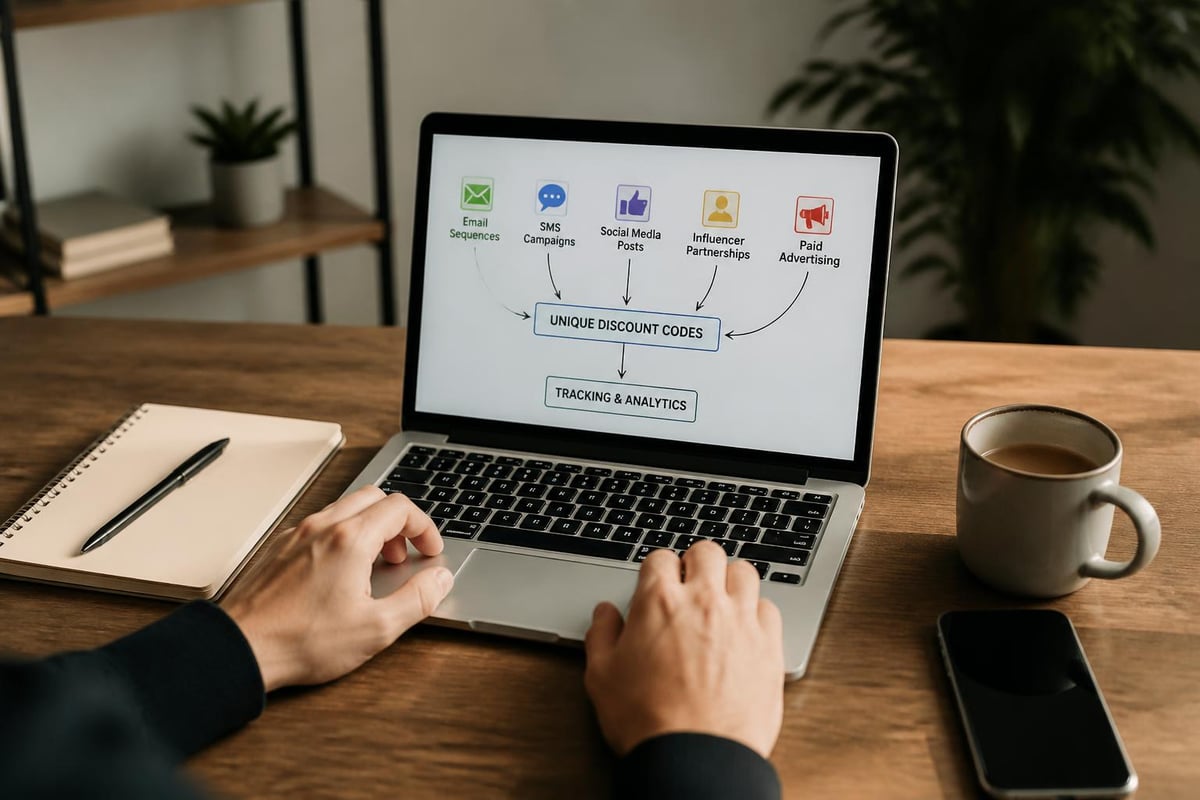
Unique discount codes provide perfect attribution tracking for influencer partnerships and paid social campaigns. Create influencer-specific codes that:
- Include the influencer's name or handle for clear attribution
- Offer the influencer's audience exclusive value (higher discount than general codes)
- Set usage caps aligned with the influencer's genuine reach
- Expire within campaign timeframes to prevent indefinite circulation
For paid social campaigns on Meta and Google, test whether direct discounts at ad level outperform driving traffic to discount code landing pages. Platform algorithms increasingly favour offers that reduce checkout friction.
Common Discount Code Mistakes to Avoid
Even experienced merchants make critical errors when implementing shopify discount codes. Common mistakes include poor code hygiene, inadequate testing, and failure to analyse performance data.
Mistake One: No Expiration Dates
Permanent discount codes train customers to never purchase at full price. Every code should have a clear expiration date, creating urgency whilst allowing you to rotate promotional strategies.
Mistake Two: Combining Multiple Discounts
Shopify prevents customers from stacking multiple discount codes, but poorly configured automatic discounts can combine with manual codes, creating unintended margin erosion. Test all discount combinations before launching campaigns.
Mistake Three: Ignoring Mobile Experience
Over 70% of UK eCommerce traffic originates from mobile devices in 2026. Discount codes that are difficult to copy-paste on mobile or require excessive typing abandon at higher rates. Use short, simple codes and implement one-click copy buttons in promotional emails.
Mistake Four: Poor Tracking and Attribution
Without proper UTM parameters and code-specific tracking, you cannot determine which discount campaigns drive profitable revenue. Create unique codes for each channel and campaign, then analyse:
- Redemption rate by source
- Average order value per code
- Customer acquisition cost including discount value
- Repeat purchase rate from discount-acquired customers
- Profit margin per code
This data reveals which discount strategies drive sustainable growth versus unsustainable margin destruction.
Mistake Five: Generic Messaging
The context surrounding your discount code matters as much as the discount itself. Generic "Get 10% off" messages convert poorly compared to specific value propositions:
- "Welcome! Enjoy 15% off your first order"
- "Your cart misses you. Here's 10% off to complete your purchase"
- "VIP exclusive: 20% off our new spring collection"
Contextual messaging aligned with customer journey stage significantly improves redemption rates.
Advanced Discount Strategies for Growth
Beyond basic promotional codes, sophisticated Shopify merchants use discount functionality to drive specific commercial outcomes and customer behaviour patterns.
Tiered Discount Structures
Progressive discounts that increase with order value naturally boost average basket size:
- Spend £50: Save 10%
- Spend £100: Save 15%
- Spend £150: Save 20%
These tiered structures feel more valuable than flat discounts whilst giving you control over margin impact. Customers perceive higher value in "unlocking" better discounts through larger purchases.
Exclusive Launch Codes
New product launches benefit from exclusive early-access codes distributed to VIP customers and email subscribers. This approach:
- Rewards loyal customers with first access
- Generates initial sales velocity that improves organic ranking
- Creates perceived scarcity and exclusivity
- Provides valuable early feedback on pricing and positioning
Launch codes should offer modest discounts (10-12%) that reward early adopters without establishing low-price anchoring for the product.
Referral and Affiliate Integration
Customer referral programmes gain traction when both referrer and referee receive discount codes. Shopify apps enable automatic code generation when customers share referral links, creating viral growth loops.
Similarly, affiliate partnerships tracked through unique discount codes provide clear attribution whilst incentivising affiliates to actively promote your products. Set affiliate codes at margins that maintain profitability after commission payments.
Seasonal and Event-Based Automation
Shopify Flow enables automated discount code generation triggered by specific customer behaviours or dates. Create workflows that:
- Generate birthday discount codes automatically
- Trigger VIP codes after customers reach spending thresholds
- Send anniversary codes on the customer's first purchase date
- Create seasonal codes that activate automatically on campaign start dates
This automation ensures consistent promotional presence without manual campaign management overhead.
Measuring Discount Code Performance
Strategic discount management requires continuous performance measurement and optimisation. Shopify's native analytics provide basic discount reporting, but comprehensive analysis demands deeper investigation.
Key Performance Indicators
Track these metrics for every discount code campaign:
- Redemption rate: Percentage of distributed codes actually used
- Incremental revenue: Sales directly attributable to the discount
- Average order value: Basket size when code is applied vs baseline
- Profit margin: Actual profit after discount, COGS, and fulfilment
- Customer acquisition cost: Total campaign cost divided by new customers acquired
- Repeat purchase rate: Percentage of discount customers who buy again at full price
- Discount abuse rate: Attempts to use expired or invalid codes
Low redemption rates signal poor targeting or unclear value communication. High redemption with low repeat purchase indicates you're attracting discount-dependent customers unlikely to deliver long-term value.
A/B Testing Discount Variables
Shopify A/B testing methodologies apply perfectly to discount code optimisation. Test variables including:
- Discount depth (10% vs 15% vs 20%)
- Code format (percentage vs fixed amount vs free shipping)
- Minimum purchase thresholds (none vs £50 vs £75)
- Expiration urgency (24 hours vs 72 hours vs 7 days)
- Message framing ("Save 15%" vs "Get 15% off" vs "15% discount inside")
Run controlled tests with statistically significant sample sizes before rolling winning variations to your full audience. Small improvements in conversion or average order value compound significantly across thousands of transactions.
Discount Codes and Customer Lifetime Value
The most sophisticated perspective on shopify discount codes considers their impact on customer lifetime value rather than isolated transaction profitability. A first-purchase discount that acquires a customer who generates £2,000 profit over three years represents excellent investment, even if the initial transaction loses money.
Segmenting by Acquisition Channel
Customers acquired through discount codes behave differently based on how they discovered the code. Analysis typically reveals:
- Email subscribers: Higher repeat rates, accept full-price purchases sooner
- Paid social: More discount-dependent, lower lifetime value
- Influencer codes: Variable based on audience quality and alignment
- Organic search: Already high-intent, often convert without discounts
This segmentation reveals which channels deserve discount code investment versus those better served with full-price positioning. Premium brands often find organic search traffic devalues when aggressive discounting appears in paid channels.
Building Post-Discount Engagement
The customer journey after discount code redemption determines long-term profitability. Implement post-purchase strategies that transition customers from discount-seekers to brand advocates:
- Excellent product quality that exceeds discount-driven expectations
- Educational email content that builds brand affinity beyond price
- Loyalty programmes rewarding repeat purchases with non-monetary benefits
- Exceptional customer service that justifies full-price positioning
- Community building that creates belonging beyond transactional relationships
When these elements align, initial discount codes become efficient customer acquisition tools rather than margin-destroying necessities. For ambitious brands looking to strengthen customer experience alongside promotional strategies, platforms like CreateSell demonstrate how digital products and automated systems can enhance customer engagement beyond traditional discount mechanics.
Technical Considerations for Scale
As your Shopify store grows, discount code management becomes increasingly complex. Enterprise-level merchants managing hundreds of active codes require robust systems and processes.
Code Organisation and Naming Conventions
Establish systematic naming conventions that communicate code purpose, channel, and timing at a glance:
- CAMPAIGN_CHANNEL_DISCOUNT_DATE
- SPRING26_EMAIL_15OFF_0401
- BLACKFRI_SOCIAL_20OFF_1126
This structure enables quick identification, prevents duplicate codes, and simplifies performance analysis across campaigns.
Automation and Workflow Integration
Manual discount code creation doesn't scale beyond early-stage operations. Implement automation for:
- Abandoned cart codes generated automatically 4 hours after abandonment
- VIP tier codes triggered when customers reach spending thresholds
- Seasonal codes activated automatically on campaign dates
- Influencer codes created through partnership management platforms
- Referral codes generated when customers share links
Integration between Shopify, your email platform, CRM, and customer service tools ensures discount codes flow seamlessly through customer touchpoints without manual intervention.
App Ecosystem Considerations
Numerous Shopify apps extend native discount functionality with advanced features like:
- Tiered automatic discounts based on cart contents
- Time-sensitive countdown timers on discount expiration
- Geographic targeting for location-specific promotions
- Customer tag-based automatic code application
- Advanced reporting and attribution
Reviews of Shopify discount apps highlight the strategic and technical considerations when selecting tools that enhance native functionality without introducing unnecessary complexity.
Regulatory and Brand Considerations
UK eCommerce operates within specific regulatory frameworks that affect discount code implementation. Non-compliance creates legal risk whilst damaging customer trust.
Advertising Standards Compliance
The ASA (Advertising Standards Authority) requires promotional claims to be clear, honest, and substantiated. When promoting shopify discount codes:
- State terms clearly (minimum spend, exclusions, expiration)
- Don't claim "up to X% off" if only limited products qualify
- Ensure "limited time" claims have genuine expiration dates
- Disclose significant conditions before customers click through
Price Comparison Regulations
If you claim discounts are "savings" from previous prices, those previous prices must have been genuine selling prices for a reasonable period. You cannot artificially inflate prices before sales to exaggerate discount value.
Data Protection and Privacy
Collecting email addresses to distribute discount codes requires GDPR compliance. Ensure:
- Clear opt-in for marketing communications
- Transparent data usage explanations
- Easy unsubscribe mechanisms
- Secure data storage and processing
Brand Positioning Impact
Beyond legal requirements, consider how discount frequency affects brand perception. Luxury and premium brands risk commoditisation through excessive discounting. Mid-market brands balance accessibility with value perception.
Strategic brand positioning determines appropriate discount frequency, depth, and messaging. Brands built on quality and exclusivity use codes sparingly for VIP customers. Value-positioned brands leverage frequent promotions as core commercial strategy. There's no universal correct approach, only alignment between brand promise and promotional tactics.
Video Content and Visual Promotion
Visual content significantly impacts discount code performance, particularly on social channels where static text converts poorly. Modern eCommerce marketing increasingly relies on short-form video to communicate promotional offers.
Tools like AdsRaw enable rapid creation of user-generated content style video ads that showcase discount offers authentically. These AI-generated videos mimic genuine customer testimonials whilst highlighting specific discount codes, creating social proof that static discount announcements lack.
Video formats that drive strong discount code redemption include:
- Unboxing videos revealing a discount code at the end
- Product demonstration content with embedded promotional codes
- Customer testimonial videos mentioning the exclusive discount
- Behind-the-scenes content rewarding viewers with special codes
- Tutorial or educational content featuring product use with discount offers
Short-form video (15-60 seconds) performs particularly well on Instagram Reels, TikTok, and YouTube Shorts, where younger demographics discover brands and products. Embedding discount codes directly in video content or pinned comments reduces friction between discovery and purchase.
Future-Proofing Your Discount Strategy
The eCommerce landscape continues evolving rapidly, with new technologies and customer expectations reshaping effective promotional strategies. Forward-thinking Shopify merchants build discount systems that adapt to emerging trends.
Personalisation at Scale
Generic discount codes increasingly underperform against personalised offers calculated from individual customer data. Advanced implementations use:
- Purchase history to determine optimal discount depth
- Browsing behaviour to identify products worth discounting
- Customer lifetime value predictions to segment discount eligibility
- Real-time inventory levels to push discounts on overstocked items
Machine learning models can predict which customers respond to specific discount types, optimising promotional spend whilst maximising conversion impact.
Zero-Party Data Collection
Direct customer preferences gathered through quizzes, surveys, and preference centres enable more sophisticated discount targeting than behavioural tracking alone. Customers willingly share preferences in exchange for relevant, valuable discount offers.
Sustainability and Ethical Considerations
Younger consumers increasingly prefer brands whose promotional strategies align with values beyond pure commerce. Consider:
- Donation-matching instead of pure discounts
- Loyalty rewards emphasising experience over price reduction
- Sustainable product bundles at reduced rates
- Second-hand or refurbished product discounts supporting circular economy
These approaches maintain promotional appeal whilst strengthening brand values and differentiation beyond price competition.
Shopify discount codes deliver powerful commercial results when implemented strategically, with clear objectives, proper technical configuration, and continuous performance measurement. The difference between margin-destroying giveaways and profitable growth tools lies entirely in strategic planning and disciplined execution. If you're building or optimising a Shopify store and want expert guidance on conversion-focused strategies that protect your margins whilst driving growth, Futur Media helps ambitious UK brands design, build, and optimise high-performing eCommerce stores through data-led development and strategic commercial planning.



.svg)