
.svg)






%201.avif)
The checkout experience determines whether browsers become buyers. For Shopify merchants, the decision to enable guest checkout represents one of the most significant conversion optimisation choices available. This setting affects cart abandonment rates, customer data collection, and long-term retention strategies. Understanding how guest checkout shopify configurations impact your store's performance requires examining both immediate conversion metrics and broader customer relationship implications.
Understanding Guest Checkout on Shopify
Guest checkout allows customers to complete purchases without creating an account. This streamlined approach removes friction from the buying process, particularly for first-time visitors who want products quickly without committing to another password or profile.
Shopify's default settings enable guest checkout automatically, recognising that forced account creation represents a primary abandonment trigger. The platform's checkout infrastructure is designed for conversion, balancing merchant needs for customer data with buyer preferences for speed and convenience.
How Guest Checkout Works
When guest checkout shopify functionality is enabled, customers proceed directly to shipping and payment information. They provide essential details like email address, shipping location, and payment method without username or password requirements. After purchase completion, Shopify automatically creates a customer profile in the admin panel, storing order history and contact information for future marketing efforts.
The technical implementation operates seamlessly across devices and maintains PCI compliance standards. Customers receive order confirmations, can track shipments, and access receipts without logging into accounts they never created.

Benefits of Enabling Guest Checkout
Reducing friction in the purchase process delivers measurable improvements across key performance indicators. Multiple studies demonstrate that guest checkout significantly reduces cart abandonment, with forced registration cited as a primary reason customers leave before completing transactions.
Conversion Rate Improvements
Guest checkout directly impacts bottom-line revenue by converting more visitors into customers. Industry data suggests stores offering guest options see 20-45% higher checkout completion rates compared to those requiring account creation.
Key conversion benefits include:
- Faster purchase completion for time-sensitive buyers
- Lower psychological commitment for first-time customers
- Reduced form fields and interaction requirements
- Mobile-optimised experience with minimal typing
- International customer accommodation where account creation feels excessive
Competitive Advantages
UK ecommerce brands compete against retailers offering frictionless experiences. Guest checkout positions Shopify stores competitively against marketplaces and direct-to-consumer brands that prioritise speed over data collection. Modern buyers expect purchase flexibility, particularly when shopping from mobile devices where account creation feels cumbersome.
Potential Drawbacks to Consider
While guest checkout improves immediate conversions, merchants must weigh trade-offs against long-term customer relationship building. The decision involves balancing short-term sales against lifecycle value optimisation.
Customer Data Collection Challenges
Account creation provides structured opportunities to gather preference data, birthday information, and communication preferences. Guest purchases limit this intelligence gathering, though Shopify still captures essential contact and purchase history details automatically.
| Data Type | Guest Checkout | Account Required |
|---|---|---|
| Email address | ✓ | ✓ |
| Purchase history | ✓ | ✓ |
| Marketing preferences | Limited | Comprehensive |
| Saved addresses | No | Yes |
| Wishlist data | No | Yes |
| Loyalty programme integration | Difficult | Seamless |
Retention and Repeat Purchase Impact
Customers without accounts may perceive lower connection to brands. They lack saved payment methods, order history access, and personalised dashboard experiences that encourage returning. This can affect metrics like repeat purchase rate and customer lifetime value.
Research from ecommerce checkout optimisation experts indicates that whilst guest checkout increases initial conversion, account holders demonstrate 30-50% higher lifetime value due to easier repurchasing and stronger brand affinity.
Configuring Guest Checkout Shopify Settings
Shopify provides straightforward controls for managing checkout requirements. Access these settings through your admin panel under Settings > Checkout, where you'll find customer account options that determine registration requirements.
Available Configuration Options
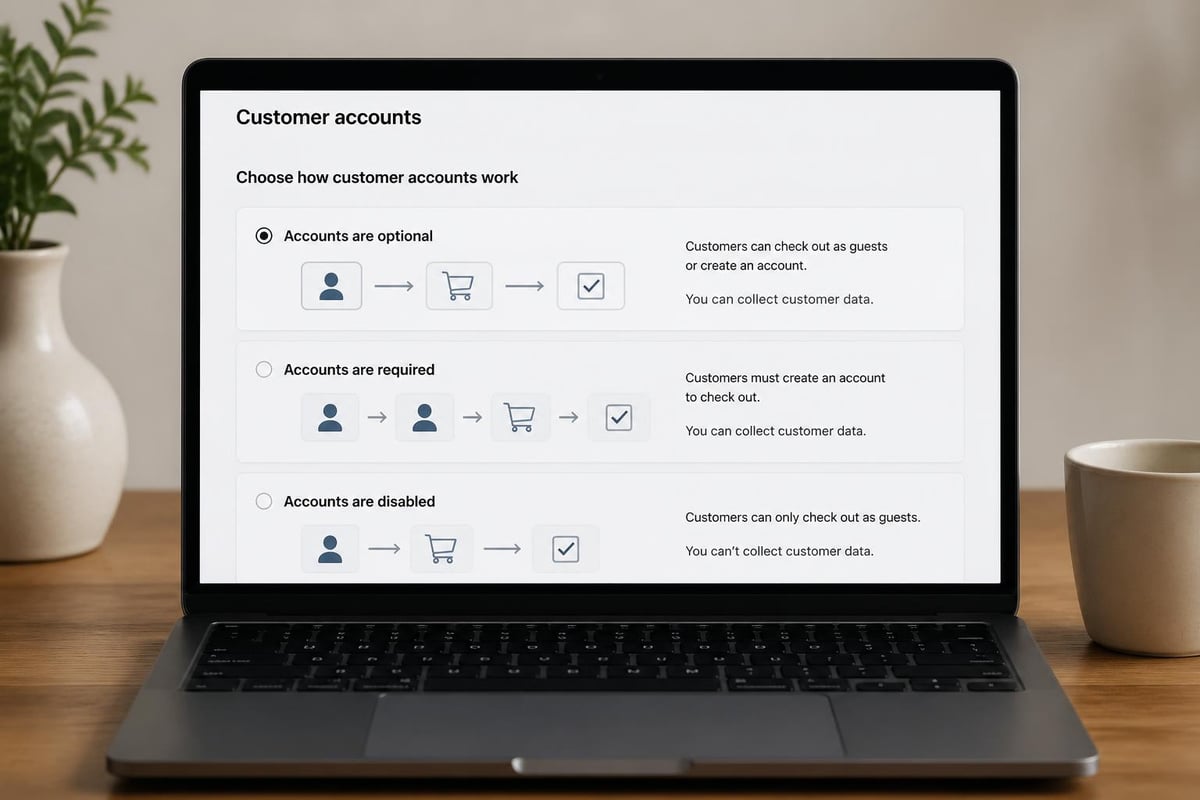
Shopify offers three distinct customer account settings:
- Accounts are optional (recommended): Customers choose between guest checkout or account creation
- Accounts are required: Every purchase requires registration before checkout
- Accounts are disabled: Only guest checkout allowed, no account creation option
The optimal configuration for most stores is "accounts are optional," providing flexibility whilst encouraging account creation through value messaging rather than force.
Implementation Best Practices
When enabling guest checkout shopify features, implement thoughtful design patterns that guide customers toward account creation without mandatory requirements. Position account benefits clearly, offering incentives like faster future checkouts, order tracking, and exclusive member benefits.
Technical implementation checklist:
- Enable guest checkout in Shopify admin settings
- Add optional account creation prompts post-purchase
- Implement email capture for marketing consent
- Configure post-purchase account creation emails
- Test checkout flow across mobile and desktop devices
- Verify abandoned cart recovery functions properly
Optimising Guest Checkout Experience
Simply enabling guest checkout isn't sufficient. The implementation quality determines whether you capture conversion improvements whilst minimising retention challenges. Strategic optimisation focuses on reducing friction whilst encouraging voluntary relationship building.
Form Field Minimisation
Guest checkouts should request only essential information. Every additional field increases abandonment probability. Review your checkout requirements and eliminate optional fields that don't directly enable order fulfilment.
Shopify's native checkout includes smart field ordering and autofill support. Leverage these features by maintaining clean, standard field names and avoiding custom fields unless absolutely necessary for operational requirements.
Trust Signal Integration
Guest buyers lack the account-creation commitment that signals trust. Compensate by prominently displaying security badges, clear return policies, and shipping information. These elements reduce purchase anxiety for customers making first-time commitments.
Essential trust elements include:
- Secure payment icons (Visa, Mastercard, PayPal)
- SSL certificate badges
- Money-back guarantee messaging
- Estimated delivery timeframes
- Customer service contact information
For stores requiring deeper checkout modifications or custom functionality, working with specialists in Shopify development ensures implementations maintain conversion focus whilst meeting unique business requirements.
Balancing Guest Checkout with Customer Accounts
The most successful strategies don't choose between guest checkout and accounts but instead implement both thoughtfully. This hybrid approach captures immediate conversions whilst building long-term customer relationships through voluntary account creation.
Post-Purchase Account Creation
Rather than forcing registration before purchase, invite customers to create accounts after successful transactions. This timing leverages the positive emotional state following purchase completion, making account creation feel like added value rather than obstacle.
Shopify enables automatic post-purchase account invitation emails. These messages include order confirmation alongside simple account activation links, allowing customers to set passwords and access order history without re-entering information.
Incentivised Account Benefits
Communicate tangible advantages that make account creation worthwhile. Generic messaging about "faster checkout next time" lacks compelling motivation. Instead, offer concrete benefits like exclusive discounts, early product access, or loyalty programme points.
| Incentive Type | Effectiveness | Implementation Complexity |
|---|---|---|
| Discount on next order | High | Low |
| Loyalty points programme | Very High | Medium |
| Birthday rewards | Medium | Low |
| Early product access | Medium | Medium |
| Free shipping threshold | High | Low |
Mobile Checkout Considerations
Over 70% of ecommerce traffic originates from mobile devices in 2026, making mobile checkout optimisation non-negotiable. Guest checkout particularly benefits mobile users who find account creation painfully slow on smaller screens with touch keyboards.
Touch-Optimised Form Design
Mobile guest checkout requires larger input fields, generous spacing between elements, and smart keyboard type triggers (numeric for phone numbers, email keyboards for addresses). Shopify's native checkout handles these automatically, but custom checkout modifications must maintain mobile-first principles.
Mobile optimisation essentials:
- Single-column layouts for easy scrolling
- Autofill compatibility with device password managers
- Clear error messaging above the fold
- Sticky CTAs that remain visible during scrolling
- Progress indicators showing checkout completion status
Payment Method Variety
Mobile shoppers particularly appreciate diverse payment options. Guest checkout shopify stores should enable digital wallets like Apple Pay, Google Pay, and Shop Pay, which eliminate manual data entry entirely. These express checkout options represent the ultimate guest experience, converting browsers to buyers in seconds.

Guest Checkout Impact on Marketing
Customer data fuels targeted marketing campaigns. The guest checkout decision directly affects email list quality, segmentation capabilities, and retargeting precision. Understanding these implications helps merchants develop compensation strategies.
Email Marketing List Building
Guest checkouts still capture email addresses, maintaining your ability to build marketing lists. However, marketing consent requirements differ between account creation and guest purchases. Clear opt-in messaging during guest checkout ensures GDPR compliance whilst maximising list growth.
Implement post-purchase email sequences that deliver value beyond order confirmations. Product care instructions, complementary item suggestions, and brand story content nurture relationships with guest customers, gradually building familiarity that encourages future account creation.
Retargeting and Customer Segmentation
Shopify creates customer profiles automatically for guest purchasers, enabling basic segmentation by purchase history, order value, and product category interest. Whilst this lacks the depth of account-holder data, it provides sufficient intelligence for targeted campaigns.
Effective guest customer segments include:
- One-time purchasers for retention campaigns
- High-value orders for VIP programme invitations
- Category-specific buyers for related product launches
- Geographic segments for regional promotions
Technical Integration Considerations
Guest checkout functionality intersects with various Shopify apps and third-party integrations. Ensuring compatibility across your technology stack prevents checkout errors that damage conversion rates.
Loyalty Programme Integration
Loyalty apps traditionally rely on customer accounts for point tracking and reward redemption. Modern solutions now support guest checkout through email-based identification or post-purchase account linking. Verify your loyalty platform handles guest transactions appropriately before assuming incompatibility.
Abandoned Cart Recovery
Shopify's native abandoned cart emails function identically for guest and account-based checkouts, using email addresses captured during checkout initiation. This ensures you don't sacrifice recovery capabilities by enabling guest purchases.
Third-party cart abandonment apps may handle guest data differently. Test recovery sequences thoroughly to confirm emails trigger correctly and include appropriate product information for guest abandoners.
Performance Metrics to Monitor
Data-driven decisions require measuring how checkout configuration changes affect business outcomes. Establish baseline metrics before modifying guest checkout shopify settings, then track changes over subsequent weeks.
Key Performance Indicators
Focus measurement on metrics directly influenced by checkout friction levels:
| Metric | Target Direction | Measurement Period |
|---|---|---|
| Checkout completion rate | Increase | Weekly |
| Cart abandonment rate | Decrease | Weekly |
| Time to purchase | Decrease | Monthly |
| Repeat purchase rate | Monitor closely | Monthly |
| Customer lifetime value | Monitor closely | Quarterly |
| Marketing email open rate | Monitor | Monthly |
Working with specialists in Shopify CRO provides expertise in testing methodology and statistical significance determination, ensuring changes genuinely improve performance rather than reflecting normal variance.
Testing Guest Checkout Variations
Rather than guessing optimal configurations, implement structured testing that reveals how your specific audience responds to checkout requirements. A/B testing methodologies enable data-backed decisions based on actual customer behaviour rather than industry generalisations.
Testing Frameworks
Shopify Plus merchants access native checkout customisation and testing capabilities. Standard Shopify stores require third-party testing platforms or sequential testing approaches where configurations change for set periods whilst monitoring performance shifts.
Test variations might include:
- Guest checkout enabled versus required accounts
- Different account benefit messaging
- Voluntary post-purchase account creation timing
- Incentive offers for account registration
- Progressive profiling that builds data over multiple purchases
Sample Size and Duration Considerations
Meaningful test results require sufficient transaction volume. Stores processing fewer than 500 monthly orders need longer testing periods to achieve statistical confidence. Consider seasonal variations and promotional periods that might skew results if testing spans Black Friday or other high-traffic events.
Industry-Specific Recommendations
Guest checkout suitability varies by business model, average order value, and purchase frequency patterns. Tailoring your approach to industry dynamics optimises results beyond generic best practices.
High-Frequency, Low-Value Products
Subscription services, consumables, and frequently purchased items benefit most from account creation. The repeat purchase nature justifies initial registration friction, whilst saved payment details and automatic reordering features deliver genuine customer value.
For these businesses, consider positioning account creation as mandatory but streamlining the process with social login options and minimal required fields.
Premium or Complex Products
Luxury goods, technical products, and high-consideration items often involve longer research periods and infrequent purchases. Guest checkout removes barriers for customers making rare, significant purchases who don't want ongoing brand relationships.
These stores should emphasise guest checkout availability whilst offering optional accounts for customers who value order tracking and warranty registration convenience.
Regulatory and Privacy Considerations
Data protection regulations influence guest checkout implementation, particularly for UK stores serving customers across jurisdictions. GDPR compliance requires transparent data handling regardless of account status.
Consent Management
Guest checkouts must still capture marketing consent separately from purchase completion. Pre-ticked boxes violate GDPR requirements. Implement clear, action-based consent requests that explain what customers receive when subscribing to marketing communications.
Shopify's native checkout includes compliant consent mechanisms, but custom implementations require careful legal review to ensure regulatory adherence.
Data Retention Policies
Guest customer data remains in Shopify's database indefinitely unless manually purged or automatically removed through data retention policies. Establish clear policies regarding guest customer data storage duration and deletion protocols for compliance with data minimisation principles.
Common Implementation Mistakes
Understanding frequent guest checkout shopify errors helps merchants avoid performance-damaging configurations that undermine conversion improvements.
Mixed Messaging
Enabling guest checkout whilst prominently displaying "sign in to continue" messaging confuses customers. Ensure all checkout communication clearly indicates guest options exist and are encouraged for speed-focused shoppers.
Overcomplicated Guest Forms
Adding unnecessary fields to guest checkouts because "we might use that data later" defeats friction reduction benefits. Collect only information essential for order fulfilment, using post-purchase surveys or progressive profiling for additional data gathering.
Neglecting Mobile Testing
Desktop checkout functionality doesn't guarantee mobile performance. Test guest checkout thoroughly on actual devices across iOS and Android, verifying form behaviour, payment method display, and completion speed match desktop experience quality.
Ignoring Post-Purchase Opportunities
Treating guest purchases as dead-end transactions wastes conversion potential. Implement sophisticated post-purchase email sequences that deliver value, build brand affinity, and encourage voluntary account creation or repeat purchases.
Integration with Broader Conversion Strategy
Guest checkout represents one element within comprehensive conversion optimisation. Isolated changes deliver limited improvements compared to holistic approaches addressing multiple friction points simultaneously.
Strategic implementation considers how checkout settings interact with product page clarity, site speed, navigation intuitiveness, and trust signal placement. For merchants building new stores or conducting significant redesigns, Shopify web design services ensure checkout decisions align with overall user experience strategy.
Cross-Functional Considerations
Marketing teams need customer data for segmentation. Operations teams require accurate shipping information. Finance teams want fraud prevention. Guest checkout configuration must balance these competing priorities through implementation choices that serve business needs without sacrificing conversion performance.
Regular cross-department reviews ensure checkout settings continue serving evolving business requirements as product lines, customer segments, and growth stages shift over time.
Future-Proofing Guest Checkout Strategy
Ecommerce behaviour patterns evolve continuously. Checkout strategies effective in 2026 may require adjustment as payment technologies, device capabilities, and consumer expectations shift. Building flexibility into your approach enables adaptation without complete overhauls.
Emerging Technologies
Passwordless authentication, biometric payment verification, and AI-powered checkout assistance will influence how customers interact with purchase processes. Maintain awareness of platform developments that enhance guest checkout capabilities whilst enabling account creation for customers who value those features.
Continuous Optimisation Mindset
Rather than "set and forget" checkout configurations, implement quarterly reviews examining performance metrics, customer feedback, and competitive landscape changes. This ongoing refinement ensures your guest checkout shopify implementation maintains competitive effectiveness as market dynamics evolve.
Guest checkout configuration significantly impacts both immediate conversion performance and long-term customer relationship building, requiring thoughtful implementation that balances competing priorities. By enabling guest options whilst encouraging voluntary account creation through value rather than force, Shopify merchants capture sales from friction-sensitive buyers whilst building relationships with customers ready for deeper brand engagement. If you're looking to optimise your checkout experience, improve conversion rates, or build a high-performing Shopify store that balances sales velocity with customer retention, Futur Media combines strategic ecommerce expertise with technical Shopify proficiency to deliver measurable results for ambitious UK brands.



.svg)