
.svg)





%201.avif)
Shopify ab testing has become an essential practice for ecommerce brands looking to maximise conversions and revenue in 2026. With online competition intensifying and customer acquisition costs rising, understanding what works on your store through systematic testing is no longer optional. Whether you're testing product page layouts, checkout processes, or call-to-action buttons, A/B testing provides the data you need to make informed decisions that directly impact your bottom line. This guide explores everything you need to know about implementing effective Shopify ab testing strategies that drive measurable improvements.
Understanding Shopify A/B Testing Fundamentals
Shopify ab testing, also known as split testing, involves comparing two versions of a webpage or element to determine which performs better. You show version A to one segment of visitors and version B to another, then measure which variant achieves your desired outcome more effectively.
The methodology is straightforward yet powerful. You identify an element to test, create a variation, split your traffic between the two versions, and analyse the results to determine a winner. This approach removes guesswork from optimisation decisions.
Key benefits include:
- Reduced bounce rates through improved user experience
- Higher conversion rates from optimised checkout flows
- Increased average order values via strategic product placement
- Better return on ad spend through improved landing pages
- Data-driven insights that compound over time

What Makes Shopify A/B Testing Different
Testing on Shopify requires consideration of platform-specific factors. Unlike traditional website testing, Shopify stores must account for dynamic product catalogues, inventory changes, and ecommerce-specific metrics like cart abandonment and average order value.
The platform's liquid templating system and theme structure affect how tests are implemented. Understanding these technical considerations ensures tests run smoothly without disrupting the shopping experience. According to Shopify's comprehensive A/B testing guide, successful ecommerce testing requires balancing user experience improvements with commercial objectives.
Critical Elements to Test on Your Shopify Store
Prioritising what to test determines the impact of your Shopify ab testing programme. Not all elements deliver equal value, so focusing on high-impact areas maximises returns on your testing investment.
Product Pages and Merchandising
Product pages are where conversion decisions happen. Small changes here can generate significant revenue improvements across your entire catalogue.
Element to TestPotential ImpactTypical Test DurationProduct images (angle, zoom, lifestyle vs white background)High7-14 daysProduct descriptions (length, format, bullet points)Medium14-21 daysPrice presentation (strikethrough, bundles, payment plans)High7-14 daysCall-to-action buttons (text, colour, size, placement)High7-10 daysReviews placement (above fold, below description, sidebar)Medium14-21 daysTrust badges and guaranteesMedium14-21 days
Testing product page layouts through Shopify CRO strategies often reveals surprising insights about customer behaviour. What works for one audience segment may underperform for another.
Homepage and Navigation Structure
Your homepage sets the tone for the entire shopping experience. Testing navigation patterns, featured collections, and promotional banners helps visitors find products faster and reduces friction in the buying journey.
Consider testing hero banner messaging, the number of featured products, category layouts, and search bar prominence. These elements guide visitors towards conversion and significantly impact overall site performance. Smart homepage design can reduce the steps to purchase and increase the likelihood of first-time visitors making a purchase.
Checkout Process Optimisation
The checkout stage is where you've done the hard work but haven't yet secured revenue. Even minor friction here causes abandoned carts and lost sales.
- Test single-page versus multi-step checkout to find what your customers prefer
- Experiment with guest checkout prominence versus account creation requirements
- Optimise form field order and labelling to reduce cognitive load
- Test trust signals placement such as security badges and money-back guarantees
- Evaluate shipping cost presentation timing to minimise cart abandonment
Research on calculating confidence intervals for A/B tests demonstrates the importance of statistical rigour when measuring checkout improvements, as small sample sizes can produce misleading results.
Selecting the Right Shopify A/B Testing Tools
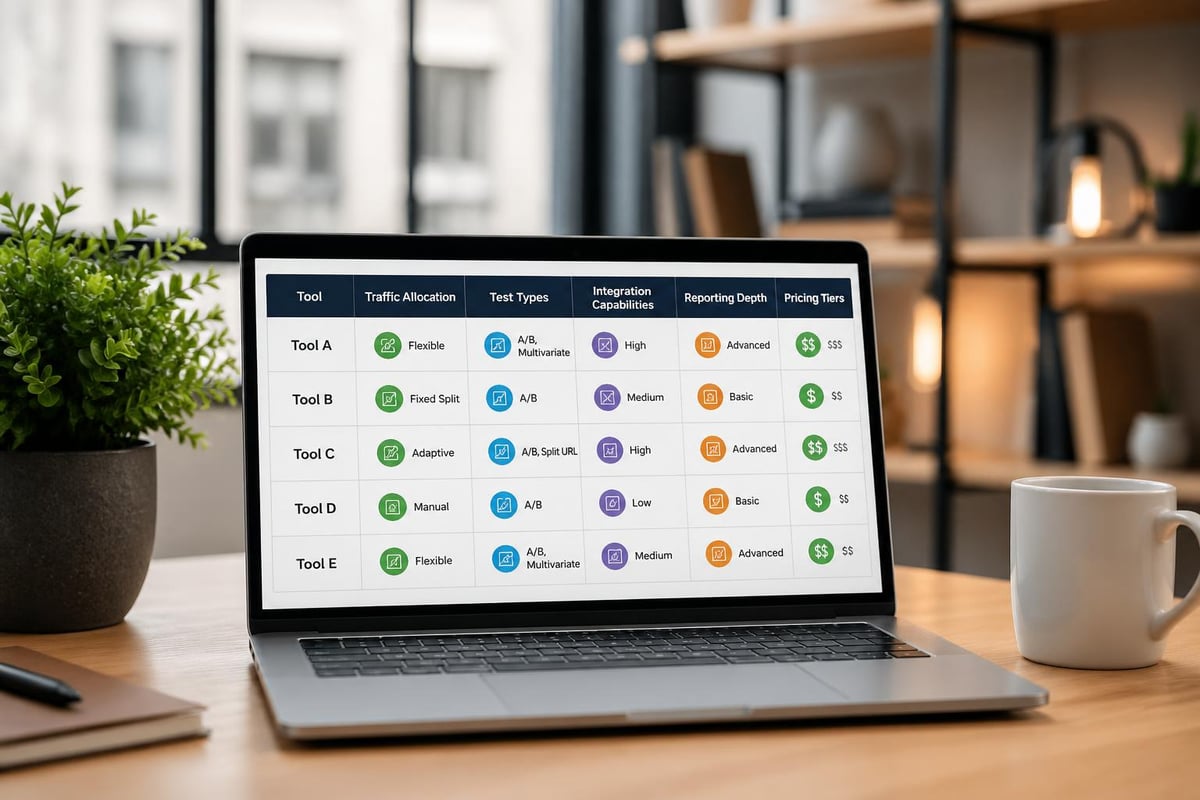
The Shopify ecosystem offers numerous testing solutions, each with distinct capabilities and pricing structures. Choosing the right tool depends on your technical resources, budget, and testing sophistication.
Native Shopify Tools and Limitations
Shopify doesn't include built-in A/B testing functionality in standard plans. This limitation means you'll need third-party applications or custom development to run tests effectively.
Some merchants attempt manual testing by creating duplicate product pages or theme templates, but this approach lacks statistical validity and proper traffic splitting. Professional testing requires dedicated tools that handle randomisation, tracking, and statistical analysis automatically.
Third-Party Testing Applications
Popular Shopify A/B testing apps include:
- Neat A/B Testing for comprehensive store-wide tests
- Shoplift for page builder integration and visual editing
- Google Optimize (free tier available) for basic split testing
- Convert Experiences for advanced targeting and personalisation
- Optimizely for enterprise-level testing programmes
These tools vary significantly in capabilities and complexity. Entry-level solutions suit merchants testing simple elements like button colours or headlines, whilst advanced platforms support multivariate testing, audience segmentation, and complex statistical models.
Custom Development Approaches
Larger merchants with development resources may build custom testing frameworks. This approach offers maximum flexibility but requires significant technical investment and ongoing maintenance.
Custom solutions integrate directly with your theme code and analytics platform, providing granular control over test implementation. However, the development cost only makes sense for high-volume stores where small percentage improvements translate to substantial revenue gains. For most merchants, established third-party tools provide better value.
Building Effective Testing Hypotheses
Random testing wastes time and resources. Successful Shopify ab testing programmes start with clear, data-informed hypotheses that target specific problems or opportunities.
Data-Driven Hypothesis Formation
Your hypothesis should articulate what you're changing, why you believe it will improve performance, and how you'll measure success. Weak hypotheses like "blue buttons might work better" lack the structure needed for meaningful tests.
Strong hypotheses follow this format: "Changing the product page CTA from 'Add to Cart' to 'Buy Now' will increase conversion rate by reducing perceived friction, measured by add-to-cart rate and checkout initiation."
Foundation elements for hypothesis development:
- Analytics data showing where visitors drop off
- Heatmaps revealing how users interact with pages
- Customer feedback identifying pain points
- Industry benchmarks highlighting improvement opportunities
- Competitor analysis revealing alternative approaches
Platforms like RankPill can help identify content opportunities through competitor analysis, which informs testing priorities around product descriptions and category pages.
Prioritising Tests by Potential Impact
Not all tests deserve equal priority. A framework for prioritisation considers potential impact, implementation difficulty, and statistical confidence requirements.
Priority LevelCharacteristicsExample TestsHighHigh traffic, clear problem, easy implementationHomepage CTA, checkout button textMediumModerate traffic, hypothesis supported by dataProduct image layout, shipping calculator placementLowLow traffic, speculative hypothesisFooter links, rarely visited collection pages
Focus your Shopify ab testing efforts on high-priority elements first. Testing low-traffic pages requires extended durations to achieve statistical significance, delaying insights and implementation.
Running Statistically Valid Tests
Statistical validity separates meaningful results from noise. Understanding sample size requirements, test duration, and significance levels prevents false conclusions that could harm performance.
Sample Size and Test Duration
Premature test conclusions are common mistakes that lead to implementing losing variations. You need sufficient visitors in each variant to detect genuine differences from random variation.
Minimum sample sizes depend on your baseline conversion rate and the minimum detectable effect you want to identify. A store converting at 2% needs roughly 10,000 visitors per variant to detect a 10% relative improvement with 95% confidence.
Test duration must also account for weekly traffic patterns. Running a test Monday to Wednesday might miss weekend shoppers with different behaviours. Industry research on A/B testing practices and challenges emphasises the importance of controlling for temporal effects in ecommerce environments.
Avoiding Common Testing Mistakes
Even experienced merchants make errors that invalidate test results. Being aware of common pitfalls helps you design more robust experiments.
- Testing too many elements simultaneously makes it impossible to identify which change drove results
- Stopping tests early when one variant takes an initial lead, before reaching significance
- Ignoring external factors like seasonality, promotions, or traffic source changes
- Testing without sufficient traffic leads to inconclusive results and wasted effort
- Making decisions on vanity metrics instead of revenue and profit-focused outcomes
The concept of Safe Testing for experimentation platforms provides frameworks for continuous monitoring without increasing false positive rates, particularly valuable for ongoing optimisation programmes.
Interpreting Results and Implementing Winners
Collecting data is only half the battle. Proper analysis and thoughtful implementation ensure you capitalise on testing insights whilst minimising risk.
Statistical Significance and Confidence Levels
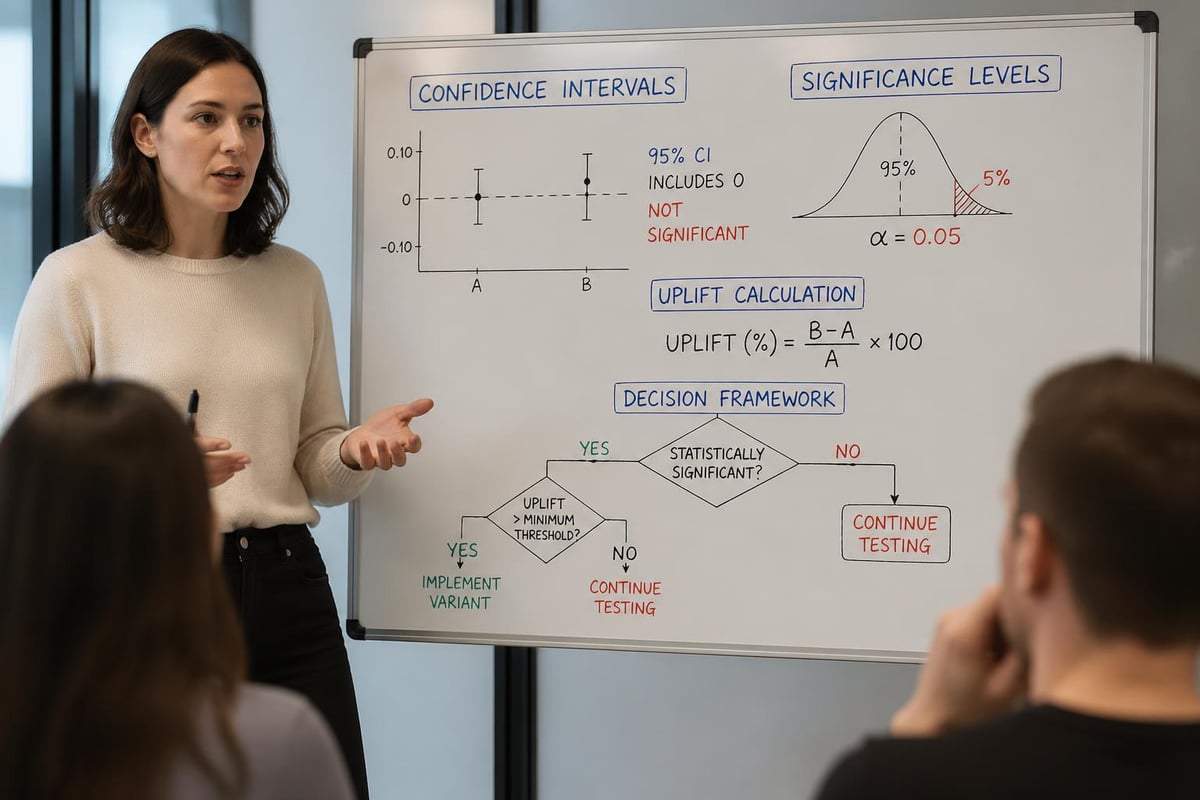
A variant showing higher conversion doesn't automatically win. Statistical significance indicates whether observed differences likely reflect genuine improvements or random chance.
Most ecommerce tests use 95% confidence levels, meaning you're 95% certain the observed difference isn't due to chance. Some merchants use 90% for faster iteration, accepting slightly higher risk of false positives.
Consider these factors when evaluating results:
- P-value: Probability results occurred by chance (below 0.05 for 95% confidence)
- Conversion rate uplift: Percentage improvement over control
- Revenue impact: Total financial gain from the improvement
- Consistency across segments: Whether all visitor types benefited equally
When working with design and development teams on test implementation, ensuring proper tracking and variant consistency becomes crucial. Strong technical foundations, whether through Shopify web design or development resources, enable smoother testing processes.
Rolling Out Winning Variations
Implementing winning tests requires careful planning, especially for significant changes affecting multiple pages or user segments. A phased rollout minimises risk whilst capturing improvement benefits.
Start by validating the winning variant over a longer period to confirm sustained performance. Some variations show initial improvements that fade as novelty wears off. After confirmation, implement the change site-wide whilst monitoring key metrics for unexpected issues.
Document every test and result in a centralised testing log. This knowledge base prevents redundant testing and helps new team members understand what's been tried and what worked.
Advanced Testing Strategies for Growth
Once you've mastered basic Shopify ab testing, advanced techniques unlock deeper optimisation opportunities and accelerate improvement velocity.
Multivariate Testing for Complex Changes
Whilst A/B tests compare two versions, multivariate tests examine multiple elements simultaneously to understand interaction effects. For example, testing headline variations, image styles, and CTA button colours together reveals which combination performs best.
This approach requires significantly more traffic than simple split tests but provides richer insights. A test with three elements, each with two variants, creates eight possible combinations requiring adequate traffic distribution.
Multivariate testing suits high-traffic stores looking to optimise complex pages like homepages or key landing pages. Lower-traffic stores should stick with sequential A/B tests to maintain statistical validity.
Personalisation and Segmented Testing
Not all visitors behave identically. Testing variations tailored to specific segments often outperforms one-size-fits-all approaches.
Valuable segments for differentiated testing:
- New visitors versus returning customers
- Mobile versus desktop users
- Traffic sources (organic, paid, email, social)
- Geographic locations with different preferences
- High-intent versus browsing visitors
Personalised experiences based on segment testing create more relevant shopping journeys. A returning customer might respond better to "Restock Your Favourites" whilst new visitors need "Shop Best Sellers" guidance.
SEO Considerations in Testing
Testing can impact search engine performance if not implemented carefully. Google's algorithms detect cloaking and thin content, potentially penalising your site for testing variations that manipulate search results.
The Shopify SEO A/B testing guide outlines best practices for testing SEO elements like meta descriptions, page titles, and content structure without risking penalties. Key principles include using proper canonicalisation, avoiding cloaking, and implementing changes that genuinely improve user experience rather than manipulating rankings.
When testing elements that affect organic visibility, monitor both conversion metrics and search performance. A variation improving conversion but harming SEO creates a net negative outcome.
Building a Continuous Testing Culture
Sustainable ecommerce growth comes from treating optimisation as an ongoing process rather than occasional campaigns. Embedding Shopify ab testing into your operational rhythm creates compound improvements over time.
Establishing Testing Cadence and Governance
Successful testing programmes run continuously with clear ownership and processes. Assign responsibility for hypothesis development, test design, implementation, and analysis to specific team members.
Create a testing calendar that sequences experiments logically, avoiding overlapping tests that could interfere with each other. Document your testing standards, including minimum sample sizes, significance thresholds, and decision frameworks.
Regular review meetings examine test results, extract learnings, and prioritise upcoming experiments. This rhythm keeps optimisation front-of-mind and ensures insights translate to action.
Learning from Failed Tests
Not every test produces a winner, and that's valuable information. Failed tests reveal what doesn't work, preventing future misguided assumptions and refining your understanding of customer preferences.
Analyse losing variations to understand why they underperformed. Did they increase friction? Create confusion? Misalign with brand expectations? These insights inform future hypotheses and help you avoid similar mistakes.
Maintain a balanced portfolio of safe tests likely to produce incremental gains and bold tests that might yield breakthrough improvements or fail entirely. The combination drives steady progress whilst exploring innovation opportunities.
Integration with Broader Optimisation Strategy
Shopify ab testing should complement other optimisation activities like user research, analytics review, and technical performance improvements. Data from one discipline informs the others, creating a holistic understanding of how to serve customers better.
For instance, insights from heat mapping might reveal that visitors scroll past your product benefits section, suggesting a test moving it higher on the page. Similarly, customer service feedback about confusion during checkout could inspire tests simplifying the process.
Agencies specialising in custom ecommerce web development often integrate testing capabilities from the start, building stores with experimentation infrastructure and analytics foundations that support continuous improvement.
Testing Tools and Technical Implementation
Implementing Shopify ab testing effectively requires understanding both the strategic and technical dimensions of experimentation platforms and methodologies.
Server-Side vs Client-Side Testing
Testing implementations fall into two categories: client-side tests that modify pages in the browser using JavaScript, and server-side tests that deliver different versions from the server.
Client-side testing advantages:
- Easier implementation without backend development
- Visual editors for creating variations
- Quick iteration and deployment
- Most Shopify apps use this approach
Server-side testing advantages:
- No page flicker as content loads
- Better performance and user experience
- Greater control over test execution
- Reduced impact on page speed metrics
Most Shopify merchants start with client-side tools due to accessibility. High-volume stores may justify custom server-side implementations for performance benefits, particularly on mobile devices where JavaScript execution impacts load times.
Analytics Integration and Tracking
Accurate tracking forms the foundation of reliable test results. Your testing tool must integrate properly with Google Analytics, Shopify's native analytics, and any additional tracking platforms you use.
Ensure test variants are tracked as custom dimensions or events, allowing segmented analysis of visitor behaviour beyond the primary conversion metric. You might discover a variant increases purchase rate but decreases average order value, creating a nuanced decision.
Tag management systems like Google Tag Manager facilitate testing tool deployment and tracking configuration. Proper implementation prevents data gaps that could invalidate results or hide important patterns.
Mobile-Specific Testing Considerations
Mobile commerce now represents the majority of ecommerce traffic for many Shopify stores. Yet mobile and desktop users exhibit different behaviours requiring separate testing strategies.
Test elements specifically for mobile environments:
- Thumb-friendly button sizes and placement
- Simplified navigation for smaller screens
- Image loading performance on slower connections
- Form input optimisation for touch keyboards
- Mobile-specific payment options (Apple Pay, Google Pay)
Run dedicated mobile tests rather than assuming desktop winners will translate. Mobile constraints and user contexts often demand different solutions.
Shopify ab testing transforms ecommerce optimisation from guesswork into a systematic, data-driven discipline that compounds improvements over time. By establishing clear hypotheses, running statistically valid experiments, and building continuous testing into your operations, you create a sustainable competitive advantage that delivers measurable revenue growth. Whether you're looking to refine product pages, streamline checkout, or optimise your entire customer journey, Futur Media can help you build the testing infrastructure and strategic approach that turns visitors into customers and customers into advocates.



.svg)