
.svg)





%201.avif)
Email remains one of the most powerful revenue drivers for online retailers, consistently delivering exceptional returns when executed strategically. For Shopify merchants, ecommerce email marketing represents a direct line to customers that no algorithm controls, making it essential for sustainable growth. Understanding how to structure campaigns, automate workflows, and personalise messaging transforms this channel from a basic communication tool into a sophisticated revenue engine that works around the clock.
Why Ecommerce Email Marketing Delivers Measurable Results
The numbers tell a compelling story about email's effectiveness for online retail. According to verified statistics on ecommerce email marketing, the channel generates an average return of £36 for every pound spent, making it one of the highest-performing marketing investments available. This performance stems from email's unique position in the customer journey, where recipients have actively opted in to hear from your brand.
Open rates for ecommerce emails average between 15% and 25%, while click-through rates typically range from 2% to 5%. These benchmarks vary significantly based on industry, list quality, and segmentation strategies. Personalised subject lines alone can increase open rates by up to 26%, demonstrating how small optimisations compound into substantial performance improvements.
Key performance indicators worth tracking include:
- Open rate and click-through rate by campaign type
- Conversion rate and revenue per email sent
- List growth rate versus unsubscribe rate
- Email-attributed revenue as a percentage of total sales
- Engagement metrics for different subscriber segments
Beyond direct revenue, email marketing strengthens customer relationships by providing value, education, and timely offers. When your store appears in someone's inbox at the right moment with the right message, you create opportunities that paid advertising simply cannot replicate. The channel allows for storytelling, detailed product information, and multi-touch nurturing that builds trust over time.

Building Your Email Infrastructure for Growth
Before launching campaigns, establishing the right technical foundation ensures deliverability and scalability. Your email service provider should integrate seamlessly with Shopify, support sophisticated automation, and provide detailed analytics. Leading platforms offer features specifically designed for ecommerce, including product recommendation engines, abandoned cart tracking, and revenue attribution.
Authentication protocols protect your sender reputation and improve inbox placement rates. Implementing SPF, DKIM, and DMARC records validates that emails genuinely come from your domain, reducing the likelihood of messages landing in spam folders. These technical elements, while often overlooked, directly impact whether your carefully crafted campaigns actually reach subscribers.
List building strategies determine long-term success. Growing a permission-based list of engaged subscribers requires multiple touchpoints across your customer journey. Exit-intent popups, checkout opt-ins, account creation confirmations, and post-purchase follow-ups all present opportunities to expand your audience. The quality of subscribers matters far more than quantity, as engaged recipients drive the majority of email-attributed revenue.
| List Building Method | Expected Conversion Rate | Subscriber Quality |
|---|---|---|
| Exit-intent popup | 2-4% | Medium |
| Checkout opt-in | 15-25% | High |
| Content upgrade | 10-20% | High |
| Footer signup form | 0.5-2% | Low to Medium |
| Account creation | 60-80% | High |
Consider the entire customer experience when designing signup forms. A 10% discount for first-time subscribers often works well, but some brands successfully grow lists by offering exclusive content, early access to sales, or entry into giveaways. Test different value propositions to identify what resonates with your specific audience.
Segmentation Strategies That Drive Revenue
Generic, one-size-fits-all email campaigns underperform because they ignore customer context and behaviour. Effective segmentation divides your list into groups based on shared characteristics, allowing personalised messaging that speaks directly to each subscriber's situation. This approach can significantly boost ROI by ensuring relevance at every touchpoint.
Behavioural segmentation tracks actions like browsing history, purchase patterns, and engagement levels. Someone who frequently opens emails but hasn't purchased needs different messaging than a customer who buys monthly but rarely reads promotional content. Understanding these patterns allows you to tailor frequency, content type, and offer strategy accordingly.
Essential segments for ecommerce brands:
- Recent purchasers (0-30 days)
- Lapsed customers (no purchase in 90+ days)
- VIP customers (high lifetime value)
- Engaged non-purchasers (opens emails, hasn't bought)
- Category-specific browsers
- Geographic or demographic groups
Advanced segmentation incorporates predictive elements, such as likelihood to purchase within the next 30 days or customers at risk of churning. While these require more sophisticated data analysis, they enable proactive outreach that addresses customer needs before problems arise. Tools that integrate with your Shopify store automatically track these behaviours, making implementation straightforward.
Product affinity segmentation groups customers by their preferred categories or brands. If you sell both skincare and makeup, sending skincare promotions to makeup-only customers wastes opportunities and may increase unsubscribes. Category-specific campaigns demonstrate that you understand individual preferences, strengthening the relationship.
Automation Workflows That Scale Your Business
Email marketing automation removes manual work while ensuring timely, relevant communication at every customer touchpoint. Once configured, automated workflows run continuously, nurturing relationships and recovering revenue without ongoing intervention. This scalability makes automation essential for growing ecommerce brands.
Welcome series introduce new subscribers to your brand, products, and values. A three-to-five email sequence sent over the first two weeks performs significantly better than a single welcome message. These emails enjoy exceptionally high open rates, as subscribers actively anticipate hearing from you after signing up.
Abandoned cart sequences represent one of the most profitable automated workflows, with recovery rates averaging 10-15% when properly implemented. The first email should send within one hour of abandonment, addressing immediate concerns or questions. Subsequent messages might offer social proof, answer common objections, or provide a small incentive to complete purchase.
Post-purchase automation transforms one-time buyers into repeat customers. Confirmation emails set delivery expectations, while follow-up sequences request reviews, suggest complementary products, and provide usage tips. These touchpoints keep your brand top-of-mind during the crucial period when customer satisfaction and repeat purchase intent are highest.
Browse abandonment workflows target visitors who viewed products but didn't add items to cart. These sequences typically include product details, customer reviews, and related recommendations. While conversion rates run lower than cart abandonment, the volume of browse abandoners often makes these campaigns highly profitable.
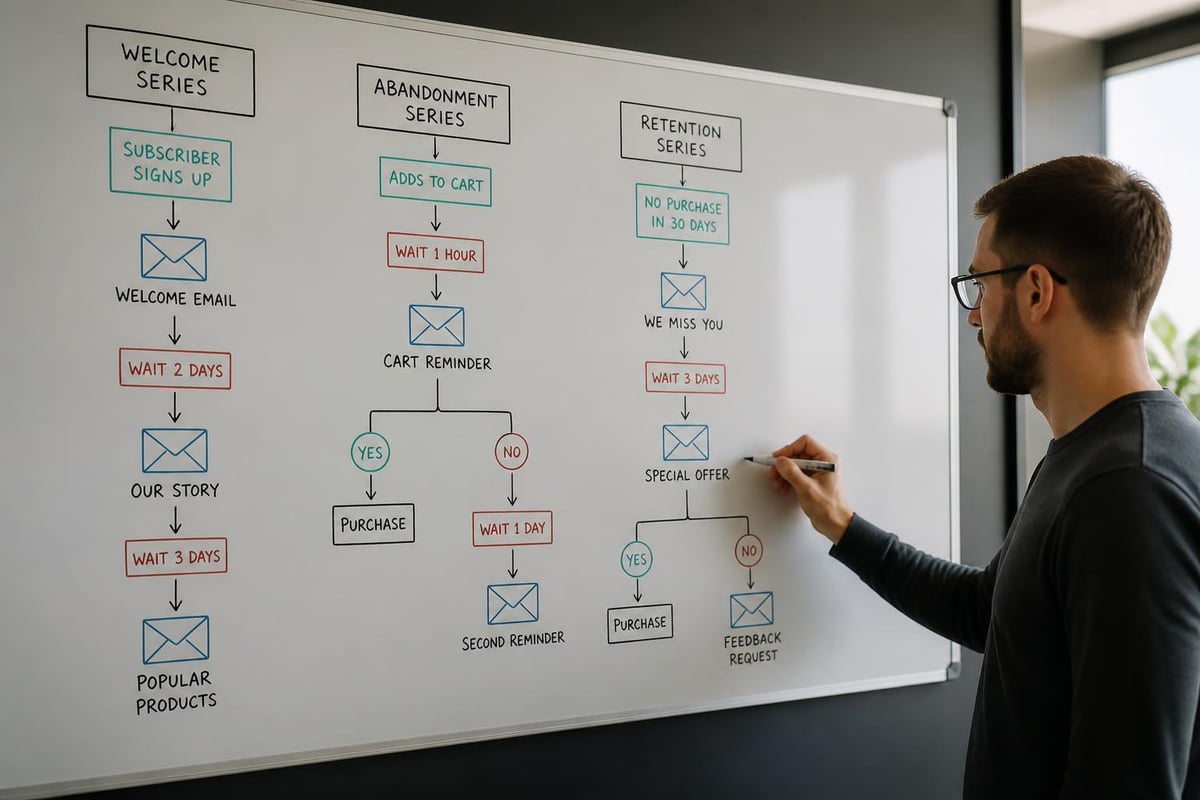
Re-engagement campaigns identify subscribers who haven't opened emails in 60-90 days, offering compelling content or incentives to rekindle interest. These campaigns either reactive dormant customers or identify addresses to remove, keeping your list healthy and engagement metrics accurate. A clean, engaged list improves deliverability for all campaigns.
Campaign Types That Generate Consistent Revenue
Beyond automation, regular promotional campaigns drive traffic and sales during key periods. The most successful ecommerce brands maintain a consistent email calendar that balances promotional content with educational material, ensuring subscribers find value beyond discounts.
Product launch announcements build anticipation and drive initial sales velocity. Teaser emails create curiosity, launch-day messages provide full details and purchasing information, and follow-up campaigns address questions or highlight reviews. This sequence maximises visibility during the critical launch window.
Effective promotional campaign structures:
- Seasonal sales aligned with shopping behaviour
- Flash sales creating urgency with limited-time offers
- Category-specific promotions for engaged segments
- New arrival showcases highlighting latest inventory
- Bundle and cross-sell campaigns increasing average order value
Educational content positions your brand as a trusted resource rather than just a retailer. How-to guides, styling tips, ingredient explanations, or industry insights provide value regardless of immediate purchase intent. These campaigns maintain engagement between promotional pushes, ensuring subscribers don't fatigue from constant sales messages.
Customer stories and social proof campaigns leverage user-generated content, reviews, and testimonials. Featuring real customers builds credibility and helps prospects visualise themselves using your products. These campaigns often include specific product recommendations tied to the featured story, creating natural purchase pathways.
When planning your ecommerce email marketing calendar, consider how campaigns support broader business objectives. If increasing average order value is a priority, bundle promotions and recommendation engines deserve focus. For brands struggling with repeat purchases, post-purchase nurturing and loyalty campaigns become critical.
Design and Copywriting Principles for Conversion
Visual design significantly impacts email performance, with mobile responsiveness being non-negotiable given that over 60% of emails open on smartphones. Single-column layouts, large tap targets, and concise copy ensure readability across devices. Testing on multiple email clients and screen sizes prevents formatting disasters that tank conversion rates.
Subject lines determine whether emails get opened, making them the most critical copy element. Effective subject lines create curiosity, promise value, or convey urgency without resorting to spam-trigger words. Personalisation, such as including the recipient's name or referencing their specific behaviour, consistently improves open rates.
Body copy should be scannable, with clear hierarchy guiding readers toward the call-to-action. Most subscribers skim rather than read, so bullet points, subheadings, and bolded text highlight key information. Each email should have a single primary objective, whether that's driving product page visits, encouraging review submission, or promoting a specific offer.
Calls-to-action require clarity and visual prominence. Buttons outperform text links, with contrasting colours drawing attention to the desired action. Copy should specify exactly what happens next, using active language like "Shop New Arrivals" rather than generic "Click Here" instructions.
Product imagery showcases items in use rather than just catalogue shots. Lifestyle photography helps customers envision ownership, while detailed product views address quality concerns. Many successful ecommerce emails combine both approaches, using lifestyle images to create desire and product shots to provide information.
| Email Element | Best Practice | Impact on Performance |
|---|---|---|
| Subject line length | 40-50 characters | Higher open rates |
| Preview text | Complement subject line | Improves click-through |
| CTA buttons | One primary, contrasting colour | Clearer conversion path |
| Image-to-text ratio | 40:60 or 30:70 | Better deliverability |
| Send time | Weekday mornings, test for your audience | Optimised open rates |
Personalisation extends beyond using names to include product recommendations based on browsing history, location-specific content, and messaging tailored to customer lifecycle stage. Dynamic content blocks adapt email content to individual recipients, showing different products, offers, or messaging based on segmentation rules.
Testing and Optimisation for Continuous Improvement
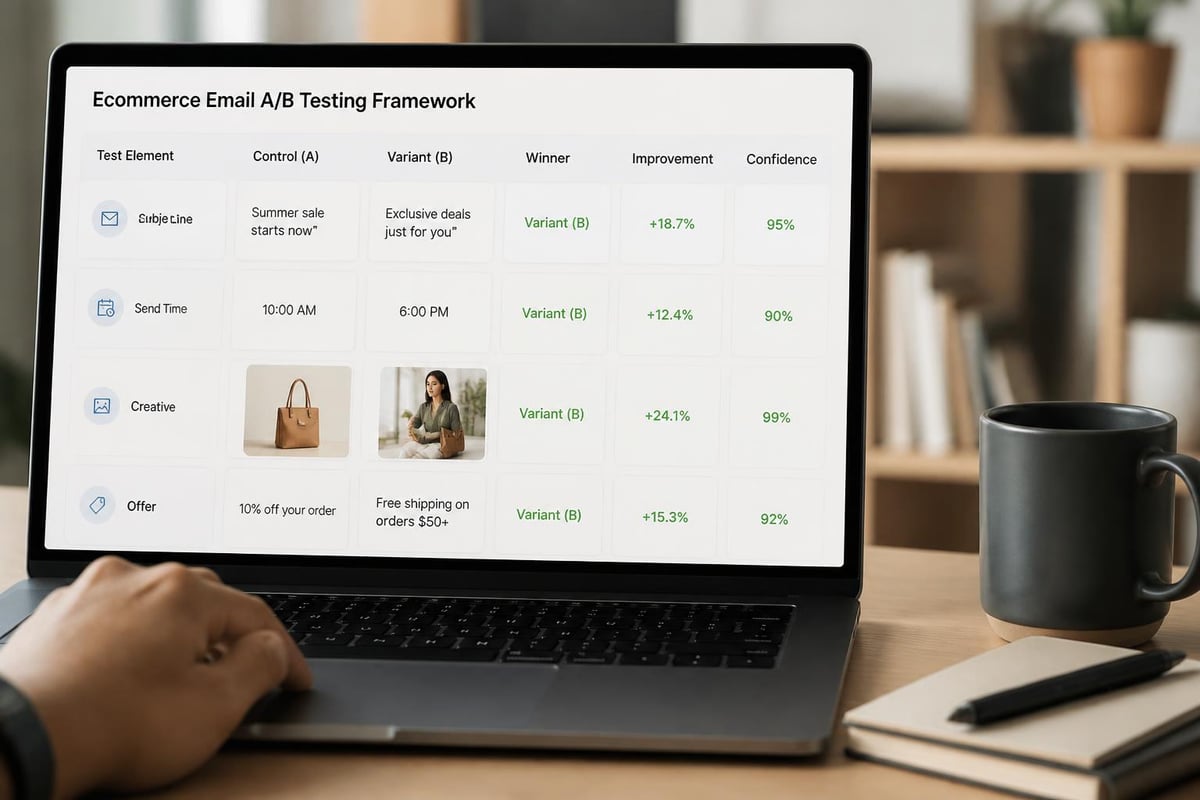
Data-driven testing separates exceptional ecommerce email marketing from mediocre efforts. A/B testing isolates variables to identify what resonates with your specific audience, removing guesswork from strategic decisions. Regular testing compounds small wins into substantial performance improvements over time.
Subject line tests often yield the quickest wins, as they directly impact open rates. Test different approaches: question versus statement, emoji versus plain text, length variations, or personalisation tactics. Run tests with statistically significant sample sizes, typically at least 1,000 recipients per variant, to ensure reliable results.
Elements worth testing systematically:
- Send time and day of week
- Email design and layout variations
- Call-to-action copy and button colour
- Discount amounts and offer presentation
- Content length and image selection
- Sender name and from address
Beyond A/B tests, multivariate testing examines how multiple elements interact. While more complex, these tests can reveal unexpected combinations that significantly outperform individual optimisations. Most modern email platforms support multivariate testing, though it requires larger lists to achieve statistical significance.
Deliverability metrics deserve ongoing monitoring, as they indicate list health and sender reputation. Bounce rates above 2%, spam complaint rates above 0.1%, or declining open rates signal potential problems requiring immediate attention. Regular list cleaning, removing inactive subscribers, and maintaining proper authentication help preserve deliverability.
Analytics should connect email performance to actual revenue and customer behaviour. Beyond open and click rates, track conversion rates, revenue per email, and customer lifetime value by acquisition source. This attribution demonstrates email's true impact on business outcomes, informing budget allocation and strategic priorities. Tools like those reviewed by industry experts provide comprehensive analytics that connect email activity to ecommerce results.
Compliance and Subscriber Trust
Regulatory compliance protects both your business and subscriber relationships. GDPR, PECR, and other data protection regulations require explicit consent before sending marketing emails, transparent data usage policies, and easy unsubscribe mechanisms. Non-compliance risks substantial fines and reputational damage that far outweigh any short-term gains from questionable tactics.
Double opt-in processes, where subscribers confirm their email address after initial signup, reduce spam complaints and improve list quality. While this approach slightly lowers conversion rates on signup forms, the resulting subscribers engage at much higher rates, making the trade-off worthwhile for most brands.
Unsubscribe processes should be straightforward and immediate. Hiding unsubscribe links or requiring login to manage preferences frustrates subscribers and increases spam complaints. Every marketing email must include a visible unsubscribe option, typically in the footer, that processes requests within 10 business days as required by law.
Preference centres allow subscribers to control email frequency and content types rather than unsubscribing entirely. Someone overwhelmed by daily emails might happily receive weekly digests, while customers interested only in specific categories can opt out of irrelevant content. This approach reduces unsubscribes while improving engagement metrics.
Transparency about data usage builds trust that encourages ongoing engagement. Clear privacy policies, secure data handling, and respectful communication demonstrate that you value the relationship beyond immediate sales. This foundation of trust becomes increasingly valuable as customers grow more protective of their personal information.
Integration with Broader Marketing Strategy
Email doesn't exist in isolation but rather connects with every other marketing channel. Coordinating messaging across email, social media, paid advertising, and on-site experiences creates cohesive customer journeys that reinforce key messages and offers. This integration amplifies each channel's effectiveness while preventing contradictory or repetitive communication.
Retargeting campaigns benefit from email data, allowing you to exclude recent purchasers from ads or target engaged subscribers with category-specific creative. Similarly, social media can promote email-exclusive offers, driving list growth while rewarding existing subscribers. These cross-channel strategies maximise marketing efficiency and customer experience.
Content marketing provides valuable material for email campaigns while email distribution amplifies content reach. Blog posts, guides, and videos gain traction when shared with your subscriber base, who are already interested in your brand. This relationship creates a content flywheel where each element supports the others.
The role of Shopify CRO becomes particularly important when email drives significant traffic to your store. Well-crafted campaigns waste their potential if they send subscribers to poorly optimised product pages or complicated checkout processes. Aligning email strategy with site optimisation ensures you capitalise on the engagement you've worked to create.
Post-purchase email sequences can gather valuable feedback and reviews that inform product development, marketing messaging, and customer service improvements. This closed-loop system turns customers into active participants in your brand evolution, strengthening relationships while providing actionable business intelligence.
Advanced Techniques for Mature Programmes
Once foundational elements are performing well, advanced tactics can unlock additional growth. Predictive segmentation uses machine learning to identify patterns in customer behaviour, enabling proactive outreach before customers churn or precisely when they're most likely to purchase again. These capabilities, once available only to enterprise retailers, are increasingly accessible through modern platforms.
Lifecycle value optimisation focuses campaigns on actions that maximise long-term customer value rather than immediate conversions. This approach might prioritise second purchases over new customer acquisition or emphasise high-margin products in recommendations. The shift from transactional to relationship thinking transforms how you structure campaigns and measure success.
Dynamic product recommendations personalise email content at send time, ensuring each recipient sees items relevant to their browsing history, purchase patterns, and preferences. This real-time personalisation dramatically increases click-through and conversion rates compared to static product showcases that ignore individual context.
Advanced automation scenarios:
- Win-back sequences with progressive incentives
- Milestone celebrations (purchase anniversaries, birthdays)
- Category replenishment reminders for consumables
- Cross-sell sequences triggered by specific purchases
- VIP tier progression notifications
Experimentation with emerging technologies like AI-generated subject lines shows promise for improving engagement. Research into using large language models for email marketing suggests these tools can create more relevant, engaging content at scale. While adoption is still early, forward-thinking brands are testing these capabilities to stay ahead of competitors.
Understanding how email marketing supports other areas of your business, such as how to make money from Shopify more effectively, creates opportunities for strategic integration. Email becomes a lever for achieving specific business outcomes rather than just another marketing channel to manage.
Measuring Success and Setting Benchmarks
Establishing clear metrics aligned with business objectives ensures your ecommerce email marketing programme stays focused on outcomes that matter. Vanity metrics like total subscribers or email sends don't reflect actual business impact, while revenue attribution, customer acquisition cost, and lifetime value demonstrate strategic contribution.
Industry benchmarks from leading platforms provide context for your performance, though direct competitors and your historical trends matter more than cross-industry averages. Aim for consistent improvement quarter-over-quarter rather than fixating on whether your open rate matches published benchmarks.
Attribution models determine how email receives credit for conversions. Last-click attribution gives email full credit only when it's the final touchpoint before purchase, undervaluing its role in customer journeys. Multi-touch attribution distributes credit across channels, providing a more accurate picture of email's contribution to revenue.
| Metric | What It Measures | Why It Matters |
|---|---|---|
| Revenue per subscriber | Total email revenue ÷ list size | Overall programme efficiency |
| Email-attributed revenue % | Email revenue ÷ total revenue | Channel contribution |
| Subscriber lifetime value | Average revenue per subscriber over time | Long-term programme value |
| List growth rate | (New subscribers - unsubscribes) ÷ total list | Audience expansion health |
| Engagement rate | Opens + clicks ÷ delivered emails | Content relevance |
Customer feedback provides qualitative insights that numbers alone cannot capture. Surveys asking why customers subscribed, what content they find valuable, or why they're unsubscribing inform strategic decisions about content mix, frequency, and messaging approach. This direct input prevents making assumptions about what your audience wants.
Regular reporting keeps stakeholders informed and ensures email's strategic importance remains visible. Monthly dashboards highlighting revenue, growth metrics, and key wins demonstrate ongoing value while identifying areas needing attention. This visibility often leads to increased investment in email capabilities as leadership recognises the channel's contribution.
Following email marketing best practices designed specifically for ecommerce ensures your programme incorporates proven strategies while leaving room for testing and innovation. The balance between following established principles and experimenting with new approaches drives sustainable improvement.
Platform Selection and Technical Considerations
Choosing the right email service provider determines what's possible with your programme. Platforms built specifically for ecommerce offer features like product catalogues, revenue tracking, and abandoned cart capabilities that generic email tools lack. Integration quality with Shopify directly impacts implementation complexity and data accuracy.
Scalability considerations include both list size limits and automation complexity. A platform suitable for 5,000 subscribers might lack the segmentation capabilities or API access needed as you grow to 50,000. Understanding your growth trajectory helps select tools that won't require migration just as your programme gains momentum.
Essential platform capabilities for ecommerce:
- Native Shopify integration with real-time sync
- Advanced segmentation based on purchase behaviour
- Visual automation builder for complex workflows
- Product recommendation engine
- Detailed revenue attribution reporting
- Mobile-responsive template builder
Deliverability track record varies significantly between providers, directly impacting whether your emails reach inboxes. Established platforms invest heavily in sender reputation, maintaining relationships with ISPs, and providing tools that help users maintain healthy lists. These behind-the-scenes elements matter as much as visible features.
Support quality and educational resources help you maximise platform capabilities. Providers offering strategic guidance, best practice documentation, and responsive technical support enable faster implementation and better results. The platform becomes a partner in your success rather than just a software vendor.
Migration between platforms, while disruptive, sometimes becomes necessary as needs evolve. Planning migrations carefully, similar to Shopify migrations, protects subscriber relationships and preserves historical data. Testing thoroughly before switching all traffic ensures continuity in customer communication.
Resource Planning and Team Structure
Effective ecommerce email marketing requires dedicated resources, whether internal team members or external partners. The channel's complexity spans strategy, copywriting, design, technical implementation, and analytics, making it difficult for one person to excel at every aspect without support.
Copywriters who understand ecommerce psychology create subject lines and body content that drive action. This skill differs from general marketing writing, requiring knowledge of direct response principles, customer objections, and persuasive techniques specific to online retail. Investing in specialised talent or training pays dividends in campaign performance.
Designers familiar with email-specific constraints ensure campaigns look professional across email clients while maintaining brand consistency. Email design requires different approaches than web design, with limitations around CSS support, image loading, and responsive behaviour that generic designers may not understand.
Resource allocation for email programmes:
- Strategy and planning: 20% of time
- Content creation and design: 40% of time
- Technical implementation: 15% of time
- Testing and optimisation: 15% of time
- Analysis and reporting: 10% of time
Strategic oversight ensures day-to-day execution aligns with business objectives and customer needs. Someone must own the overall programme, coordinating between team members, making prioritisation decisions, and advocating for resources. Without this leadership, email becomes a tactical afterthought rather than a strategic revenue driver.
Many growing brands partner with specialists who bring experience across multiple ecommerce clients. This expertise accelerates implementation, avoids common pitfalls, and introduces proven strategies that in-house teams might take years to develop through trial and error. The investment often pays for itself through improved performance and faster time-to-value.
Understanding your ecommerce website architecture helps identify opportunities for tighter email integration, such as personalised landing pages that extend email messaging or preference centres that sync with account settings. This technical coordination creates seamless experiences that improve conversion rates.
Strategic ecommerce email marketing transforms subscriber relationships into sustainable revenue streams through personalisation, automation, and continuous optimisation. The channel's combination of direct access, measurable results, and scalable workflows makes it indispensable for ambitious online retailers seeking profitable growth. If you're ready to unlock more revenue from your Shopify store through expert email strategy or need support across design, development, and optimisation, Futur Media helps UK ecommerce brands build high-performing stores that convert. Our team specialises in creating cohesive customer experiences that turn visitors into loyal customers.



.svg)