
.svg)






%201.avif)
Checkout abandonment sits at 70.19% across UK ecommerce, according to Behaviour Digital's 2026 benchmarks. Most brands respond by tweaking product pages, running more ads, or testing new hero images. The one page that directly touches every sale, the checkout, gets ignored.
For years, customising the Shopify checkout meant wrestling with checkout.liquid: fragile, hard to maintain, and increasingly a liability. Shopify deprecated it for Plus merchants in August 2024. It's gone.
What replaced it, Checkout Extensibility, is a fundamentally different system. And for UK brands in 2026, it's not just a technical upgrade.
The part most coverage misses: every article about Checkout Extensibility focuses on the migration. This one focuses on what comes after it, because that's where the revenue is.
Why This Matters Now
Here's why this matters right now:
- Checkout.liquid is deprecated. Brands still relying on legacy customisations are on unsupported infrastructure.
- BNPL regulation takes effect in the UK from 15 July 2026, changing how payment options must be presented at checkout.
- The European Accessibility Act came into force in June 2025, raising the bar for brands selling into the EU.
- Most merchants who migrated did the minimum. The commercial opportunity from building properly on the new system remains largely untapped.
What Is Checkout Extensibility, and What Changed?
Checkout Extensibility is Shopify's replacement for checkout.liquid, the old template file that Shopify Plus merchants used to customise their checkout. Shopify's official documentation describes it as a modular, app-based system built on two core components.
The old system vs. the new one
| checkout.liquid | Checkout Extensibility | |
|---|---|---|
| Customisation method | Direct code edits to a template file | Modular UI extensions and Shopify Functions |
| Maintenance | High, breaks with Shopify updates | Low, extensions are sandboxed |
| Performance | Blocked Shopify's native optimisations | Fully compatible with Shopify's checkout improvements |
| Compliance | Custom code often not WCAG-compliant | Extensions built to WCAG 2.1 AA by default |
| Status (Plus) | Core checkout: deprecated August 2024. Thank You / Order Status: sunset 28 August 2025 | Current standard |
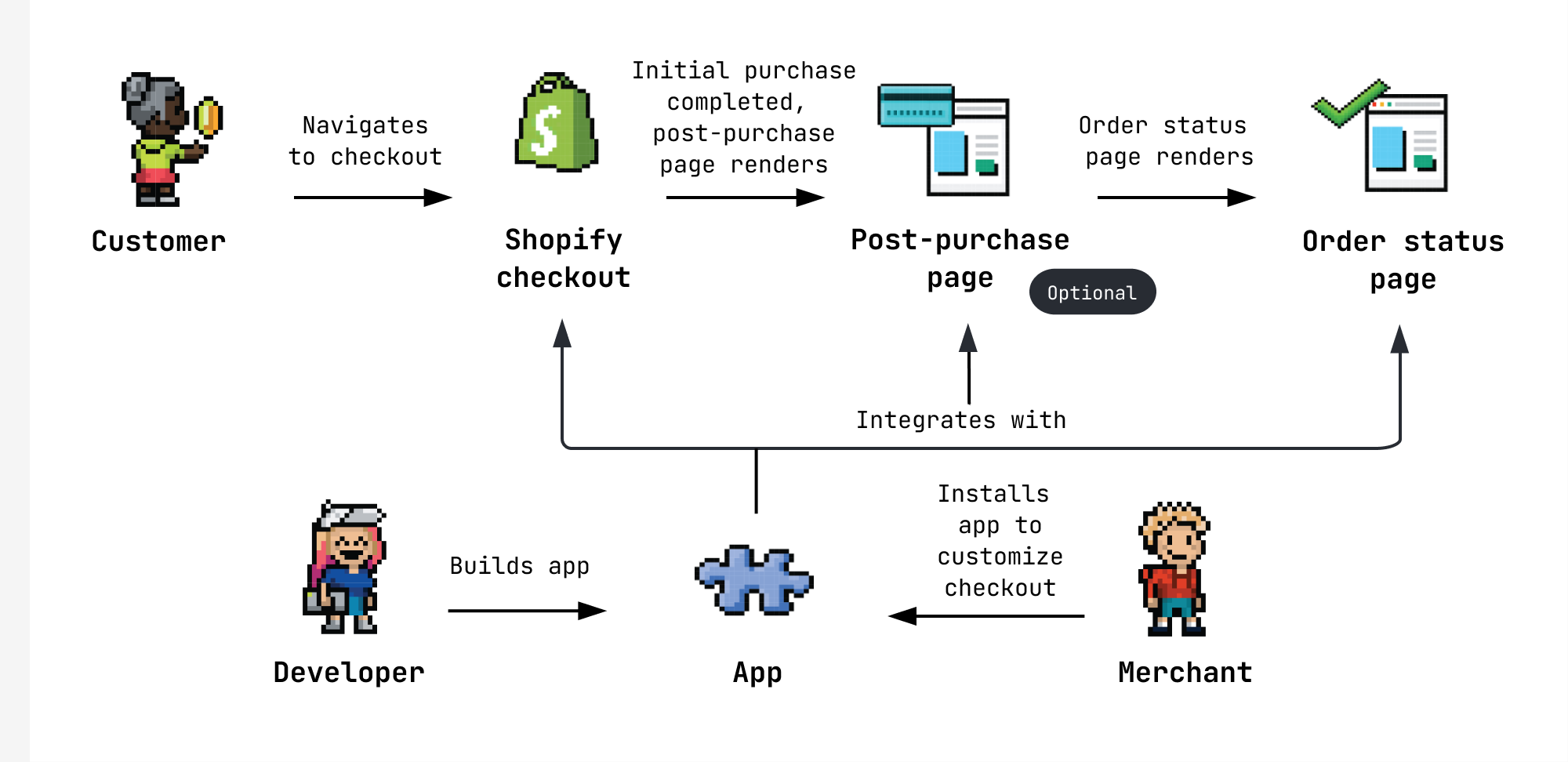
The two building blocks of the new system are:
- Checkout UI Extensions: modular blocks you add to the checkout without touching core Shopify code. Think trust badges, delivery timelines, gift message fields, charity donation prompts, loyalty point displays.
- Shopify Functions: server-side logic that runs natively on Shopify's infrastructure. Custom discount rules, tiered pricing, B2B order minimums, free gift mechanics. Faster and more reliable than the old Script Editor, which was also retired.
The key shift is that checkout.liquid gave you control by letting you edit everything directly. Checkout Extensibility gives you control through a structured, stable API. You lose the ability to change anything you want, but you gain reliability, performance, and access to Shopify's ongoing checkout improvements, including the one-page checkout that rolled out in 2023.
For Shopify Plus merchants, migration was mandatory by August 2024. If you're still running checkout.liquid, you're not just behind, you're on deprecated infrastructure. Check your theme editor now: if checkout.liquid appears in your theme files, you haven't completed the migration.
What UK Brands Can Now Build (and Why It Matters Commercially)
Migrating away from checkout.liquid is the floor, not the ceiling. The real question is what you build on top of the new system. Checkout Extensibility opens four commercial capabilities that simply weren't possible, or weren't stable, on the old infrastructure.
1. Custom UI blocks that build trust at the point of purchase
Checkout UI Extensions let you add modular content blocks directly into the checkout flow without touching core Shopify code. They're sandboxed, so adding or removing them doesn't risk breaking anything else.
What you can add
- Delivery promise messaging (e.g. "Order before 2pm for next-day delivery")
- Trust badges and security reassurance at the payment step
- Gift message fields for brands in gifting categories
- Charity donation prompts (round-up or fixed amount)
- Loyalty point balance displays for returning customers
Why it matters
These are the details that reduce hesitation at the exact moment a customer is deciding whether to complete a purchase.
2. Shopify Functions for native checkout logic
Shopify Functions replace the old Script Editor, which was retired alongside checkout.liquid. They run server-side on Shopify's infrastructure, which makes them faster and more reliable than the app-based workarounds many brands currently rely on.
What Functions handle natively: custom discount rules, tiered pricing, free gift mechanics, B2B order minimums, and customer-tag-based logic. If you're currently running a third-party app to manage any of those, there's a good chance Functions can replace it with less overhead and better performance.
3. Payment method control
This is the capability most relevant to UK brands right now. Checkout Extensibility lets you show or hide specific payment methods based on cart value, customer tag, geography, or product type.
For merchants offering Klarna or Clearpay, that control matters more than ever. With UK BNPL regulation taking effect from 15 July 2026, how those options are presented at checkout is no longer just a UX decision. It's a compliance one.
4. Post-purchase extensions
The Thank You page and Order Status page are now customisable through the same extension framework. That opens up:
- Post-purchase upsell offers (no second payment step required)
- Subscription or replenishment prompts for consumable products
- Loyalty programme enrolment immediately after conversion
- Zero-party data collection (preferences, occasion type, gift recipient details)
The commercial case in one line: a customer who has just completed a purchase is the most engaged they will ever be. Post-purchase extensions let you act on that without interrupting the checkout itself.
Why UK Brands Need a Different Playbook in 2026
Generic Checkout Extensibility guides cover the platform mechanics. They don't cover what's happening in the UK market right now. These are the five considerations that make the UK context materially different.
| UK consideration | Why it matters | How Checkout Extensibility helps |
|---|---|---|
| BNPL regulation (15 July 2026) | Klarna, Clearpay, and other BNPL providers must comply with FCA rules on how credit is presented and communicated | Payment method control lets you adjust BNPL display, messaging, and eligibility logic without a full redevelopment |
| FCA Consumer Duty | Merchants selling regulated or finance-adjacent products must demonstrate clear, fair communication. Checkout copy and payment presentation are in scope | Extensions give you precise control over messaging at each checkout step |
| European Accessibility Act (June 2025) | UK brands selling into the EU must meet EAA requirements, which align closely with WCAG 2.1 AA. Custom checkout.liquid code was often non-compliant | Checkout UI Extensions are built to WCAG 2.1 AA standards by default |
| Open banking payments | TrueLayer, Volt, and similar providers are gaining traction in UK checkout, particularly for high-AOV purchases where card fees are a real cost | Extensibility allows open banking options to be surfaced as a payment method within the supported framework |
| UK B2B and VAT display | Trade customers expect ex-VAT pricing. Displaying this correctly without a third-party app has historically been awkward | Shopify Functions handle customer-specific pricing and VAT display logic natively |
BNPL regulation: the immediate priority
The FCA's BNPL regulation comes into force on 15 July 2026. From that date, BNPL providers operating in the UK must be FCA-authorised, and the way credit options are presented to consumers becomes subject to regulatory scrutiny.
For merchants, this means checkout presentation matters in a way it didn't before. Showing Klarna or Clearpay prominently to a customer who may not be eligible, or presenting credit options without adequate context, is not just a UX problem. It's a potential compliance issue.
Checkout Extensibility gives you the tools to respond. You can control which payment options appear based on cart value, customer tag, or order context, and you can adjust messaging without waiting for a developer to push code changes.
Consumer Duty and checkout clarity
The FCA's Consumer Duty, which came into force in July 2023, sets expectations around fair value, clear communication, and customer outcomes. If your checkout presents payment options, promotional terms, or finance offers in a way that's confusing or misleading, that's a Duty consideration.
This isn't legal advice. But it is a practical reason to audit your checkout messaging and ensure you have the flexibility to update it quickly when guidance evolves.
Note: The accessibility and compliance points above are practical checkout considerations, not legal advice. If you sell regulated financial products or have specific BNPL obligations, take independent legal or compliance advice.
What Merchants Are Actually Building
The capabilities above aren't theoretical. Here are three representative builds from UK Shopify Plus brands, presented as examples of what's commercially achievable rather than verified case studies.
A UK gifting and fashion brand added a gift message field and personalisation prompt at the checkout step. The prompt appeared only for orders above a threshold value, keeping it contextually relevant. The result was a measurable increase in average order value during gifting periods, driven by customers adding personalisation options they hadn't considered before arriving at checkout.
A UK food and drink brand built a post-purchase subscription prompt on the Thank You page, triggered for first-time buyers of specific product lines. It offered a discounted recurring order with a single click, without requiring customers to re-enter payment details. Conversion rates from one-time buyer to subscriber ran between 8% and 12% across different product categories.
A UK B2B homeware brand used Shopify Functions to apply trade pricing and minimum order rules based on customer tags assigned at account approval. Previously, this required a third-party app with its own maintenance overhead and occasional conflicts with other apps in the stack. Functions replaced it with native logic that runs without the extra layer.
The pattern across all three: the most effective checkout builds are targeted, contextual, and use the new infrastructure to do something that wasn't reliably possible before, rather than simply recreating what existed under checkout.liquid.
How to Audit Your Current Checkout
Most merchants who migrated to Checkout Extensibility did the minimum: they moved off checkout.liquid and stopped there. That's not an audit. It's a checkbox. Here are four questions that reveal whether your checkout is actually in good shape.
1. Are you still running any checkout.liquid logic?
Go to your theme editor and look for checkout.liquid in your theme files. If it's there, you haven't completed the migration and you're on deprecated infrastructure. Some brands migrated their main checkout but left legacy code in place for edge cases. Check thoroughly, not just at the surface level.
If you migrated from a legacy platform like Magento, it's worth reading our Magento to Shopify migration guide alongside this audit, since platform migrations and checkout migrations sometimes get conflated during the transition.
2. Which customisations survived the migration, and which were quietly dropped?
This is the most common gap. When brands moved to Checkout Extensibility, some of their old checkout.liquid customisations simply didn't have a direct equivalent in the new system. Rather than rebuild them, they were left out. Review what your checkout was doing before the migration and compare it to what it does now. You may find trust elements, promotional messaging, or B2B logic that disappeared without anyone noticing.
If you need to rebuild customisations that didn't survive the move, our guide to customising the Shopify checkout page walks through the practical options under the new system.
3. Are your BNPL options displaying correctly and compliantly?
Check Klarna, Clearpay, or any other BNPL method across different devices, cart values, and customer types. Ask:
- Does the option appear for cart values where it's appropriate?
- Is the messaging clear about what the customer is agreeing to?
- Does it behave consistently on mobile and desktop?
With UK BNPL regulation live from 15 July 2026, this is no longer a question of UX preference. It's a question of whether your checkout presentation meets the new regulatory standard.
4. Have you tested your checkout for accessibility?
WCAG 2.1 AA is the benchmark for web accessibility in the UK and EU. Checkout UI Extensions are built to this standard by default. If you added custom code on top, or if you're still running any legacy checkout elements, those additions may not be compliant.
Run your checkout through an automated accessibility checker, then do a manual keyboard navigation test. If you're selling into the EU, the European Accessibility Act makes this a legal requirement, not a best practice.
If you can't answer all four questions with confidence, your checkout needs attention. The good news is that Shopify's checkout customisation framework makes addressing these issues more straightforward than it was under the old system, provided you know what to build. For the conversion side beyond migration, our guide to optimising your Shopify checkout for more sales covers the UX and payment changes that lift completion rates.
What to Do Next
Where you are right now determines what the next step looks like.
- You haven't migrated from checkout.liquid. This is urgent. You're on deprecated infrastructure, you're missing Shopify's ongoing checkout improvements, and with BNPL regulation now live, you're carrying compliance risk. Get an agency audit booked now.
- You've migrated but haven't built anything on top of it. You're on the right infrastructure but you're leaving revenue on the table. The commercial case for checkout extensions, from trust blocks to post-purchase upsells, is straightforward. The question is which ones are right for your store and your customers.
- You've migrated and built extensions, but haven't reviewed them recently. Checkout builds need periodic review. Payment presentation rules are changing, accessibility standards are being enforced, and Shopify's checkout framework continues to evolve. A quarterly audit is a reasonable cadence for most Plus merchants.
In any of these situations, the starting point is the same: understand exactly what your checkout is doing, what it's missing, and what it's costing you.
If you'd like a clear picture of where your checkout stands, we offer a free Shopify audit covering checkout performance, conversion opportunities, and technical compliance for UK brands. No obligation, delivered within 48 hours.
You can also explore how our Shopify development service and Shopify CRO work support brands at each stage of this process, from migration through to ongoing optimisation. If you're concerned about checkout abandonment more broadly, our guide to Shopify abandoned cart recovery covers the complementary strategies that work alongside a well-built checkout.



.svg)