
.svg)





%201.avif)
Retail is changing rapidly, and the distinction between online and offline commerce continues to blur. For brands operating physical stores alongside their eCommerce presence, managing inventory, processing transactions, and maintaining consistent customer experiences across channels has become essential rather than optional. Shopify POS Go represents a significant step forward in unified commerce, offering retailers a purpose-built mobile device that brings Shopify's retail functionality into a compact, portable format designed specifically for modern selling environments.
What Is Shopify POS Go and Why It Matters
Shopify POS Go is a handheld point-of-sale device built exclusively for Shopify merchants who need mobility, reliability, and seamless integration with their existing online store. Unlike generic card readers or tablet-based solutions, this dedicated hardware combines payment processing, inventory management, and customer relationship tools in a single device designed to withstand the demands of busy retail environments.
The device runs on Shopify's POS software, which means transactions processed in-store automatically sync with your online inventory, customer profiles, and sales data. This eliminates the fragmented systems that plague many retailers who attempt to bridge their physical and digital operations through multiple platforms.
Key specifications include:
- 5-inch touchscreen optimised for retail use
- Built-in barcode scanner for rapid product lookup
- Integrated payment terminal accepting contactless, chip, and swipe
- All-day battery life supporting full retail shifts
- WiFi and 4G connectivity for reliable operation
- Ruggedised design built for retail environments
For UK retailers, Shopify's eCommerce platform has become increasingly popular due to its flexibility and scalability, and the POS Go extends these advantages into physical retail spaces.
Hardware Features and Technical Capabilities
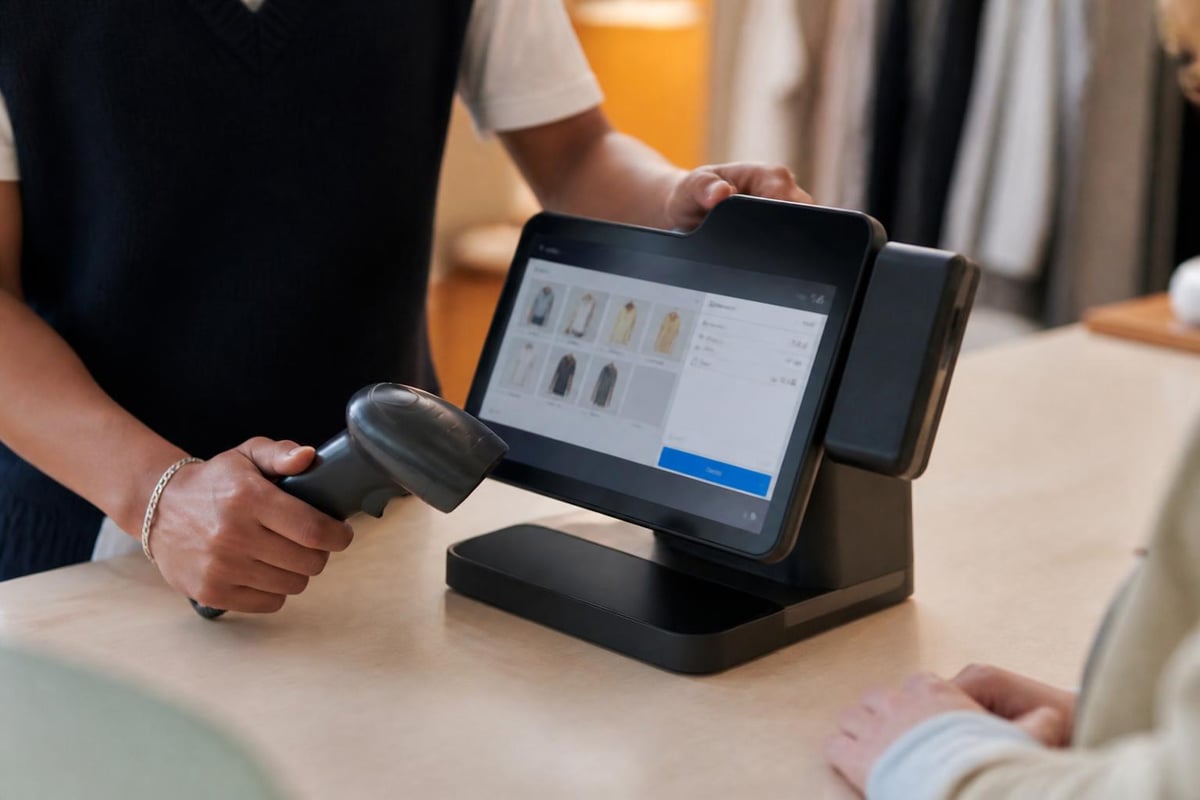
The physical design of shopify pos go prioritises practicality over aesthetics, though the device maintains Shopify's characteristically clean appearance. The 5-inch screen provides sufficient real estate for transaction processing whilst remaining compact enough for single-handed operation during busy periods.
Payment Processing and Transaction Speed
Payment acceptance covers the full spectrum of modern payment methods. Customers can pay via contactless cards, mobile wallets including Apple Pay and Google Pay, traditional chip and PIN, or magnetic stripe for older cards. Transaction processing typically completes within seconds, which proves crucial during peak trading periods when queue length directly impacts customer satisfaction and sales volume.
The device processes payments through Shopify Payments when available, ensuring competitive transaction fees and simplified reconciliation. For merchants using third-party payment processors, integration remains straightforward, though fees and settlement times may vary depending on the provider.
Barcode Scanning and Inventory Management
The integrated barcode scanner eliminates the need for separate scanning equipment, streamlining the checkout process considerably. Staff can scan products, apply discounts, process returns, and complete transactions without switching between devices or systems. This integration reduces training time for new employees and minimises transaction errors.
Inventory updates occur in real-time across all channels. When a product sells in-store through shopify pos go, the online store's available quantity adjusts immediately, preventing overselling and maintaining accurate stock levels across your entire operation.
Pricing Structure and Cost Considerations
Understanding the total cost of implementing shopify pos go requires examining both hardware expenses and ongoing subscription fees. The device itself retails at approximately £329, positioning it as a mid-range investment compared to traditional POS terminals or iPad-based systems with separate card readers.
| Cost Component | Details | Typical Price |
|---|---|---|
| Hardware | POS Go device | £329 one-time |
| Shopify Plan | Basic or higher required | From £25/month |
| POS Pro | Advanced retail features | £79/location/month |
| Transaction Fees | Via Shopify Payments | 1.5% - 2.0% per transaction |
| Additional Staff | Extra device access | Included in POS Pro |
Beyond the hardware cost, merchants need either a Shopify Basic plan (starting at £25 monthly) or higher tier. For retailers requiring advanced features like unlimited staff accounts, detailed reporting, and smart inventory management, the POS Pro add-on at £79 per location per month becomes necessary.
Transaction fees depend on your Shopify plan tier and whether you use Shopify Payments. UK merchants typically pay between 1.5% and 2.0% per transaction when using Shopify Payments, with rates decreasing as plan tier increases.
Setting Up Your Shopify POS Go System
Implementation begins with ensuring your existing Shopify store meets the requirements. Merchants need an active Shopify subscription at Basic level or above, along with a business bank account for payment processing. The setup process, whilst straightforward, benefits from methodical execution to avoid common pitfalls.
Initial Configuration Steps
- Unbox and charge the device ensuring full battery before first use
- Connect to your WiFi network and activate cellular data if required
- Log into your Shopify admin using your existing credentials
- Configure your locations defining where the device will operate
- Set up staff permissions determining who can process transactions
- Test payment processing with small transactions before going live
- Import or verify product data ensuring barcodes match inventory
The device arrives pre-loaded with Shopify's POS software, eliminating complex installation procedures. Most retailers complete basic setup within 30-60 minutes, though comprehensive configuration including staff training and inventory verification may extend across several days.

Staff Training and Operational Readiness
Training requirements remain modest due to the intuitive interface. Most retail staff familiar with smartphones adapt quickly to the POS Go system. Key training areas include:
- Processing standard transactions and refunds
- Applying discounts and managing promotions
- Handling cash payments and end-of-day reconciliation
- Creating customer profiles and viewing purchase history
- Managing stock transfers between locations
Shopify provides comprehensive documentation and video tutorials, supplemented by active community forums where merchants share practical tips and solutions. Real-world feedback, such as this year-long POS Go review, offers valuable insights into daily operation and common challenges.
Advanced Features for Growing Retailers
Shopify pos go extends beyond basic transaction processing into territory traditionally reserved for enterprise-level retail systems. These advanced capabilities prove particularly valuable for brands operating multiple locations or managing complex inventory scenarios.
Unified Customer Profiles and Marketing Integration
Every transaction creates or updates customer profiles that sync across all channels. When a customer makes their first in-store purchase, their profile automatically appears in your Shopify admin, enabling targeted email marketing, personalised recommendations, and loyalty programme management.
This unified data approach eliminates the siloed customer information that plagues many retailers using separate systems for online and offline operations. Marketing campaigns can target customers based on their complete purchase history, regardless of channel, whilst customer service teams access full order histories during support interactions.
Smart Inventory and Stock Management
The system's inventory management capabilities extend well beyond simple stock counting. Features include:
- Automated stock alerts notifying staff when products approach reorder points
- Stock transfers between locations processed directly through the device
- Variant management handling products with multiple sizes, colours, or configurations
- Supplier tracking maintaining purchase order history and vendor relationships
- Inventory forecasting based on historical sales patterns and seasonal trends
For retailers managing substantial product catalogues, these features significantly reduce administrative overhead whilst improving stock accuracy. The case study of Polkadog's implementation demonstrates how even during peak periods, the system maintains reliable inventory control across multiple store locations.
Integration with Existing Shopify Stores
The primary advantage of shopify pos go lies in its seamless integration with existing Shopify eCommerce operations. Merchants already running online stores find implementation particularly straightforward, as the device accesses existing product catalogues, customer databases, and reporting systems without requiring data migration or complex synchronisation.
Product Catalogue Synchronisation
Your existing online product catalogue automatically becomes available through POS Go. Product titles, descriptions, variants, pricing, and images all sync bidirectionally. Changes made in your Shopify admin reflect immediately on the POS device, ensuring consistency across channels.
This synchronisation eliminates the duplicate data entry that frustrates retailers using separate systems for online and offline sales. When you add a new product to your online store, it immediately becomes available for in-store selling without additional configuration.
Reporting and Analytics Integration
Sales data from POS Go feeds into Shopify's standard reporting suite, providing unified analytics across all channels. Reports segment data by location, staff member, product, time period, and numerous other dimensions, enabling detailed performance analysis.
Standard reports include:
- Sales by location and channel
- Product performance and inventory turnover
- Staff productivity and transaction metrics
- Customer acquisition and lifetime value
- Payment method distribution
- Return and refund analysis
For brands working with specialists like those offering Shopify CRO services, this integrated data proves invaluable for identifying conversion opportunities and optimising both online and offline customer journeys.

Comparing POS Go to Alternative Solutions
Understanding where shopify pos go fits within the broader POS landscape helps retailers make informed decisions about their point-of-sale infrastructure. The device occupies a specific niche: mobile-first retail for brands already committed to or considering Shopify as their eCommerce platform.
| Feature | Shopify POS Go | iPad POS Systems | Traditional Terminals |
|---|---|---|---|
| Hardware Cost | £329 | £400-800+ | £200-500 |
| Portability | Excellent | Good | Poor |
| Battery Life | Full day | 6-8 hours | Mains powered |
| Durability | Retail-hardened | Fragile | Very durable |
| Integration | Native Shopify | Via apps | Limited |
| Setup Complexity | Simple | Moderate | Complex |
Traditional countertop terminals offer durability and familiarity but lack the mobility increasingly demanded by modern retail environments. iPad-based solutions provide flexibility but require separate card readers, protective cases, and careful battery management.
The POS Go strikes a balance between portability, functionality, and cost that appeals particularly to retailers prioritising mobility and Shopify integration over other considerations. When setting up a Shopify store, planning for unified commerce from the outset simplifies future retail expansion.
Practical Limitations and Considerations
Despite its strengths, shopify pos go presents certain limitations that retailers should evaluate against their specific requirements. Understanding these constraints before purchase prevents disappointment and ensures the device matches operational needs.
Screen Size and Complex Transactions
The 5-inch screen, whilst adequate for standard transactions, can feel restrictive when processing complex orders involving numerous products, custom pricing, or detailed customer interactions. Retailers accustomed to larger tablet interfaces may find the compact display requires adjustment.
For businesses processing primarily simple transactions with few items per sale, the screen size proves perfectly adequate. However, retailers frequently handling large orders or requiring extensive note-taking during transactions might prefer supplementing the POS Go with a larger device for specific use cases.
Connectivity Dependencies
The system requires reliable internet connectivity for optimal operation. Whilst basic transaction processing continues during brief connection interruptions, extended offline periods limit functionality. Sales still process but sync only when connectivity restores, which can create inventory discrepancies if not managed carefully.
Connectivity considerations:
- WiFi provides primary connection in most retail environments
- 4G backup ensures continuity during WiFi outages
- Offline mode allows basic sales but limits advanced features
- Remote locations may experience synchronisation delays
- Multiple devices require sufficient bandwidth
Urban retailers typically encounter few connectivity challenges, whilst those in rural locations or areas with unreliable internet should test connection stability before committing to the system.
Who Benefits Most from POS Go
Shopify pos go serves specific retail scenarios particularly well whilst proving less suitable for others. Identifying whether your operation aligns with the device's strengths ensures investment delivers expected returns.
Ideal Use Cases
Pop-up shops, market stalls, and temporary retail installations benefit enormously from the device's portability and quick setup. Retailers can literally carry their entire POS system in a pocket, setting up wherever customers gather without requiring permanent infrastructure.
Stores practising clienteling, where staff assist customers throughout the shopping journey rather than manning fixed checkouts, find the mobility transformative. Associates can check inventory, demonstrate products, and complete transactions anywhere in the store, creating seamless customer experiences.
Multi-location retailers already using Shopify for eCommerce gain immediate value from the unified inventory and customer data. The ability to view stock across all locations, process transfers, and maintain consistent customer profiles justifies the investment through operational efficiency alone.
Less Suitable Scenarios
High-volume retailers processing hundreds of transactions hourly may find single-device throughput insufficient. In these environments, multiple POS Go units or supplementary fixed terminals become necessary, increasing costs and potentially complicating operations.
Businesses requiring extensive cash handling might prefer traditional tills with secure cash drawers over the POS Go's more basic cash management. Whilst the device handles cash transactions, it lacks the physical security features of purpose-built cash registers.
Retailers heavily dependent on industry-specific features not available in Shopify's ecosystem should carefully evaluate whether the platform meets their needs before investing in dedicated hardware. Working with specialists offering Shopify web design services can help assess platform suitability for specific retail requirements.
Maximising ROI from Your POS Investment
Purchasing shopify pos go represents just the beginning; extracting maximum value requires strategic implementation and ongoing optimisation. Retailers who treat the device as part of a broader unified commerce strategy typically achieve significantly better results than those viewing it merely as a payment terminal.
Leveraging Customer Data Across Channels
The unified customer profiles created through POS transactions enable sophisticated marketing approaches previously available only to enterprise retailers. Encourage staff to capture customer emails during in-store purchases, building your marketing database whilst creating opportunities for post-purchase engagement.
Segment customers based on their channel preferences and purchase patterns. Those who buy exclusively in-store might respond well to local events or VIP shopping hours, whilst omnichannel customers might appreciate early access to new products across all channels.
Staff Enablement and Mobile Selling
Transform your retail floor by empowering staff with mobile POS capabilities. Rather than directing customers to fixed checkouts, enable associates to complete transactions anywhere, reducing friction and improving conversion rates. This approach proves particularly effective in:
- Experiential retail environments
- Stores with seasonal queue management challenges
- Boutiques prioritising personalised service
- Retail spaces with distinct product zones
Training staff to view the POS Go as a customer service tool rather than merely a payment device unlocks its full potential. When associates can check stock, review customer history, and process transactions without leaving the customer's side, service quality improves measurably.
Inventory Optimisation and Loss Prevention
Real-time inventory synchronisation enables more aggressive stock management without increasing stockout risk. Monitor sales velocity across locations to identify opportunities for stock transfers, ensuring high-demand products remain available whilst reducing excess inventory in slower locations.
The detailed transaction logging inherent in shopify pos go systems provides strong deterrents against internal theft whilst enabling rapid identification of discrepancies. Every transaction links to specific staff members, creating accountability that manual systems cannot match.
Future-Proofing Your Retail Operations
The retail landscape continues evolving rapidly, with customer expectations, technology capabilities, and competitive pressures driving constant change. Investing in infrastructure that adapts alongside these shifts proves essential for long-term success.
Platform Scalability and Feature Development
Shopify consistently develops new features and capabilities for its POS ecosystem. Recent additions include enhanced loyalty programme support, improved analytics, and expanded payment options. Merchants using shopify pos go benefit from these improvements automatically through software updates, without requiring hardware replacement.
This ongoing development contrasts sharply with traditional POS systems that may require costly upgrades or complete replacement to access new features. The cloud-based architecture ensures your investment remains current as retail technology advances.
Expansion and Multi-Location Growth
The system scales efficiently as retail operations expand. Adding additional locations requires minimal incremental investment, as each new store simply needs its own POS Go device and location configuration. Inventory, customers, and reporting remain unified regardless of store count.
For brands planning geographical expansion or additional retail concepts, this scalability proves particularly valuable. The operational knowledge and staff training transfer directly to new locations, reducing the overhead typically associated with retail network growth. For those considering platform changes, Shopify migration services can help transition existing multi-location operations onto the unified Shopify ecosystem.
Security, Compliance, and Payment Protection
Financial security and regulatory compliance form critical considerations for any payment processing system. Shopify pos go incorporates enterprise-grade security measures whilst maintaining the simplicity that characterises consumer devices.
PCI Compliance and Data Protection
The device achieves PCI DSS Level 1 certification, the highest security standard in the payment card industry. Customer payment data remains encrypted throughout the transaction process, with sensitive information never stored on the device itself. This architecture significantly reduces merchants' compliance burden compared to systems that store payment data locally.
Security features include:
- End-to-end encryption for all payment data
- Tokenisation protecting stored card information
- Regular security updates automatically deployed
- Two-factor authentication for admin access
- Granular staff permission controls
- Detailed audit logs for all transactions
For UK retailers, GDPR compliance remains paramount. The unified customer database facilitates proper consent management and enables customers to exercise their data rights across all channels simultaneously.
Fraud Prevention and Chargeback Management
Shopify's fraud analysis tools extend to POS transactions, flagging potentially fraudulent activity based on pattern recognition and risk scoring. Whilst most in-person transactions carry lower fraud risk than online orders, the protection proves valuable for high-value purchases or suspicious patterns.
Integrated receipt delivery via email or SMS creates clear transaction records that help resolve disputes and reduce chargebacks. When customers receive digital receipts immediately, return and exchange processes simplify considerably whilst providing documentation that protects against fraudulent chargeback claims.
Shopify POS Go represents a significant advancement in retail technology, bringing enterprise-level unified commerce capabilities to retailers of all sizes through an affordable, portable device. The seamless integration with Shopify's eCommerce platform creates operational efficiencies that extend far beyond simple transaction processing, enabling truly unified retail operations. Whether you're launching a new retail concept, expanding an existing eCommerce brand into physical retail, or seeking to modernise outdated POS infrastructure, Futur Media helps ambitious UK brands build high-performing Shopify stores that deliver measurable results across all channels. Get in touch to discuss how we can optimise your eCommerce and retail operations.



.svg)