
.svg)






%201.avif)
The retail landscape has transformed dramatically over recent years, with customers expecting seamless experiences whether they shop online, in-store, or through a combination of both. For ambitious UK brands operating across multiple channels, choosing the right point-of-sale technology isn't just about processing transactions anymore. It's about creating a unified commerce ecosystem that connects every touchpoint, synchronises inventory in real-time, and provides a complete view of customer behaviour. The Shopify POS system has emerged as a compelling solution for retailers who want to bridge the gap between their physical and digital presence, offering native integration with one of the world's leading ecommerce platforms.
Understanding the Shopify POS System Architecture
The Shopify POS system operates as an integrated extension of your Shopify store, rather than a standalone point-of-sale solution. This fundamental architectural difference sets it apart from traditional POS systems that treat ecommerce as an afterthought.
At its core, the system consists of a mobile application available on iOS and Android devices, paired with compatible hardware including card readers, barcode scanners, receipt printers, and cash drawers. The application connects directly to your Shopify admin, ensuring that every sale, return, or inventory adjustment flows through a single source of truth.
Native Integration Benefits
Unified inventory management represents perhaps the most significant advantage of this architecture. When a customer purchases a product in-store, your online stock levels update instantly. This eliminates the overselling problems that plague retailers using disconnected systems.
- Real-time stock synchronisation across all sales channels
- Automatic inventory reservations during checkout
- Low stock alerts that consider both online and offline sales
- Centralised product catalogues with variant management
The system also maintains a single customer database that tracks purchasing behaviour regardless of channel. A customer who browses online and completes their purchase in-store appears as one unified profile, not two separate entries in different systems.

Hardware Compatibility and Requirements
Shopify POS works with a broad range of hardware configurations, from basic smartphone setups to comprehensive retail stations. The flexibility allows businesses to scale their investment based on transaction volume and operational needs.
| Hardware Component | Basic Setup | Professional Setup | Enterprise Setup |
|---|---|---|---|
| Card Reader | Shopify Tap & Chip | Shopify Retail Stand | Multiple terminals |
| Receipt Printer | Email/SMS receipts | Star TSP143IIIU | Network printers |
| Barcode Scanner | Camera-based | Socket Mobile S700 | Zebra DS4608 |
| Cash Management | Not required | Star mPOP | Heavy-duty drawer |
The modular approach means you can start with minimal investment and expand as your retail operations grow. For brands setting up their first Shopify store, beginning with a mobile-first POS configuration often makes strategic sense.
Feature Set and Operational Capabilities
The Shopify POS system delivers functionality that extends well beyond basic transaction processing. Understanding these capabilities helps retailers evaluate whether the platform aligns with their operational requirements.
Transaction Processing and Payment Handling
Shopify Payments integration provides the smoothest experience, enabling tap, chip, swipe, and contactless payments through a single processor. Merchants benefit from consolidated reporting and faster settlement times when using the native payment gateway.
Accepted payment methods include:
- Credit and debit cards (Visa, Mastercard, American Express)
- Contactless payments (Apple Pay, Google Pay)
- Cash transactions with change calculations
- Split payments across multiple tender types
- Custom payment methods for invoicing or trade accounts
The system handles complex scenarios like partial payments, layaways, and custom sale types. Tax calculations adjust automatically based on product type, customer location, and local regulations, which proves particularly valuable for UK retailers navigating VAT requirements.
Customer Management and Loyalty
The customer profiles within Shopify POS capture purchase history, contact information, and marketing preferences. This data becomes actionable intelligence for targeted campaigns and personalised service.
Staff can quickly retrieve customer information during checkout, view previous purchases, and make product recommendations based on buying patterns. The integration with Shopify's email marketing tools means in-store purchases can trigger automated follow-up sequences, review requests, or loyalty rewards.
For retailers focused on maximising customer lifetime value, this seamless data flow between channels supports sophisticated retention strategies. When combined with conversion rate optimisation efforts across your digital touchpoints, the unified customer view drives measurable improvements in repeat purchase rates.
Pricing Structure and Plan Comparison
Understanding the cost implications of the Shopify POS system requires examining both the software subscription and hardware investment. Shopify offers tiered pricing that scales with business complexity and transaction volume.
Software Subscription Tiers
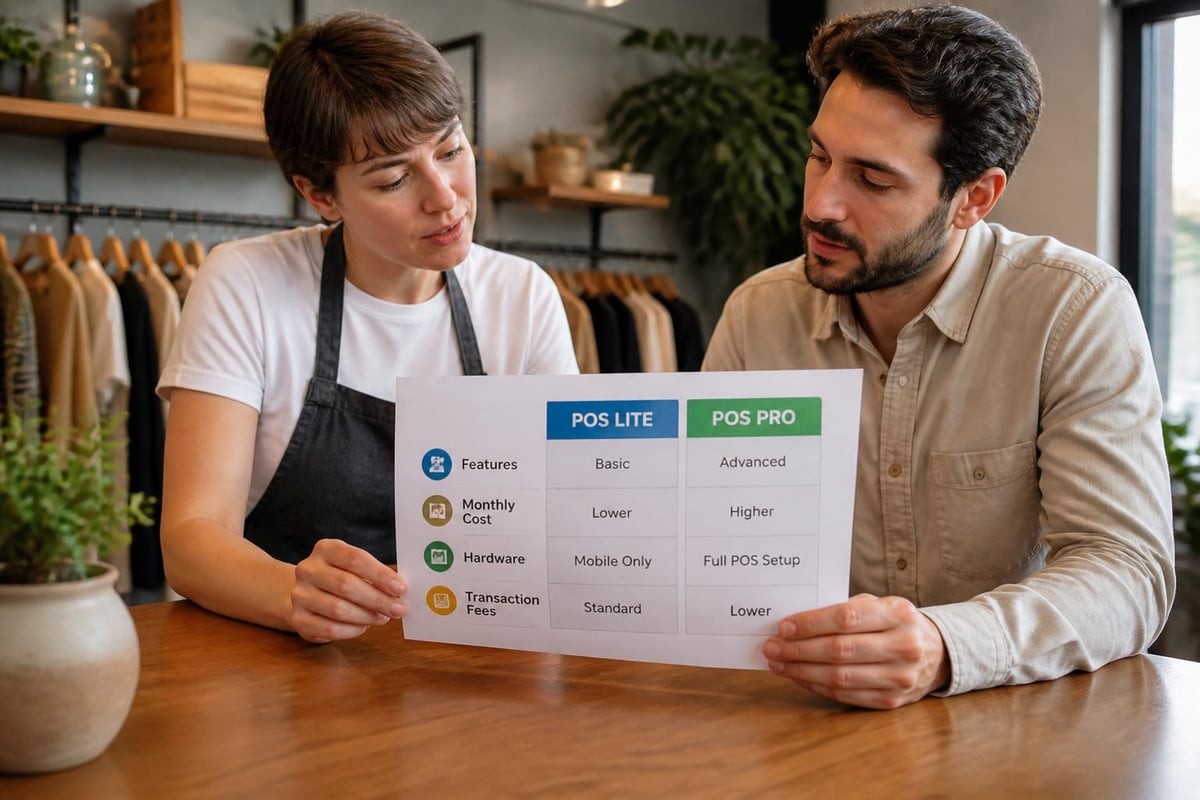
The POS Lite version comes included with all Shopify plans at no additional cost. This provides basic point-of-sale functionality suitable for occasional in-person selling at markets, pop-ups, or events.
POS Lite includes:
- Unlimited products and variants
- Basic inventory tracking
- Email and SMS receipts
- Core reporting and analytics
- Cash, card, and custom payment acceptance
POS Pro requires an additional monthly subscription per location and unlocks advanced retail features. According to NerdWallet's comprehensive review, the Pro tier becomes cost-effective for businesses processing significant in-store volume.
| Feature Category | POS Lite | POS Pro |
|---|---|---|
| Smart inventory management | Limited | Advanced |
| Unlimited registers | No | Yes |
| Staff permissions | Basic | Granular |
| Advanced reports | No | Yes |
| Omnichannel features | Limited | Full suite |
| Monthly cost | Included | £79 per location |
Hardware Investment Considerations
The initial hardware outlay varies considerably based on your retail format and operational requirements. A single-location boutique might invest £500-£1,000 for a complete setup, whilst multi-location retailers require proportionally larger investments.
Shopify's hardware bundles provide tested configurations, but the system's compatibility with third-party equipment offers flexibility for retailers with existing infrastructure. This openness contrasts with proprietary systems that lock merchants into specific hardware ecosystems.
Implementation and Staff Training
Rolling out a Shopify POS system successfully requires thoughtful planning around data migration, staff onboarding, and operational workflow design. The technical setup proves relatively straightforward, but the human elements often determine long-term adoption success.
Initial Configuration Steps
Setting up your first location involves:
- Defining your store location and operating hours in Shopify admin
- Configuring local tax rates and shipping zones
- Installing the POS application on staff devices
- Pairing hardware components via Bluetooth or network connections
- Testing transaction flows with sandbox payments
Product catalogues synchronise automatically from your existing Shopify store, eliminating manual data entry. However, retailers should review and optimise product organisation for in-store browsing, as effective online categorisation doesn't always translate to efficient POS navigation.
The system supports custom receipt templates that reinforce brand identity whilst including required VAT information and return policies. These details matter significantly for UK retailers who must comply with consumer protection regulations.
Staff Training and Adoption
The interface prioritises simplicity, but comprehensive training ensures staff can handle edge cases confidently. Most teams achieve basic proficiency within a few hours of hands-on practice.
Training should cover:
- Standard transaction processing and payment acceptance
- Product searches using barcodes, SKUs, or keywords
- Customer profile creation and retrieval
- Return and exchange processing
- Cash drawer management and end-of-day reconciliation
- Handling split payments and custom discounts
Role-based permissions allow you to restrict sensitive functions like refunds, discounts, or reporting access to senior staff. This granular control protects against both accidental errors and intentional policy violations.
Inventory Management and Stock Control
Sophisticated inventory features distinguish the Shopify POS system from basic transaction terminals. These capabilities prove particularly valuable for retailers managing complex product catalogues across multiple locations.
Multi-Location Stock Tracking
Each retail location maintains its own inventory levels within the unified Shopify system. Staff can view stock availability at other locations during checkout, enabling them to arrange transfers or direct customers to alternative stores.
The system handles several inventory scenarios that occur in real-world retail:
- Stock transfers between locations with automatic inventory adjustments
- Purchase orders that update stock levels upon receipt
- Inventory counts for periodic reconciliation against physical stock
- Low stock alerts that trigger reorder workflows
- Product variants with location-specific availability
For brands operating both online and offline channels, intelligent inventory allocation prevents disappointing customer experiences. The system can reserve stock for online fulfilment whilst making remaining quantities available for in-store purchase.
Serialised Inventory and Tracking
Products with unique identifiers like serial numbers or lot codes require special handling within retail systems. The Shopify POS system supports serialised inventory tracking, enabling compliance with warranty requirements and regulatory mandates.
This functionality proves essential for retailers selling electronics, luxury goods, or products subject to recall procedures. Each item's journey through your supply chain becomes traceable, from receiving through final sale.
Omnichannel Retail Capabilities
The convergence of online and offline shopping behaviours demands systems that support fluid customer journeys. The Shopify POS system delivers several omnichannel features that meet modern retail expectations.
Buy Online, Pick Up In Store
BOPIS functionality allows customers to purchase through your ecommerce site and collect from a physical location. This service reduces shipping costs, accelerates delivery timelines, and drives foot traffic to retail stores where additional purchases often occur.
The POS application displays online orders awaiting collection, with notifications when customers arrive. Staff can quickly locate orders, verify customer identity, and complete the handoff efficiently.
Endless Aisle and Ship from Store
When products are out of stock at one location but available elsewhere, staff can process the sale through POS and arrange delivery to the customer. This "endless aisle" capability prevents lost sales whilst moving inventory efficiently across your network.
Ship-from-store functionality transforms retail locations into distributed fulfilment centres. Online orders can be allocated to stores with available stock, reducing shipping distances and delivery times whilst optimising inventory distribution.

Reporting and Business Intelligence
Data-driven decision-making requires accessible, actionable insights from your retail operations. The reporting capabilities within the Shopify POS system provide visibility into sales performance, staff productivity, and customer behaviour patterns.
Standard Reporting Suite
POS Pro unlocks advanced reports including:
- Sales by staff member to identify top performers and training needs
- Product performance analytics showing bestsellers and slow-moving inventory
- Customer insights revealing purchase frequency and average order values
- Location comparisons for multi-store operations
- Profit margin analysis accounting for cost of goods sold
These reports integrate seamlessly with your online analytics, providing a complete picture of business performance across all channels. The unified view eliminates the fragmented reporting that plagues retailers using disconnected systems.
Integration with Third-Party Analytics
For businesses requiring more sophisticated analysis, the Shopify POS system exports data to tools like Google Analytics, Tableau, or custom business intelligence platforms. API access enables technical teams to build bespoke reporting solutions tailored to specific operational requirements.
When working with a Shopify development specialist, custom reporting dashboards can surface the precise metrics that drive your business decisions, moving beyond generic reports to insights that reflect your unique retail model.
Hardware Ecosystem and Partner Devices
The Shopify POS system works with an expanding ecosystem of hardware partners, providing flexibility in equipment selection whilst maintaining reliable operation. Understanding compatibility helps retailers make informed investment decisions.
Official Shopify Hardware
Shopify's branded hardware receives priority support and guaranteed compatibility with system updates. The Tap & Chip Reader represents the entry-level card acceptance solution, whilst the Retail Stand provides a comprehensive countertop system suitable for high-volume locations.
The POS Go device, launched in 2023, combines payment processing with a dedicated POS terminal in a single unit. This all-in-one approach simplifies deployment whilst delivering professional functionality.
Certified Partner Equipment
Major hardware manufacturers including Star Micronics, Epson, and Zebra offer certified products designed specifically for Shopify POS. These devices undergo rigorous testing to ensure seamless integration and reliable performance.
Receipt printers from the Star TSP series represent the most popular choice amongst Shopify merchants, offering fast printing speeds, excellent reliability, and competitive pricing. Barcode scanners from Socket Mobile provide wireless operation that improves staff mobility during busy periods.
Security and Compliance Considerations
Handling customer payment information and personal data carries significant responsibility. The Shopify POS system implements multiple security layers to protect sensitive information whilst helping merchants maintain regulatory compliance.
PCI Compliance and Data Security
Shopify maintains PCI DSS Level 1 certification, the highest security standard in the payment card industry. This certification covers both the ecommerce platform and POS system, simplifying compliance for merchants.
Security features include:
- End-to-end encryption for all payment data
- Tokenisation preventing storage of card numbers
- Secure staff authentication with optional two-factor authentication
- Automatic security updates applied across all devices
- Audit trails tracking all system access and modifications
UK retailers must also navigate GDPR requirements around customer data. The system provides tools for managing consent, honouring deletion requests, and maintaining compliant data handling practices.
Fraud Prevention and Chargebacks
The integrated nature of Shopify Payments provides enhanced fraud detection compared to third-party processors. Machine learning algorithms analyse transaction patterns, flagging suspicious activity for review before processing.
For in-person transactions, the liability shift associated with chip card acceptance protects merchants from most chargeback scenarios. The system automatically prompts for chip insertion when cards support this technology, ensuring compliance with card network requirements.
Comparing Shopify POS to Alternative Solutions
Evaluating the Shopify POS system against competing platforms requires understanding your specific retail context. Different solutions optimise for different business models and operational priorities.
TechRadar's analysis of leading POS systems positions Shopify favourably for retailers with significant online presence, whilst noting that pure-play retail operations might find specialised systems offer deeper functionality in certain areas.
Shopify POS Versus Traditional Retail Systems
Legacy POS providers like Lightspeed, Vend, or Square offer mature retail functionality developed over many years. These systems often provide more granular inventory controls, sophisticated customer loyalty programmes, and advanced employee management features.
However, their ecommerce integration typically relies on third-party connectors that introduce synchronisation delays and potential data conflicts. For businesses where online sales represent a significant channel, this architectural limitation creates operational friction.
Unified Commerce Advantages
The fundamental advantage of the Shopify POS system lies in its unified commerce architecture. Rather than connecting disparate systems, everything operates within a single platform built specifically for omnichannel retail.
This architecture delivers tangible benefits including real-time inventory accuracy, unified customer profiles, consolidated reporting, and simplified technical management. The trade-off involves accepting that certain specialised retail features may not reach the depth found in pure-play POS systems.
For UK ecommerce brands evaluating platform options, understanding these architectural differences proves crucial. When considering migration to Shopify, the POS capabilities often strengthen the business case for consolidating technology infrastructure.
Mobile Selling and Pop-Up Retail
The mobile-first design of the Shopify POS system supports flexible selling scenarios beyond traditional retail stores. This versatility appeals to brands embracing experiential retail and temporary retail formats.
Trade Shows and Events
Selling at trade shows, craft fairs, or pop-up markets requires portable technology that operates reliably in temporary environments. The Shopify POS system excels in these scenarios, requiring only a smartphone or tablet and a card reader.
The offline mode ensures transactions process even when internet connectivity proves unreliable, a common challenge at event venues. Sales synchronise automatically once connection restores, maintaining accurate inventory levels across all channels.
Showroom and Appointment-Based Selling
Luxury brands and considered-purchase retailers often operate showrooms where sales associates guide customers through product selection. The mobile POS enables staff to process transactions anywhere in the space, avoiding the formality of traditional checkout counters.
This approach creates more intimate shopping experiences whilst maintaining full system functionality. Customer information, inventory availability, and payment processing all work seamlessly on mobile devices.
Scalability and Growth Considerations
Retail businesses evolve through predictable growth stages, each bringing new operational requirements. The Shopify POS system scales to accommodate expanding operations whilst maintaining the simplicity that characterises initial deployment.
Adding Locations and Registers
Growing from single to multiple locations involves minimal technical complexity with the Shopify POS system. Each new location receives its own inventory allocation, staff assignments, and local configurations whilst remaining connected to the central platform.
Unlimited registers within POS Pro means high-traffic locations can deploy multiple checkout stations without per-terminal licensing fees. This pricing structure removes common scaling obstacles found in traditional POS systems.
International Expansion
UK brands expanding into European or global markets benefit from Shopify's multi-currency and multi-language capabilities. The POS system inherits these international features, supporting location-specific pricing, local payment methods, and regional tax requirements.
Currency conversion happens automatically at current exchange rates, whilst reporting consolidates performance across geographies into unified dashboards. This global architecture proves particularly valuable for brands with international ambitions.
Support Resources and Merchant Community
Successfully operating any retail technology requires access to reliable support when issues arise. The Shopify POS system benefits from Shopify's extensive support infrastructure and active merchant community.
Official Support Channels
Shopify provides multiple support options:
- 24/7 phone and chat support for technical issues
- Comprehensive documentation covering setup and troubleshooting
- Video tutorials demonstrating common workflows
- Community forums where merchants share solutions
- YouTube resources featuring real merchant experiences
Response times and support quality scale with your Shopify plan, with Plus merchants receiving priority access to senior support specialists. This tiered approach ensures that high-volume retailers receive the rapid resolution their operations demand.
Partner Ecosystem
The Shopify Partner ecosystem includes agencies, developers, and consultants who specialise in POS implementation and optimisation. These experts provide hands-on assistance with complex deployments, custom integrations, and strategic retail planning.
Working with specialists who understand both the technical platform and retail operations accelerates implementation whilst avoiding common pitfalls. The investment in expert guidance typically delivers returns through faster deployment and fewer operational disruptions.
Integration Capabilities and App Ecosystem
Whilst the core Shopify POS system delivers comprehensive functionality, many retailers require specialised capabilities for their unique operations. The Shopify App Store provides thousands of extensions that enhance and customise POS behaviour.
Popular POS Extensions
Common integration categories include:
- Advanced loyalty and rewards programmes beyond basic functionality
- Sophisticated inventory management for complex product variants
- Employee time tracking and scheduling systems
- Accounting software connections for automated bookkeeping
- Customer relationship management platforms for sales pipelines
These integrations connect through standardised APIs, ensuring reliable data exchange and consistent user experiences. However, each additional app introduces complexity and potential points of failure, making judicious selection important.
Custom Development Opportunities
For businesses with unique requirements not addressed by existing apps, custom development becomes an option. The Shopify API provides extensive access to POS data and functionality, enabling bespoke solutions tailored to specific operational needs.
Technical research into intelligent POS systems demonstrates the evolving capabilities possible through advanced integration and automation. Whilst cutting-edge implementations require significant technical investment, they can deliver competitive advantages in efficiency and customer experience.
Real-World Performance and Merchant Feedback
Understanding how the Shopify POS system performs in actual retail environments provides valuable context beyond marketing materials and feature lists. Merchant experiences reveal both strengths and limitations across diverse retail scenarios.
Detailed merchant reviews highlight the system's intuitive interface and rapid deployment as key advantages, particularly for businesses new to integrated retail technology. The learning curve proves gentle compared to legacy POS systems, enabling staff to achieve productivity quickly.
Common Praise Points
Merchants consistently appreciate the unified inventory management, which eliminates the stock discrepancies that plague retailers using disconnected systems. The real-time synchronisation between online and offline channels creates operational efficiency whilst improving customer satisfaction through accurate availability information.
The mobile flexibility receives frequent positive mention, with retailers valuing the ability to process transactions anywhere in their store. This mobility supports modern retail formats that prioritise experience over traditional checkout queues.
Recognised Limitations
Certain advanced retail features found in specialised POS systems remain underdeveloped in Shopify POS. Complex loyalty programmes, sophisticated employee commission tracking, and granular customer segmentation often require third-party apps to reach enterprise-grade functionality.
High-volume retailers occasionally report performance concerns during peak periods, particularly when running on older mobile devices. Hardware investment in current-generation equipment typically resolves these issues, but represents an additional cost consideration.
The Shopify POS system represents a compelling unified commerce solution for UK retailers seeking to eliminate the friction between online and offline operations. By understanding its capabilities, limitations, and strategic fit within your retail model, you can make an informed decision about whether this platform aligns with your operational requirements and growth ambitions. If you're considering how POS integration fits within your broader ecommerce strategy, or exploring how to optimise the customer journey across all touchpoints, Futur Media specialises in building and optimising high-performing Shopify stores that drive measurable results for ambitious brands.



.svg)