
.svg)






%201.png)
Building a successful eCommerce business requires more than just a good product. Behind every high-converting Shopify store sits a carefully assembled web design team that brings together creative vision, technical expertise, and strategic thinking. Whether you're planning to hire internally, partner with an agency, or scale your existing team, understanding how modern web design teams operate will help you make smarter decisions and achieve better results for your online business.
Essential Roles Within a Web Design Team
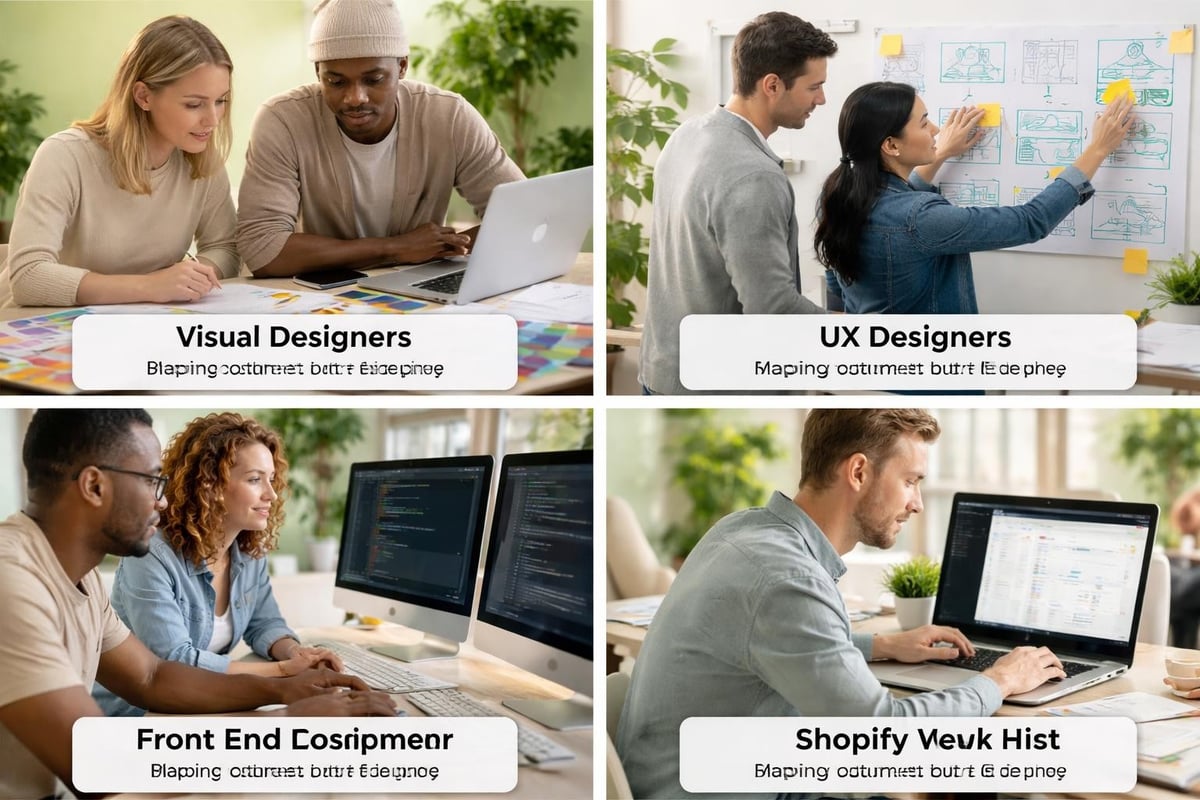
A functional web design team comprises several distinct roles, each contributing specialised knowledge to the project. The core structure typically includes designers, developers, UX specialists, and project managers who work collaboratively throughout the build process.
Creative designers focus on visual identity, brand consistency, and aesthetic appeal. They create mockups, define colour schemes, select typography, and ensure every element aligns with your brand guidelines. Their work directly influences how customers perceive your store and whether they trust it enough to complete a purchase.
Technical Development Specialists
Developers transform design concepts into functional websites. For Shopify projects specifically, front-end developers work with Liquid templating, whilst full-stack developers handle custom app integrations and complex functionality. Understanding web designer responsibilities and skills helps clarify how these roles overlap and complement each other.
- Front-end developers build responsive layouts and interactive elements
- Back-end developers manage database structures and server-side logic
- Full-stack developers handle both front-end and back-end requirements
- Shopify specialists understand platform-specific best practices and limitations
The technical team ensures your store loads quickly, functions smoothly across devices, and integrates seamlessly with third-party tools like inventory management systems or email marketing platforms.
User Experience and Strategy
UX designers examine how customers interact with your store, identifying friction points and opportunities for improvement. They conduct research, create user personas, map customer journeys, and design wireframes that prioritise conversion goals over purely aesthetic considerations.
Strategic roles might include content strategists who plan information architecture, SEO specialists who ensure discoverability, and conversion rate optimisation experts who analyse data to improve performance. These positions become increasingly important as your eCommerce operation matures.
Structuring Your Web Design Team for Success
Team structure varies significantly based on project complexity and organisational size. Effective web team structures balance specialisation with collaboration, ensuring fluid communication between departments whilst maintaining clear accountability.
In-House vs Agency Models
Building an in-house web design team offers control and deep brand knowledge. Your team lives and breathes your products daily, understanding nuances that external partners might miss. However, this approach requires significant investment in recruitment, training, tools, and ongoing professional development.
Partnering with an agency provides immediate access to diverse expertise without the overhead of permanent staff. Agencies like Futur Media bring experience from working across multiple brands and industries, offering insights that come from solving similar challenges repeatedly.
AspectIn-House TeamAgency PartnershipCost structureFixed salaries plus benefitsProject-based or retainer feesExpertise breadthLimited to hired specialistsAccess to full service capabilitiesAvailabilityDedicated but potentially stretchedScalable based on project needsBrand knowledgeDeep and accumulatedRequires briefing and onboardingInnovationCan become insularFresh perspectives from varied clients
Many successful eCommerce brands adopt a hybrid model, maintaining a small internal team for day-to-day updates whilst partnering with specialists for major projects like platform migrations or complete redesigns.
Building Effective Collaboration Processes
Even the most talented web design team will underperform without clear processes and communication frameworks. Establishing these systems early prevents misunderstandings and keeps projects on track.
Project management methodologies provide structure for complex web builds. Agile approaches work well for iterative development, allowing teams to adapt as requirements evolve. Waterfall methods suit projects with fixed specifications and minimal expected changes.
Communication Protocols
Daily stand-ups keep everyone aligned on priorities and blockers. Weekly reviews allow stakeholders to assess progress and provide feedback before too much work proceeds in the wrong direction. Clear documentation ensures decisions don't get lost in Slack messages or email threads.
Modern teams rely heavily on collaborative tools:
- Design platforms like Figma enable real-time collaboration on mockups
- Project management software tracks tasks, deadlines, and dependencies
- Version control systems prevent code conflicts and enable rollbacks
- Testing environments allow stakeholders to review work before launch
Looking at great design agencies reveals common patterns in how successful teams organise their workflows and maintain quality standards across projects.
Critical Skills for Modern Web Design Teams
Technical competence forms the foundation, but modern web design teams need broader capabilities to deliver exceptional results. Understanding web design best practices ensures teams create sites that perform well rather than just looking attractive.
Design and Development Proficiency
Designers must understand responsive principles, accessibility standards, and performance implications of their choices. Developers need familiarity with modern frameworks, API integrations, and security best practices. For Shopify-focused teams, deep platform knowledge distinguishes adequate work from exceptional results.
Performance optimisation has become non-negotiable. A web design team must know how to compress images, lazy-load content, minimise HTTP requests, and leverage browser caching. These technical considerations directly impact conversion rates and search rankings.

Strategic and Analytical Capabilities
Data literacy separates high-performing teams from average ones. Understanding Google Analytics, heatmaps, and A/B testing results allows teams to make evidence-based decisions rather than relying on opinions or assumptions.
SEO knowledge should permeate the entire web design team. Developers must implement proper heading hierarchies and semantic HTML. Designers need to consider how visual layouts guide users toward important content. Content creators should understand keyword research and search intent. For brands serious about organic growth, working with specialists who understand how to do SEO on Shopify proves invaluable.
Hiring and Retaining Top Talent
Building a strong web design team starts with smart recruitment. Technical skills can be assessed through portfolio reviews and practical tests, but cultural fit and communication abilities often prove equally important for long-term success.
Portfolio analysis reveals much about a candidate's capabilities. Look for projects similar to your needs, evidence of problem-solving, and progression in skill level over time. Be wary of portfolios containing only template implementations or work done as part of larger teams where individual contributions remain unclear.
Assessment and Interview Strategies
Practical assessments provide better insights than theoretical questions. Ask designers to critique existing work and suggest improvements. Have developers explain their approach to common Shopify challenges. Test UX specialists' ability to identify problems and propose solutions based on user research.
- Request candidates to walk through their design process on past projects
- Assess problem-solving by presenting realistic scenarios they might encounter
- Evaluate communication skills through discussions about technical trade-offs
- Check collaboration abilities by asking about past team experiences
Retaining talent requires more than competitive salaries. Professional development opportunities, exposure to interesting projects, and recognition for good work all contribute to job satisfaction. The web team roles and responsibilities should allow for growth and specialisation as team members develop their careers.
Managing Projects and Client Expectations
A web design team's success depends partly on their technical abilities and partly on how well they manage stakeholder relationships. Clear briefs, realistic timelines, and transparent communication prevent most common project failures.
Discovery and Planning Phases
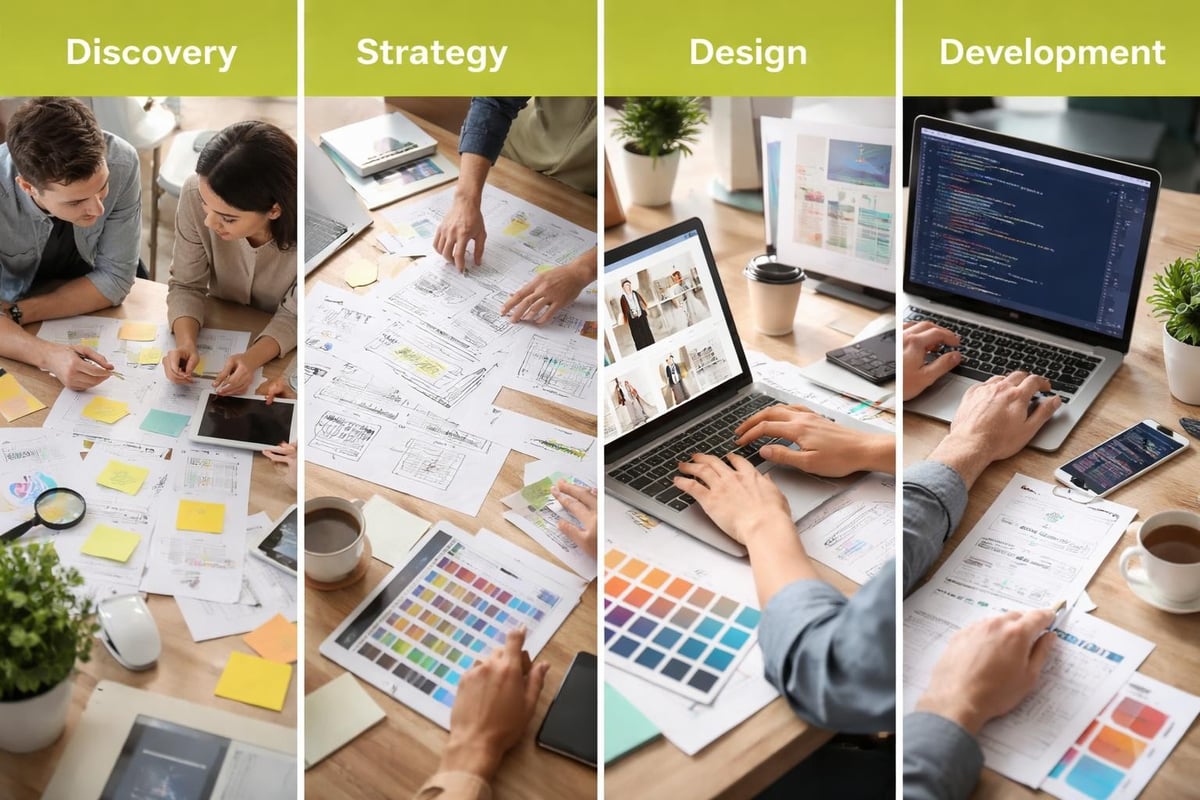
Thorough discovery prevents scope creep and misaligned expectations. Document business objectives, target audiences, success metrics, and technical requirements before design work begins. Understanding whether you're building a new store, executing a Shopify migration, or refreshing an existing site dramatically affects timeline and resource requirements.
Competitive analysis provides context for design decisions. Reviewing what works well for similar brands helps teams avoid reinventing solutions to solved problems whilst identifying opportunities for differentiation.
Project PhaseKey ActivitiesTypical DurationDiscoveryResearch, briefing, competitive analysis1-2 weeksStrategyUser journeys, information architecture, wireframes2-3 weeksDesignMockups, revisions, design system creation3-4 weeksDevelopmentBuild, integration, testing4-8 weeksLaunchFinal testing, migration, go-live1-2 weeks
These timelines vary based on project complexity, but they provide useful benchmarks for planning. Transparent schedules help manage expectations and identify potential delays early.
Continuous Improvement and Optimisation
Launch day marks the beginning, not the end, of a website's lifecycle. A mature web design team understands that optimisation continues indefinitely based on performance data and changing business needs.
Post-launch monitoring identifies technical issues, usability problems, and conversion barriers that weren't apparent during testing. Real user behaviour often differs from predicted patterns, revealing opportunities for improvement that even experienced teams couldn't anticipate.
Regular performance audits assess site speed, accessibility compliance, and SEO health. Following web design best practices for user experience ensures your store continues meeting modern standards as expectations evolve.
A/B Testing and Iteration
Systematic testing removes guesswork from design decisions. Test different homepage layouts, product page structures, checkout flows, and call-to-action placements to identify what resonates with your specific audience. When teams implement Shopify web design with conversion optimisation in mind from the start, they build testing capabilities directly into the platform.
Data-driven improvements compound over time. Small gains across multiple touchpoints can dramatically improve overall conversion rates and average order values without requiring complete redesigns.
Scaling Your Web Design Capabilities
As businesses grow, web design needs evolve from simple implementations to complex, multi-site operations requiring sophisticated team structures. Planning for this growth prevents capability gaps and bottlenecks.
Specialisation increases as teams scale. Instead of generalist designers handling everything, you might hire specialists focused exclusively on email design, landing pages, or mobile optimisation. Development teams split into platform specialists, integration experts, and performance engineers.
Documentation becomes critical at scale. Design systems ensure consistency across team members and projects. Code standards prevent technical debt accumulation. Process documentation allows new team members to onboard quickly without disrupting ongoing work.
Consider whether to expand internal capabilities or develop relationships with top eCommerce development companies who can provide specialist expertise when needed. This flexibility often proves more cost-effective than maintaining full-time specialists for occasionally needed skills.
Technology Stack Decisions
Your web design team's effectiveness depends partly on the tools they use. While individual preferences vary, certain technologies have become industry standards for good reasons.
For Shopify development specifically, teams need proficiency with Liquid templating, JavaScript frameworks like React or Vue for custom functionality, and CSS preprocessors for maintainable stylesheets. Understanding Shopify's API allows integration with external systems whilst respecting platform best practices.
Design tools have largely consolidated around Figma for interface design, with Adobe Creative Suite still dominant for brand assets and image editing. Prototyping tools like InVision or Principle help communicate interactive behaviours before development begins.
Choosing the Right Platform Expertise
Platform choice fundamentally shapes what your web design team needs to know. Shopify's ecosystem rewards specialists who understand its architecture deeply rather than generalists who know many platforms superficially. Teams familiar with how to set up a Shopify store efficiently can deliver faster results with fewer complications than those learning as they build.
The platform's app ecosystem extends functionality without custom development, but knowing which apps integrate cleanly and which cause problems requires experience. A knowledgeable team saves money by avoiding tools that promise much but deliver complications.
Quality Assurance and Testing
Rigorous testing separates professional web design teams from amateurs. Functional testing ensures features work correctly. Cross-browser testing verifies consistency across different platforms. Accessibility testing confirms compliance with WCAG guidelines. Performance testing identifies bottlenecks before they affect real customers.
User acceptance testing involves stakeholders reviewing work against original requirements. This crucial step catches misunderstandings early when corrections remain relatively simple and inexpensive.
Testing checklists prevent oversights:
- Verify all forms submit correctly and trigger appropriate emails
- Test checkout process including payment gateway integration
- Confirm mobile responsiveness across various device sizes
- Check page load speeds and identify optimisation opportunities
- Validate all links and ensure navigation works intuitively
- Review analytics implementation to ensure accurate tracking
Understanding best eCommerce homepage design principles helps teams evaluate whether their implementation matches industry standards and user expectations.
Budget Considerations and ROI
Web design team costs vary enormously based on location, experience, and specialisation. Understanding market rates helps set realistic budgets and identify when quotes seem unusually high or suspiciously low.
Internal teams require salaries, benefits, equipment, software licences, and ongoing training. Agency partnerships involve project fees or monthly retainers. Both approaches can deliver excellent ROI when matched appropriately to business needs and project complexity.
Value extends beyond initial delivery. A well-built Shopify store requires less maintenance, performs better in search results, converts more visitors, and scales smoothly as traffic grows. These long-term benefits often justify higher initial investment in quality work from experienced teams.
Calculate ROI by comparing implementation costs against revenue improvements. If a professional web design team increases your conversion rate from 1.5% to 2.5%, that additional percentage point might generate thousands in monthly revenue, paying back the investment quickly.
A high-performing web design team combines creative vision, technical expertise, and strategic thinking to build eCommerce stores that don't just look impressive but deliver measurable business results. Whether you choose to build internal capabilities or partner with specialists, understanding these roles, processes, and best practices ensures smarter decisions and better outcomes. At Futur Media, we've assembled a specialist Shopify team that brings together all these disciplines to create stores that convert visitors into customers and support sustainable growth for ambitious UK brands.