
.svg)






%201.avif)
Great Shopify store design is about far more than looks — it's about guiding visitors smoothly from landing page to checkout. This guide walks through the core design principles that separate high-converting stores from pretty-but-flat ones. If you'd like yours built for you, see our Shopify web design service.
Understanding the Strategic Role of Shopify Website Design
Shopify store design extends far beyond aesthetics. It encompasses the entire customer journey, from initial landing to post-purchase engagement.
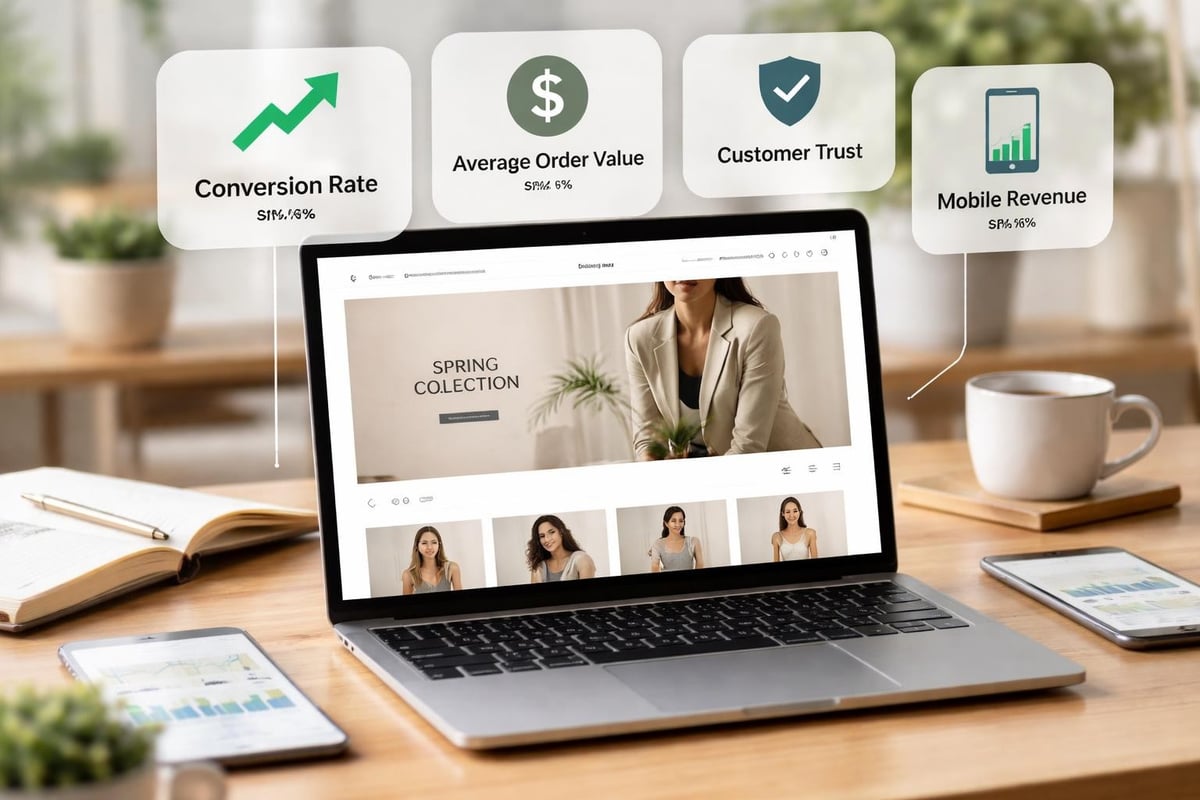
Your design choices directly influence crucial metrics:
- Average order value through strategic product presentation
- Conversion rates via streamlined navigation and checkout processes
- Customer lifetime value through brand consistency and trust signals
- Bounce rates determined by page load speed and mobile responsiveness
The Business Case for Professional Design
Many brands underestimate the commercial impact of professional store design. Research consistently demonstrates that design quality affects purchasing decisions, with 38% of users abandoning websites they find unattractive or difficult to navigate.
Professional design delivers measurable returns:
MetricImpact of Quality DesignConversion Rate20-30% improvement on averageMobile Revenue15-25% increase with optimised experiencesReturn Rate12-18% reduction through clear product presentationCustomer Trust75% higher confidence in professionally designed stores
The investment in strategic Shopify design typically recovers within months through improved performance across these metrics. Best practices for ecommerce homepage design demonstrate how targeted improvements create compounding benefits throughout the customer journey.
Core Principles of High-Converting Shopify Design
Effective Shopify store design balances brand expression with commercial functionality. The most successful stores share common characteristics that transcend industry and aesthetic preferences.
Navigation Architecture That Guides Purchases
Your navigation structure determines whether visitors find products effortlessly or abandon in frustration. Implement a hierarchy that reflects how customers think about your offerings, not how you organise inventory internally.
Best-performing navigation systems include:
- Clear primary categories limited to 5-7 main options
- Intuitive subcategories that segment products logically
- Prominent search functionality with autocomplete suggestions
- Quick access to account and basket in consistent locations
- Breadcrumb trails for easy backward navigation
According to Virtual Creators' best practices guide, navigation clarity ranks among the top three factors influencing conversion rates. Complex or confusing menus create cognitive load that directly reduces purchasing likelihood.
Visual Hierarchy and Content Structure
Store design succeeds when visitors instinctively understand where to focus attention. Visual hierarchy guides the eye through deliberate use of size, colour, contrast, and spacing.
Implementing effective hierarchy:
- Use size variations to establish importance (headlines larger than body text, featured products more prominent than alternatives)
- Apply colour strategically to draw attention to calls-to-action without overwhelming
- Create breathing room through generous whitespace that prevents cognitive overload
- Establish consistent patterns across pages to build familiarity
Short paragraphs work particularly well in ecommerce contexts. Dense text blocks discourage scanning behaviour that characterises online shopping. Break content into digestible chunks that support quick decision-making.
Mobile-First Design Philosophy
With mobile commerce representing over 60% of UK ecommerce transactions in 2026, mobile-first Shopify design has shifted from optional to essential. This approach designs for mobile constraints first, then progressively enhances for larger screens.
Mobile optimisation requires specific considerations:
- Touch-friendly navigation with adequately sized tap targets (minimum 44x44 pixels)
- Simplified checkout flows that minimise form fields
- Compressed images that load quickly on cellular connections
- Thumb-zone placement for critical actions in easily reachable areas
The mobile-first design principles outlined by industry experts emphasise testing on actual devices rather than desktop browser simulations. Real-world usage patterns often differ significantly from emulated experiences.
Essential Pages and Their Design Requirements
Different page types within your Shopify store serve distinct purposes, each requiring tailored ecommerce store design approaches.
Homepage Design Strategy
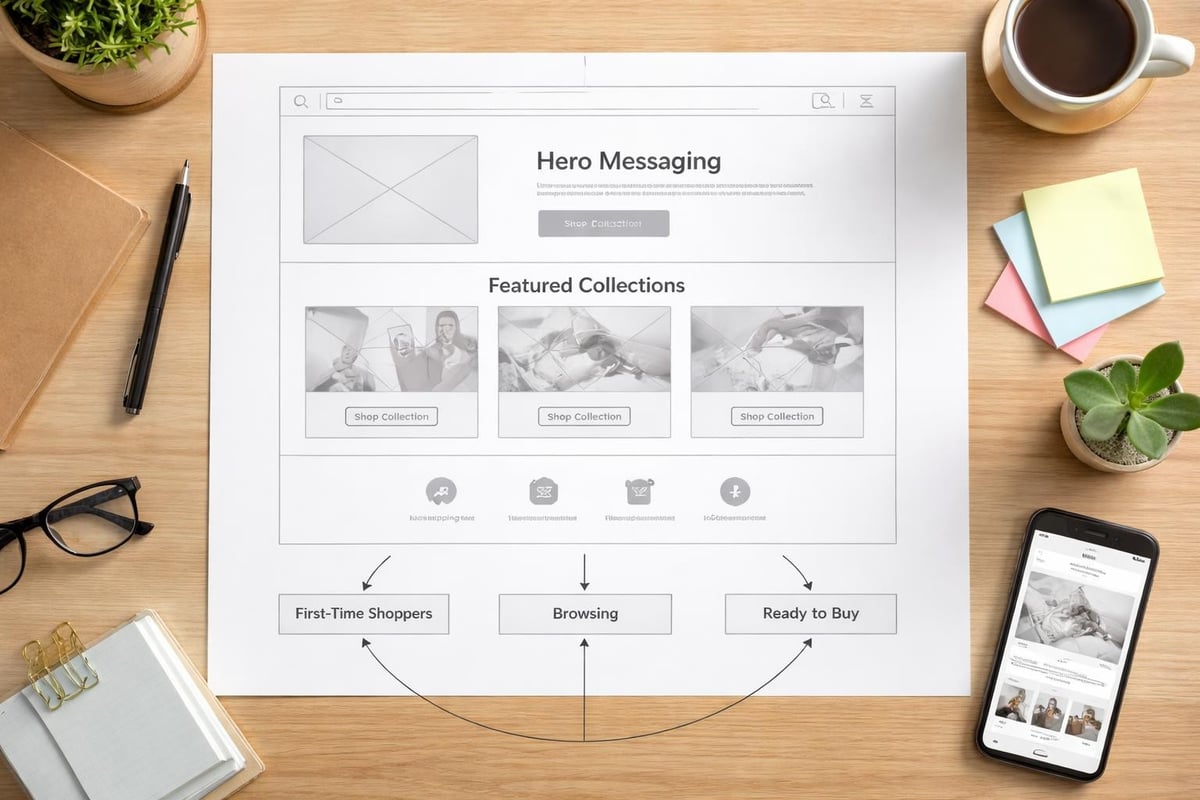
Your homepage introduces brand identity while directing traffic toward conversion opportunities. Effective homepages balance multiple objectives without creating confusion.
Critical homepage elements include:
ElementPurposeBest PracticeHero SectionImmediate value communicationSingle clear message with visual supportFeatured CollectionsProduct discovery3-4 carefully curated selectionsSocial ProofTrust buildingCustomer reviews or recognisable client logosValue PropositionsCompetitive differentiationFree delivery, guarantees, unique benefits
Common mistakes outlined in TCF's homepage analysis include overcrowding the hero section, burying key information below the fold, and neglecting clear calls-to-action. Your homepage should function as a strategic router, efficiently directing different customer segments toward relevant destinations.
Collection and Product Page Optimisation
Collection pages bridge browsing and purchasing behaviour. Your Shopify store design must facilitate product discovery through effective filtering, sorting, and visual presentation.
Implementing high-performing collection pages involves:
- Filtering options relevant to your product attributes (size, colour, price range, features)
- Clear product imagery showing items from multiple angles with consistent styling
- Quick view functionality enabling specification review without page navigation
- Stock indicators preventing disappointment from unavailable selections
Product pages convert browsers into buyers through comprehensive information presentation. The most effective designs answer questions before they arise, reducing friction in the decision-making process. Optimising Shopify collection pages requires understanding which attributes customers prioritise during evaluation.
Checkout Experience Design
Checkout represents the culmination of your store design efforts. Even minor friction at this stage dramatically impacts completion rates.
Checkout optimisation priorities:
- Progress indicators showing completion status
- Guest checkout options alongside account creation
- Multiple payment method support (cards, digital wallets, buy-now-pay-later)
- Clear error messaging with actionable correction guidance
- Security reassurances through visible trust badges
Shopify's native checkout includes numerous optimisation features, but custom implementations can further reduce abandonment. Conversion rate optimisation specifically targeting checkout flows typically delivers the highest return on investment.
Technical Performance and User Experience
Technical excellence forms the foundation of successful Shopify design. Visual appeal means nothing if pages load slowly or function unreliably.
Page Speed Optimisation
Loading speed directly correlates with both conversion rates and search rankings. Each additional second of load time reduces conversions by approximately 7%, while Google's algorithm increasingly prioritises fast-loading experiences.
Speed optimisation techniques:
- Image compression without visible quality degradation
- Lazy loading for below-the-fold content
- Minimised third-party application usage
- Critical CSS inlining for faster initial render
- Content delivery network implementation for global performance
Shopify provides built-in performance features, but theme selection and customisation choices significantly impact actual speeds. Regular testing using tools like Google PageSpeed Insights reveals opportunities for improvement.
Accessibility and Inclusive Design
Accessible ecommerce store design expands your potential market while improving usability for all visitors. Approximately 20% of the UK population experiences some form of disability, making accessibility both commercially sensible and ethically important.
Implementing accessibility includes:
- Sufficient colour contrast ratios (minimum 4.5:1 for normal text)
- Keyboard navigation support for users unable to use pointing devices
- Descriptive alt text for images enabling screen reader comprehension
- Clear heading hierarchies that create logical document structures
- Form labels explicitly associated with input fields
Many accessibility improvements benefit all users, not just those with disabilities. Clear labels, logical structures, and thoughtful interactions enhance everyone's experience.
Design Systems and Brand Consistency
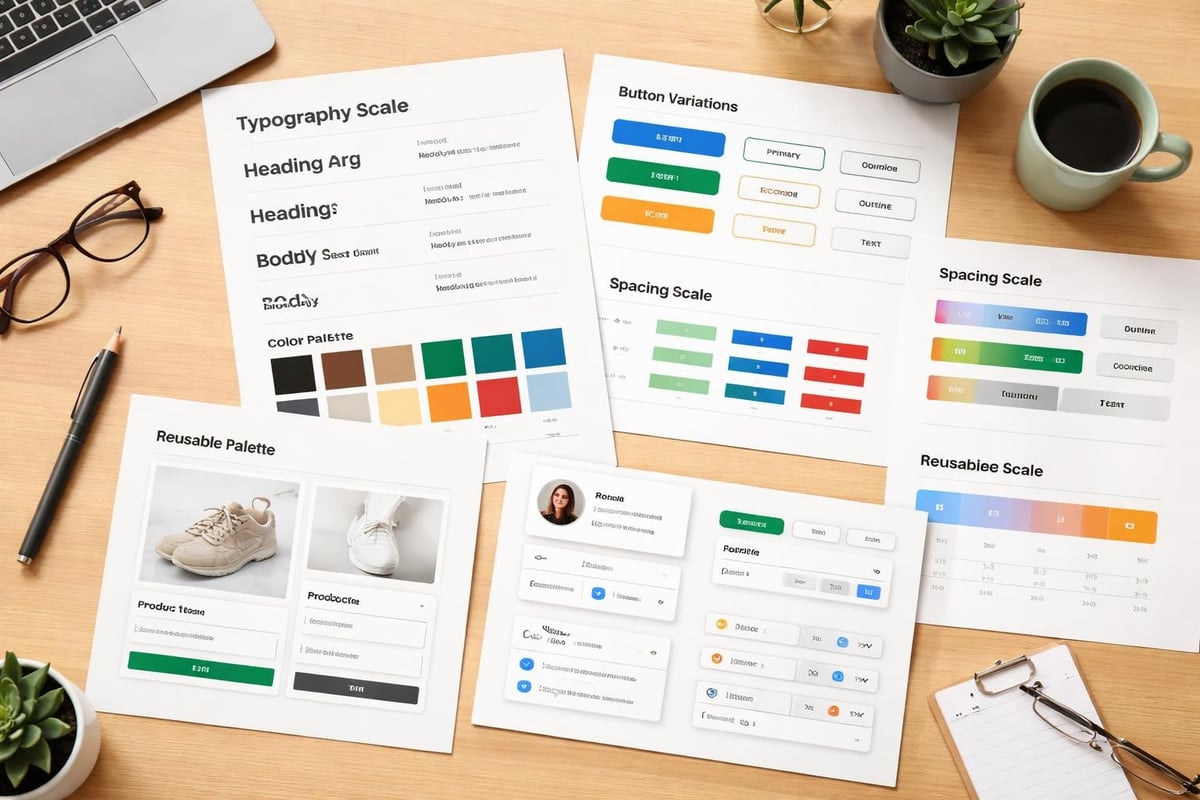
Cohesive Shopify store design relies on systematic approaches to colour, typography, spacing, and component usage. Design systems ensure consistency across hundreds of potential page variations.
Establishing Your Visual Language
Your visual language communicates brand personality while maintaining usability. Strategic choices around typography and colour create recognition and emotional resonance.
Typography considerations:
- Maximum 2-3 typeface families across the entire site
- Clear hierarchy through size, weight, and spacing variations
- Readable body text sizing (minimum 16px on mobile)
- Appropriate line height for comfortable reading (1.5-1.6 for body text)
Colour palettes should include primary brand colours alongside functional variations for success states, errors, and neutral backgrounds. The Shopify design tips emphasise restraint, with 3-5 core colours typically sufficient for cohesive experiences.
Component Libraries and Reusability
Professional store design employs reusable components that maintain consistency while enabling efficient updates. Buttons, cards, form inputs, and navigation elements should follow predictable patterns.
Creating a component library involves:
- Documenting standard variations (primary buttons, secondary buttons, tertiary buttons)
- Defining usage contexts for each component type
- Establishing spacing rules for consistent rhythm
- Specifying responsive behaviours across breakpoints
This systematic approach prevents design drift that occurs when each page receives unique treatment without overarching guidelines.
Conversion-Focused Design Strategies
Beyond aesthetics and usability, strategic Shopify design actively drives purchasing behaviour through psychological principles and optimisation techniques.
Trust Signal Integration
Online purchasing requires overcoming inherent trust barriers. Effective designs incorporate multiple trust signals that reassure hesitant customers.
Essential trust elements:
Trust SignalImplementationImpactCustomer ReviewsProduct pages and homepage63% increase in purchase likelihoodSecurity BadgesCheckout and footer17% reduction in cart abandonmentReturn PolicyProduct pages and dedicated page25% higher conversion confidenceLive Chat SupportFloating widget on key pages38% improvement in query resolution
Placement matters as much as presence. Trust signals positioned where doubt naturally arises (near add-to-basket buttons, during checkout) prove most effective.
Scarcity and Urgency Techniques
Strategic ecommerce store design can incorporate scarcity and urgency without resorting to manipulative tactics. Authentic limited availability or time-sensitive offers create motivation.
Effective implementations include:
- Stock level indicators when quantities drop below thresholds
- Countdown timers for genuine promotional periods
- "Recently purchased" notifications demonstrating real activity
- Limited edition labelling for exclusive product runs
Transparency remains crucial. False scarcity damages trust more than it generates sales.
Social Proof and Customer Content
User-generated content transforms Shopify store design from one-way communication to community demonstration. Photos, reviews, and testimonials from real customers provide persuasive evidence.
Integration opportunities span multiple page types. Homepage featured reviews, product page photo galleries, dedicated testimonial sections, and social media feeds all reinforce authenticity. Working with a Shopify agency often includes strategies for collecting and displaying customer content systematically.
Platform Capabilities and Customisation Options
Understanding Shopify's technical capabilities informs realistic store design possibilities. The platform offers flexibility through themes, applications, and custom development.
Theme Selection and Customisation
Shopify themes provide starting frameworks that require adaptation to specific brand requirements. Premium themes typically offer more flexibility and support than free alternatives.
Evaluation criteria for theme selection:
- Responsive design quality across devices
- Customisation options without code modifications
- Performance optimisation and clean code structure
- Regular updates and developer support
- Feature alignment with business requirements
Even with themes, customisation typically proves necessary. Minor CSS adjustments to colours and spacing differ significantly from structural theme modifications requiring development expertise. Conversion-focused Shopify web design often involves substantial theme customisation or complete custom builds.
Application Integration Considerations
Shopify's app ecosystem enables functionality extension, but excessive application usage creates performance issues and design inconsistencies. Strategic Shopify design carefully evaluates each application's necessity.
Before installing applications, consider:
- Whether native Shopify features address the requirement
- Performance impact through speed testing
- Design integration and customisation flexibility
- Long-term cost implications of subscription fees
- Data security and privacy compliance
Quality over quantity applies. Five well-chosen applications typically outperform twenty poorly integrated ones.
Custom Development for Unique Requirements
Brands with specific functionality needs or distinctive design visions benefit from custom development. Shopify's Liquid templating language and API enable virtually unlimited customisation.
Custom development scenarios include:
- Complex product configurators for personalised items
- Advanced filtering beyond standard collection capabilities
- Unique checkout flows for subscription or B2B models
- Bespoke calculator or recommendation tools
- Integration with external systems and databases
The Doovisual design guide emphasises balancing customisation ambitions against maintenance complexity and future flexibility.
Ongoing Optimisation and Testing
Effective ecommerce store design represents continuous improvement rather than one-time implementation. Systematic testing reveals opportunities invisible during initial development.
A/B Testing Methodology
Conversion rate optimisation through testing compares design variations to identify superior performers. Rigorous methodology prevents false conclusions from random variation.
Testing best practices include:
- Single variable isolation (testing one change at a time)
- Statistical significance requirements before declaring winners
- Sufficient traffic volume for reliable results
- Segment analysis revealing different responses across customer types
- Documentation of learnings applicable to future projects
Common testing priorities include homepage hero messaging, product page layouts, add-to-basket button styling, checkout form structures, and navigation organisation.
Analytics Integration and Interpretation
Data-driven Shopify store design requires comprehensive analytics implementation. Google Analytics 4, Shopify's native analytics, and heat mapping tools each provide unique insights.
Key metrics for design evaluation:
- Bounce rate by landing page and traffic source
- Session duration and pages per session
- Funnel completion rates from landing through purchase
- Device-specific conversion performance
- Revenue per session segmented by customer type
Regular review cycles (monthly or quarterly) identify trends requiring design responses. Declining mobile conversion rates might indicate responsive design issues, while high product page exit rates could signal insufficient information or trust signals.
Seasonal and Campaign-Specific Adaptations
Strategic store design accommodates promotional periods without permanent structural changes. Seasonal campaigns, product launches, and special events require temporary design modifications.
Flexible design systems enable efficient updates:
- Banner areas for promotional messaging
- Featured collection sections highlighting campaign products
- Colour accent adjustments maintaining brand recognition
- Landing page templates for campaign-specific traffic
Planning these accommodations during initial design prevents last-minute compromises that damage user experience or brand consistency.
Industry-Specific Design Considerations
Different product categories and business models require tailored Shopify design approaches. Fashion retail differs substantially from electronics or food and beverage brands.
Fashion and Apparel Design Patterns
Fashion brands prioritise visual storytelling and lifestyle association. Photography quality and presentation style communicate brand positioning as much as product attributes.
Fashion-specific design elements:
- Large, high-quality product imagery enabling detail examination
- Lifestyle photography showing products in context
- Size guides and fit information reducing return rates
- Colour accuracy through careful photography and display calibration
- Collection lookbooks presenting coordinated outfit suggestions
The Ayatas best practices analysis highlights how fashion brands successfully balance editorial content with commercial functionality.
Technical and Specification-Heavy Products
Electronics, tools, and technical products require different ecommerce store design priorities. Detailed specifications, comparison capabilities, and educational content drive informed purchasing decisions.
Effective approaches include:
- Comprehensive specification tables with search and filter functionality
- Comparison tools enabling side-by-side evaluation
- Technical documentation and user manual access
- Video demonstrations showing products in use
- Expert guidance content addressing common questions
These categories benefit from structured data implementation improving search visibility and rich snippet display.
Subscription and Recurring Revenue Models
Subscription businesses face unique Shopify store design challenges around value communication and commitment reduction. Clear explanation of terms, flexible options, and easy management prove essential.
Design priorities for subscription models include:
- Transparent pricing and commitment term communication
- Comparison presentation of subscription versus one-time purchase
- Account management portal design for easy modifications
- Cancellation processes that retain customers through alternatives
- Renewal reminders and preference update opportunities
Building trust through clarity determines success in subscription contexts where customers commit to ongoing relationships.
Future-Proofing Your Shopify Design
Technology evolution and changing consumer expectations require store design that adapts without complete rebuilds. Strategic decisions during initial development preserve long-term flexibility.
Scalability Planning
Growing businesses need designs accommodating expanded catalogues, increased traffic, and additional functionality. Scalable architecture prevents performance degradation as success compounds.
Scalability considerations:
- Navigation structures supporting catalogue growth
- Performance optimisation maintaining speed with more products
- Infrastructure capacity for traffic spikes
- Design systems enabling efficient page creation
- Database architecture supporting advanced filtering
Planning for success costs little initially but prevents expensive limitations later. The Shopify guide explores scalability considerations across technical and design dimensions.
Emerging Technology Integration
Artificial intelligence, augmented reality, and voice commerce represent evolving capabilities influencing Shopify design. Early adoption provides competitive advantages when implementations genuinely improve experiences.
2026 technology trends include:
TechnologyApplicationAdoption StageAI Product RecommendationsPersonalised suggestionsMainstreamAR Product VisualisationVirtual try-on and placementGrowingVoice Search OptimisationConversational product discoveryEarlyChatbot SupportAutomated customer assistanceWidespread
According to TechRadar's Shopify review, the platform continues integrating AI-driven design tools that democratise advanced capabilities. Brands should evaluate these features against genuine customer benefit rather than novelty appeal.
Design System Maintenance
Long-term success requires treating ecommerce store design as living systems rather than completed projects. Regular audits identify inconsistencies, outdated patterns, and improvement opportunities.
Maintenance activities include:
- Quarterly design reviews assessing consistency and performance
- Component library updates reflecting new requirements
- Accessibility audits ensuring continued compliance
- Performance monitoring and optimisation
- Security updates and platform version migrations
Professional ongoing support ensures designs evolve alongside business needs and platform capabilities. Many UK brands benefit from dedicated Shopify support arrangements providing consistent attention without internal resource allocation.
Effective Shopify store design balances aesthetics, functionality, and commercial objectives to create experiences that convert visitors into customers and customers into advocates. The principles outlined here provide frameworks for strategic decision-making across initial builds, redesigns, and ongoing optimisation efforts. If you're ready to create a high-performing Shopify store that drives measurable results for your brand, Futur Media combines design expertise with conversion-focused development to build ecommerce experiences that deliver sustainable growth for ambitious UK businesses.



.svg)