
.svg)






%201.avif)
Choosing the right eCommerce platform is one of the most important decisions you'll make for your online business. The shopify vs magento debate has been running for years, and in 2026, both platforms continue to evolve with distinct strengths and trade-offs. Shopify offers a hosted, user-friendly solution that gets stores live quickly with minimal technical knowledge, while Magento (now Adobe Commerce) provides an open-source framework built for complex, customisable builds. For UK brands evaluating their options, understanding the practical differences in cost, flexibility, performance, and long-term scalability is essential. This guide breaks down the shopify vs magento comparison across the factors that matter most to growing eCommerce businesses.
Platform Architecture and Hosting
The fundamental difference in the shopify vs magento conversation starts with how each platform is built and hosted.
Shopify is a fully hosted SaaS (Software as a Service) platform. This means Shopify manages your hosting, security, updates, and server infrastructure. You pay a monthly subscription and focus on running your store rather than maintaining the technology behind it.
Magento Open Source is a self-hosted platform. You download the software, arrange your own hosting, and take responsibility for security, updates, backups, and performance optimisation. Adobe Commerce (formerly Magento Commerce) offers a cloud-hosted version, but it comes with enterprise-level pricing and complexity.
What This Means in Practice
- Shopify merchants benefit from automatic updates, PCI compliance, and 99.98% uptime without needing technical expertise
- Magento users gain complete control over their hosting environment but require developer support for maintenance
- Shopify's infrastructure scales automatically during traffic spikes, ideal for seasonal businesses
- Magento requires proactive server configuration and monitoring to handle growth
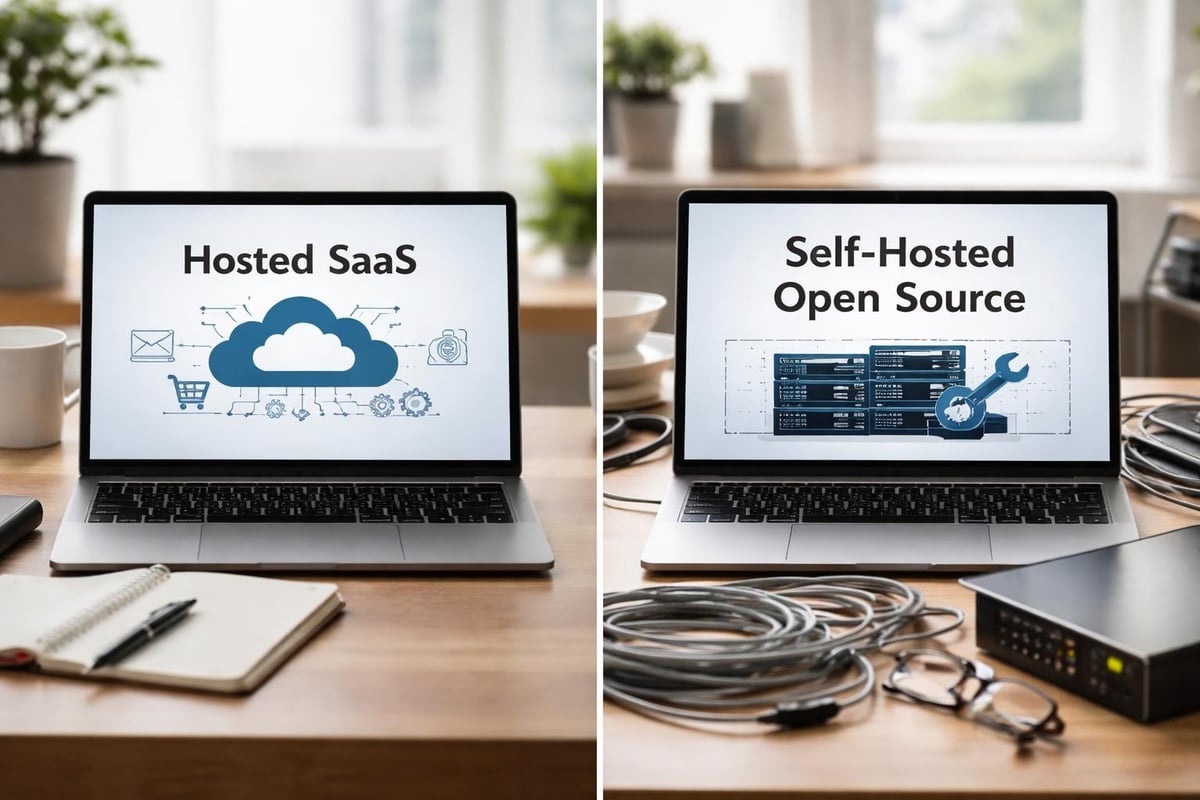
For most UK businesses, Shopify's managed approach removes technical barriers and ongoing server costs. Magento appeals to brands with existing development teams or highly specific infrastructure requirements.
Cost Comparison
The shopify vs magento cost analysis extends well beyond monthly subscription fees.
Cost FactorShopifyMagento Open SourceAdobe CommercePlatform Fee£25-£2,000/monthFree (software)From £22,000/yearHostingIncluded£20-£500+/monthIncludedDevelopment£3,000-£30,000+£10,000-£100,000+£50,000-£500,000+MaintenanceMinimal£500-£2,000+/monthManaged/high costTransaction Fees0.5-2% (without Shopify Payments)NoneNone
Shopify's pricing is transparent and predictable. Basic Shopify starts at £25 per month, Shopify at £65, Advanced Shopify at £384, and Shopify Plus from £2,000. Transaction fees apply if you don't use Shopify Payments, ranging from 2% on Basic to 0.5% on Plus.
Magento costs are largely invisible upfront. The software itself is free, but you'll need:
- Quality hosting (£50-£500+ monthly depending on traffic)
- Security certificates and compliance tools
- Developer hours for setup, customisation, and ongoing maintenance
- Extensions and integrations (many cost hundreds or thousands)
Development budgets for Magento typically start at £10,000 for basic implementations and can easily exceed £100,000 for complex builds. Annual maintenance costs often run £6,000-£24,000+.
Total Cost of Ownership
For a mid-sized UK brand doing £500,000 annually, Shopify might cost £15,000-£40,000 in year one (platform fees, theme, apps, initial development). Magento could cost £40,000-£100,000+ for the same period once you factor in development, hosting, and support.
Ease of Use and Speed to Market
The shopify vs magento comparison heavily favours Shopify for user experience and launch timelines.
Setting Up Your Store
Shopify is designed for non-technical users. You can:
- Launch a functional store in days, not months
- Use the intuitive admin panel without training
- Add products, configure shipping, and process orders through straightforward interfaces
- Choose from hundreds of professionally designed themes
Magento requires technical expertise at every stage:
- Installation involves command-line work and server configuration
- The admin panel is complex with steep learning curves
- Basic tasks often require developer intervention
- Theme customisation demands PHP and Magento-specific knowledge
For UK businesses without in-house developers, Shopify dramatically reduces time to revenue. Understanding how to start a Shopify business becomes straightforward with guided setup processes.
Customisation and Flexibility
This is where Magento traditionally excels in the shopify vs magento debate, though Shopify has closed the gap considerably.
Magento's open-source architecture allows unlimited customisation:
- Complete access to core code
- No restrictions on functionality or modifications
- Deep integration capabilities with enterprise systems
- Custom checkout flows and unique purchasing experiences
Shopify operates within defined boundaries but offers substantial flexibility:
- Liquid templating language for theme customisation
- APIs for headless commerce implementations
- Shopify Functions for customising checkout and discounts (Plus)
- Growing app ecosystem covering most use cases

When Customisation Matters
Consider Magento if you need:
- Highly complex product configurations (manufacturers, B2B with custom pricing matrices)
- Multi-warehouse inventory management with custom logic
- Deeply integrated ERP, PIM, or proprietary systems
- Unique checkout flows impossible within Shopify's framework
Shopify handles 95% of standard eCommerce requirements and many complex scenarios through apps and custom development. Shopify Development services can build bespoke functionality for most advanced needs without Magento's overhead.
Performance and Scalability
Both platforms scale effectively, but through different mechanisms.
Shopify Performance
- Global CDN (content delivery network) included
- Automatic image optimisation and lazy loading
- Sub-second server response times on managed infrastructure
- Handles traffic spikes automatically
- Performance largely independent of installed apps (though too many can slow themes)
Magento Performance
- Performance depends entirely on hosting quality and configuration
- Requires expert optimisation (caching, indexing, database tuning)
- Can achieve exceptional speeds when properly configured
- Handles massive catalogues (100,000+ products) efficiently
- Poorly configured Magento stores often suffer slow page loads
For most UK eCommerce brands, Shopify delivers faster performance with less effort. Magento can match or exceed Shopify's speed but requires ongoing technical investment.
Extensions and Integrations
The app ecosystem comparison reveals different philosophies in the shopify vs magento landscape.
Shopify App Store features over 13,000 apps covering:
- Marketing automation and email
- Inventory and fulfilment
- Customer service and reviews
- Subscriptions and loyalty programmes
- Analytics and reporting
Most apps use monthly subscription pricing (£5-£200+ monthly). Quality varies, but Shopify's review system and support structure provide accountability.
Magento Marketplace offers fewer extensions (thousands rather than tens of thousands) but many are enterprise-grade:
- Often one-time purchases (£200-£5,000+)
- More complex functionality for B2B scenarios
- Varying quality and update frequency
- Installation often requires developer assistance
Integration Capabilities
Both platforms integrate with major business tools:
- Payment gateways (Stripe, PayPal, SagePay, Worldpay)
- Shipping carriers (Royal Mail, DPD, Parcelforce)
- Accounting software (Xero, QuickBooks, Sage)
- Marketing platforms (Klaviyo, Mailchimp, Google Ads)
Magento offers more flexibility for custom integrations with proprietary systems, whilst Shopify's REST and GraphQL APIs handle most standard integration needs efficiently.
SEO Capabilities
Search visibility matters for long-term growth, making the shopify vs magento SEO comparison important for organic traffic strategies.
Shopify SEO features include:
- Clean URL structures and customisable permalinks
- Automatic sitemap generation
- Fast page speeds (crucial ranking factor)
- Mobile-responsive themes by default
- Basic meta title and description controls
- Structured data for products
Magento SEO features offer more granular control:
- Extensive URL rewrite management
- Advanced meta tag controls
- Canonical tag automation
- Multi-store SEO configuration
- Rich snippets and schema markup
- Layered navigation SEO optimisation
Both platforms are technically SEO-capable. Shopify's speed advantage and mobile-first design often deliver better results in practice, whilst Magento's flexibility benefits large catalogues with complex categorisation needs. Professional Shopify SEO strategies can maximise organic visibility within Shopify's framework.
Security and Compliance
Security responsibilities differ significantly in the shopify vs magento comparison.
Shopify Security
- Level 1 PCI DSS compliant out of the box
- Automatic security patches and updates
- SSL certificates included
- DDoS protection and fraud analysis
- Regular security audits by Shopify's team
Magento Security
- You're responsible for PCI compliance
- Manual security patch installation required
- SSL certificates purchased separately
- Server security configuration necessary
- Regular security audits recommended
Magento's security demands technical expertise and vigilance. Missing critical security updates has led to significant breaches. Shopify removes this burden entirely, which is particularly valuable for lean teams.
Support and Community
Access to help when issues arise differs substantially between platforms.
Support AspectShopifyMagento Open SourceAdobe CommerceOfficial Support24/7 chat, email, phoneCommunity forums onlyEnterprise supportDocumentationExcellent, beginner-friendlyComprehensive but technicalEnterprise resourcesCommunity SizeVery large, activeLarge developer communitySmaller, enterprise-focusedTraining ResourcesAbundant free resourcesTechnical documentation heavyPartner training
Shopify's support accessibility makes it ideal for businesses without dedicated technical teams. Magento users typically need ongoing relationships with specialist agencies or in-house developers.
Migration Considerations
The shopify vs magento question often arises when considering platform switches.
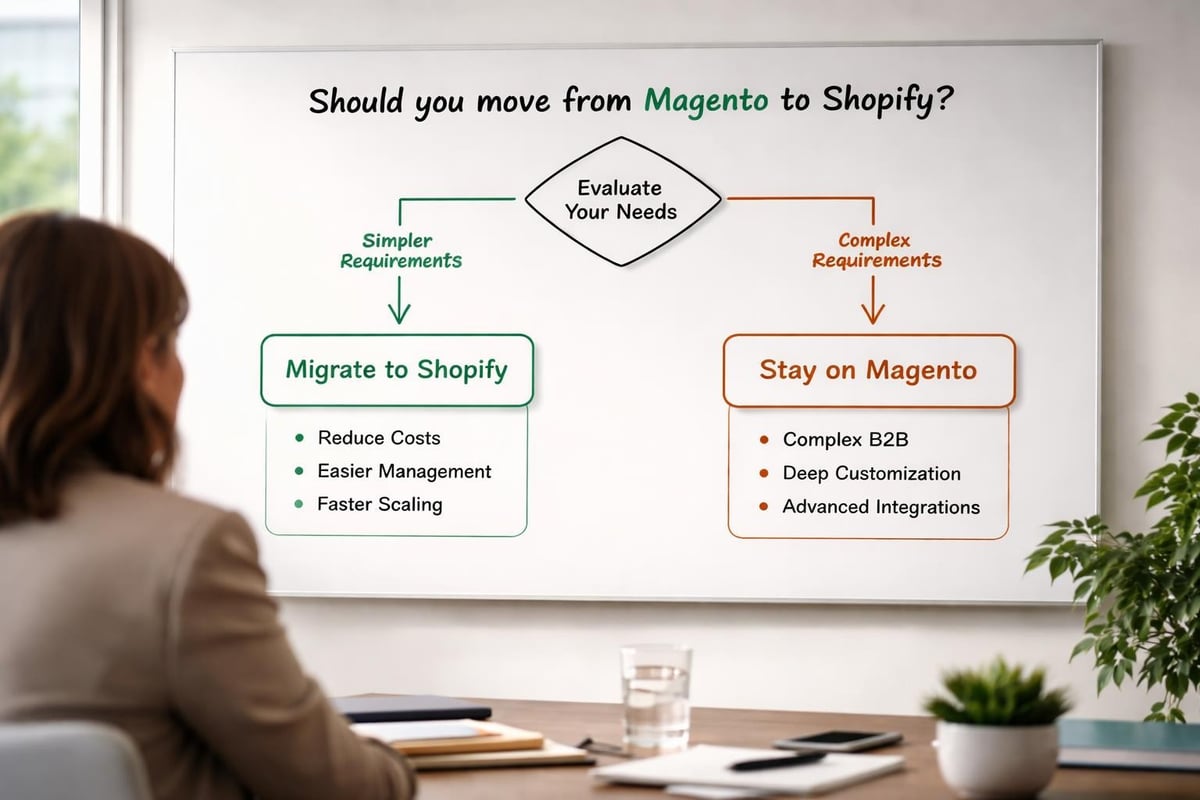
Migrating to Shopify from Magento has become increasingly common:
- Businesses reduce technical overhead and ongoing costs
- Simplified operations allow focus on growth rather than platform management
- Seamless Shopify migrations preserve SEO equity and customer data
- Many UK brands report improved performance and reduced bounce rates post-migration
Migrating from Shopify to Magento is rarer but happens when:
- B2B complexity exceeds Shopify's capabilities
- Enterprise integration requirements demand open-source flexibility
- Custom workflows require code-level control
Migration between platforms requires careful planning around data transfer, design rebuilding, app replacement, and SEO preservation. Understanding the Shopify migration process helps businesses transition smoothly.
Use Case Recommendations
The right platform in the shopify vs magento decision depends on your specific business context.
Choose Shopify When You:
- Want to launch quickly without technical teams
- Run a B2C store with standard eCommerce requirements
- Need predictable costs and minimal maintenance
- Value ease of use and fast performance
- Have a catalogue under 50,000 products
- Prioritise conversion optimisation over unlimited customisation
- Want integrated payment processing and apps
Choose Magento When You:
- Have complex B2B pricing and customer segmentation
- Need unlimited customisation of core functionality
- Operate multiple brands or storefronts with shared inventory
- Have in-house developers or reliable agency partnerships
- Require deep ERP, PIM, or warehouse system integration
- Work with massive product catalogues (100,000+ SKUs)
- Can invest £50,000+ in initial development and ongoing maintenance
Shopify Plus vs Adobe Commerce
For enterprise businesses, the comparison shifts to Shopify Plus versus Adobe Commerce:
Shopify Plus offers:
- Enterprise features at £2,000+ monthly
- Faster implementation (weeks vs months)
- Lower total cost of ownership
- Managed infrastructure and support
- Advanced automation and wholesale features
Adobe Commerce provides:
- Maximum customisation for unique requirements
- Advanced B2B functionality
- Complex multi-tenant architectures
- Higher costs but unlimited flexibility
Most UK mid-market and enterprise brands find Shopify Plus delivers 90% of the functionality at 30-50% of the cost.
Platform Growth and Future Readiness
Evaluating long-term viability is crucial in any shopify vs magento assessment.
Shopify's trajectory shows strong momentum:
- Continuous feature releases and improvements
- Growing enterprise market share
- Investment in headless commerce and composability
- Expanding international capabilities
- Strong financial position enabling ongoing innovation
Magento's position under Adobe shows different priorities:
- Focus shifting toward enterprise and Adobe ecosystem integration
- Community edition receiving fewer innovations
- Adobe Commerce pricing pushing mid-market businesses toward alternatives
- Strong existing install base but declining new project adoption
Recent data shows Shopify powering over 4.6 million stores globally, with significant growth in the UK market. Magento's market share has declined as businesses seek simpler, more cost-effective solutions.
Developer and Talent Availability
Finding skilled professionals impacts long-term platform success.
Shopify developers are:
- More abundant in the UK market
- Generally more affordable (£40-£100+ per hour)
- Capable of working across design and development
- Available through specialised Shopify agencies
Magento developers command:
- Higher rates (£60-£150+ per hour)
- Smaller talent pool, especially outside London
- More specialisation required for complex projects
- Often working through established Magento agencies
For businesses outside major cities, accessing quality Magento expertise can prove challenging. Shopify's simpler stack and larger developer community make support more accessible.
Making Your Platform Decision
The shopify vs magento choice ultimately aligns with your business priorities, resources, and growth plans.
Most UK eCommerce businesses benefit from Shopify's balance of functionality, ease of use, and predictable costs. The platform handles everything from small startups to major brands processing millions in monthly revenue. For businesses seeking high-performing stores without technical complexity, choosing the best Shopify agency ensures professional implementation and ongoing optimisation.
Magento remains relevant for specific use cases requiring unlimited customisation, complex B2B scenarios, or deep enterprise system integration. However, the total cost of ownership and technical demands mean fewer businesses genuinely need Magento's capabilities versus its complexity.
Both platforms can power successful eCommerce businesses, but Shopify's combination of ease, performance, and value makes it the right choice for most UK brands in 2026. Whether you're launching a new store, considering a platform migration, or looking to improve your existing Shopify site's performance, Futur Media specialises in building conversion-focused Shopify stores that deliver measurable results. Get in touch to discuss how we can help your business grow.



.svg)