
.svg)






%201.avif)
Choosing the right eCommerce platform can define the trajectory of your online business. For UK brands evaluating their options in 2026, the shopify vs bigcommerce debate remains one of the most relevant discussions in eCommerce strategy. Both platforms have evolved significantly, offering robust solutions for businesses of all sizes, yet each takes a distinct approach to pricing, functionality, and user experience. Understanding these differences is essential for making an informed decision that aligns with your growth ambitions, technical capabilities, and budget constraints.
Platform Overview and Market Position
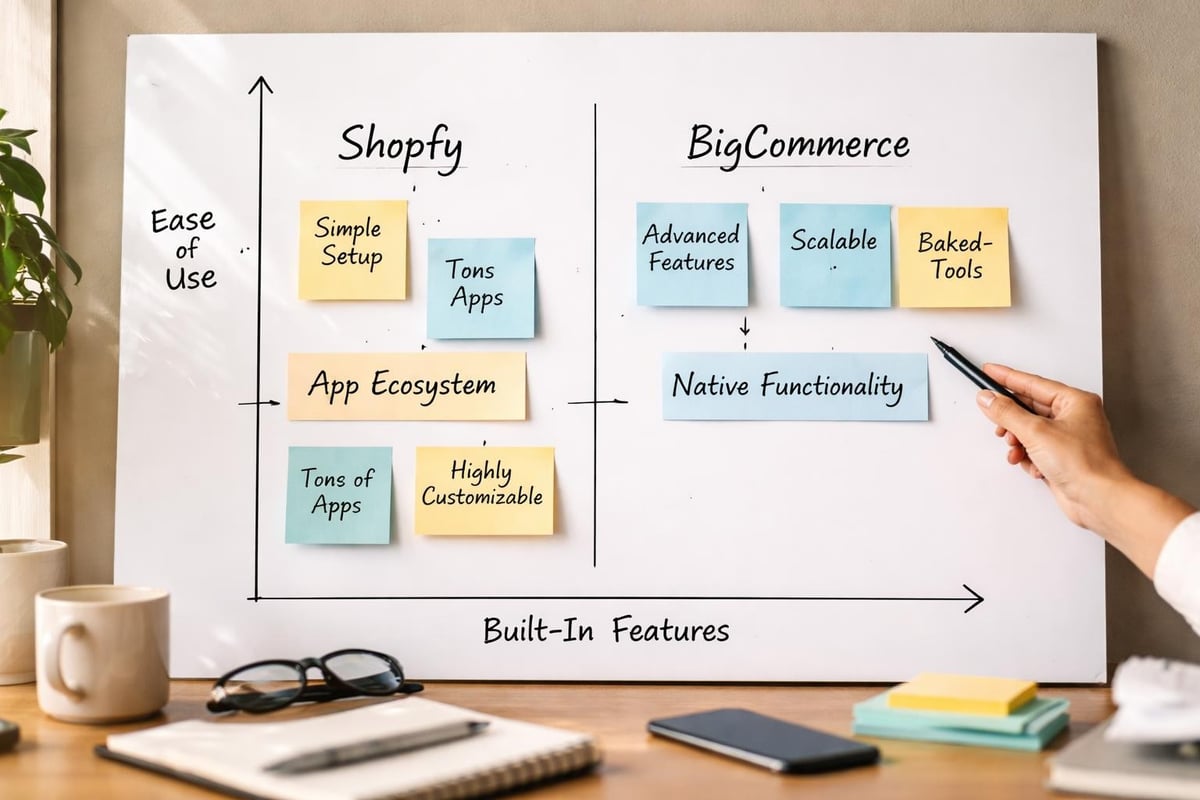
Shopify has established itself as the dominant force in eCommerce, powering over 4.5 million stores worldwide. Its reputation centres on ease of use, rapid deployment, and a vast ecosystem of apps and themes that enable businesses to launch quickly without extensive technical knowledge.
BigCommerce positions itself as the platform for businesses that prioritise built-in functionality over third-party dependencies. It appeals to merchants who want comprehensive native features without paying for multiple apps to achieve core functionality.
Target Audiences
The shopify vs bigcommerce comparison often begins with understanding which platform serves specific business types more effectively.
Shopify excels for:
- First-time eCommerce entrepreneurs
- Brands prioritising speed to market
- Businesses requiring extensive third-party integrations
- Retailers with straightforward product catalogues
- Companies wanting seamless POS integration
BigCommerce suits:
- Mid-market and enterprise retailers
- B2B merchants requiring complex catalogues
- Businesses selling high volumes with multiple variants
- Merchants wanting to avoid app subscription costs
- Brands needing advanced SEO capabilities out of the box
Pricing Structure and Hidden Costs
Pricing represents one of the most significant differentiators when evaluating shopify vs bigcommerce options. Both platforms use tiered pricing models, but the actual cost of running your store extends beyond base subscription fees.
Pricing TierShopifyBigCommerceKey DifferencesBasic£25/month£25/monthSimilar entry pointMid-tier£65/month£60/monthBigCommerce includes more featuresAdvanced£344/month£250/monthSignificant price gap widensEnterpriseCustom (Plus)CustomBoth require negotiation
Transaction Fees
Shopify charges transaction fees ranging from 2% down to 0.5% unless you use Shopify Payments. This creates an additional cost layer for UK merchants who prefer alternative payment providers or need specific banking arrangements.
BigCommerce eliminates transaction fees entirely across all plans. This proves particularly valuable for high-volume retailers where even small percentages compound into substantial annual costs.
App Dependencies
The true cost differential emerges when examining required functionality. Shopify's app-first approach means essential features often require paid subscriptions. Advanced filtering, abandoned cart recovery on lower tiers, and sophisticated reporting typically need third-party apps costing £10-£50 monthly each.
BigCommerce includes advanced product filtering, customer segmentation, abandoned cart recovery, and comprehensive analytics natively. This reduces reliance on paid apps, though the ecosystem remains smaller than Shopify's extensive marketplace.
According to TechRadar's analysis, the total cost of ownership often favours BigCommerce for established businesses, whilst Shopify's transparent pricing appeals to newcomers.
Design and Customisation Capabilities
Visual presentation directly influences conversion rates, making design flexibility a critical consideration in the shopify vs bigcommerce evaluation.
Theme Ecosystems
Shopify's theme store offers over 170 professionally designed themes, with free options available for budget-conscious merchants. The themes prioritise mobile responsiveness and fast loading times, though customisation depth varies significantly between free and premium options.
BigCommerce provides fewer native themes (around 200 total), but many include features that would require paid apps on Shopify. The design aesthetic tends towards feature-rich layouts rather than minimalist approaches.
Both platforms support custom theme development, though Shopify's Liquid templating language has wider developer familiarity than BigCommerce's Stencil framework. For brands working with agencies like Futur Media, Shopify's developer ecosystem offers greater talent availability and faster implementation timelines.
Customisation Flexibility
- Page builders: Both platforms support drag-and-drop customisation, though Shopify's online editor 2.0 provides more granular control over section placement
- Code access: Full HTML, CSS, and JavaScript access on both platforms
- Headless capabilities: Both support headless commerce architectures for advanced implementations
- Mobile optimisation: Automatic responsive design across all modern themes
For brands requiring bespoke functionality, Shopify development offers robust APIs and extensive documentation that facilitate custom feature development.
Features and Functionality Comparison
The shopify vs bigcommerce feature comparison reveals distinct philosophies about how eCommerce platforms should deliver functionality.
Product Management
BigCommerce demonstrates clear superiority in native product management capabilities. It supports up to 600 SKU combinations per product (compared to Shopify's 100), making it more suitable for retailers with extensive variant matrices. The platform also includes advanced options like custom fields, bulk pricing rules, and sophisticated inventory management without additional apps.
Shopify compensates through its app ecosystem. Whilst basic product management handles most standard requirements, complex catalogues benefit from apps that extend functionality. This modular approach provides flexibility but increases complexity and costs.
Multi-Channel Selling
Both platforms excel at omnichannel retail, integrating seamlessly with:
- Amazon and eBay marketplaces
- Social commerce (Instagram, Facebook, TikTok)
- Physical retail through POS systems
- Wholesale and B2B channels
Shopify's POS integration remains more polished, particularly for retailers operating brick-and-mortar locations alongside their online presence. The unified inventory management and customer data synchronisation create a genuinely integrated retail experience.
International Selling
For UK brands expanding globally, multi-currency and international capabilities matter significantly. Shopify offers native multi-currency support on all plans, though international domains and market-specific customisation require Shopify Plus.
BigCommerce provides more sophisticated international features on lower tiers, including multi-storefront capabilities that allow localised experiences for different markets. This proves valuable for businesses targeting diverse European markets with varying language and compliance requirements.
SEO and Performance Capabilities
Search visibility drives organic traffic, making SEO capabilities a crucial evaluation point in the shopify vs bigcommerce comparison.
Built-In SEO Features
SEO FeatureShopifyBigCommerceAdvantageCustomisable URLsYesYesEqualMeta descriptionsYesYesEqualAlt textYesYesEqualCanonical tagsAutomaticAutomaticEqualSchema markupBasicAdvancedBigCommerceURL redirects10,000 limitUnlimitedBigCommerceBlog functionalityBuilt-inBuilt-inEqualAMP supportVia appsNativeBigCommerce
BigCommerce's official comparison highlights their platform's superior native SEO capabilities, particularly around structured data and advanced URL management.
Site Speed and Performance
Page speed influences both search rankings and conversion rates. Shopify's hosted infrastructure delivers consistently fast loading times, with global CDN coverage and automatic image optimisation. The platform handles traffic spikes effectively, making it reliable during high-volume sales periods.
BigCommerce similarly provides robust hosting infrastructure with comparable speed performance. The platform's reduced reliance on third-party apps can actually improve loading times, as fewer external scripts need to load on each page.
Both platforms score well in Core Web Vitals, though actual performance depends heavily on theme quality, image optimisation, and app selection.
Payment Processing and Checkout
Checkout optimisation directly impacts conversion rates, making payment processing a vital consideration when comparing shopify vs bigcommerce solutions.
Payment Gateway Options
Shopify supports over 100 payment gateways globally, including popular UK options like Stripe, PayPal, and Klarna. The platform's native Shopify Payments solution (powered by Stripe) eliminates transaction fees and provides faster fund settlements.
BigCommerce offers similar gateway diversity without imposing transaction fees on any provider. This flexibility allows merchants to negotiate better rates with payment processors without platform-imposed penalties.
Checkout Customisation
Shopify restricts checkout customisation to Plus tier merchants, limiting conversion optimisation opportunities for businesses on lower plans. This constraint frustrates brands wanting to test checkout variations or implement specific trust signals.
BigCommerce allows full checkout customisation across all plans. This includes one-page checkout options, custom fields, and A/B testing capabilities that enable continuous conversion rate optimisation.
Abandoned Cart Recovery
- Shopify: Available on all plans, with basic automation on lower tiers and advanced segmentation on higher plans
- BigCommerce: Comprehensive abandoned cart features included natively, with advanced automation and recovery sequences
Scalability and Enterprise Features
Growth trajectory influences platform selection, particularly for ambitious brands planning significant expansion.
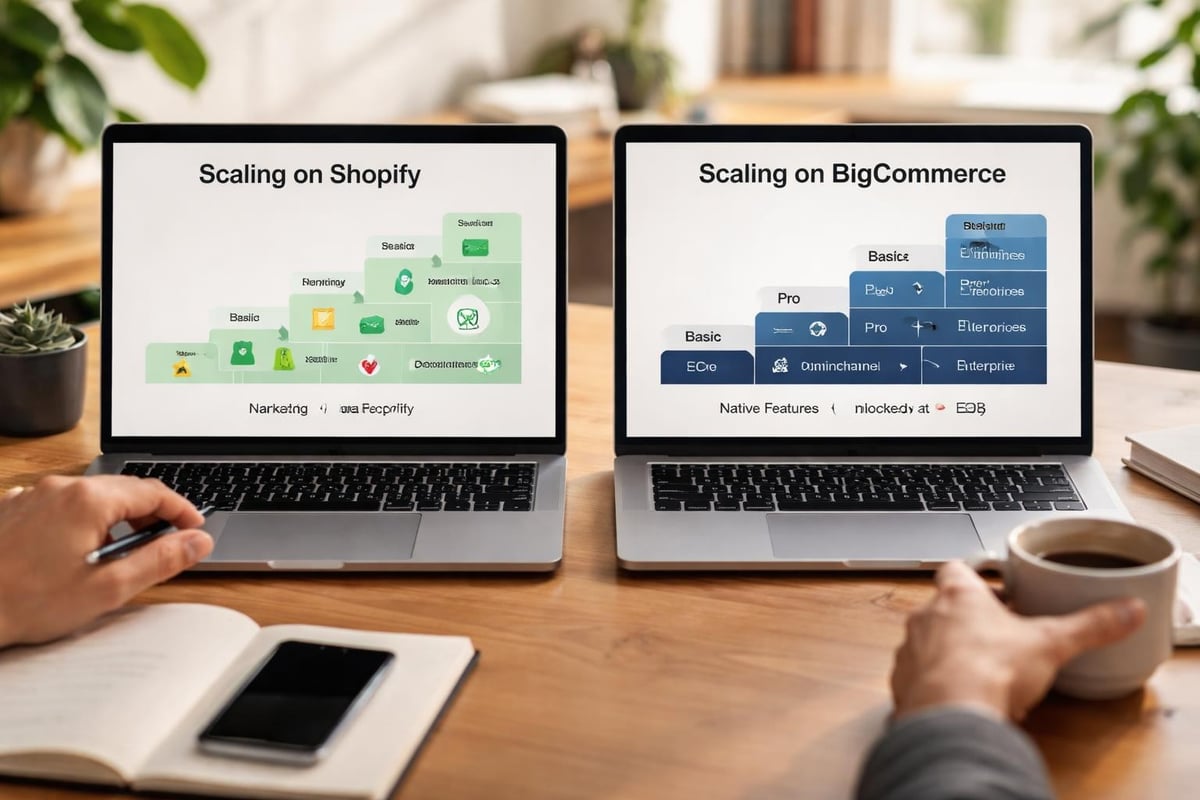
Shopify Plus
Shopify's enterprise solution starts around £1,600 monthly and provides:
- Checkout customisation capabilities
- Dedicated account management
- Exclusive wholesale channel
- Advanced API access and automation
- Priority support and SLA guarantees
Shopify Plus suits rapidly growing brands needing enterprise features with Shopify's familiar interface and ecosystem.
BigCommerce Enterprise
BigCommerce's enterprise tier offers comparable capabilities at generally lower price points, including priority support, dedicated infrastructure, and advanced B2B functionality. The platform particularly excels for businesses with complex catalogue requirements or multi-storefront needs.
Migration Considerations
Switching platforms represents a significant undertaking, whether migrating from WooCommerce, Magento, or between Shopify and BigCommerce themselves.
Migration Complexity
Both platforms offer migration tools and services, though the process requires careful planning to preserve:
- Product data and categorisation
- Customer accounts and order history
- SEO equity through proper redirects
- Design consistency and brand identity
- Third-party integrations and workflows
Shopify migrations benefit from a larger ecosystem of specialist agencies and more standardised processes due to the platform's market dominance.
Data Portability
BigCommerce provides more straightforward data export capabilities, facilitating easier migrations should business needs change. Shopify's data export functionality works effectively but may require apps for comprehensive historical data extraction.
According to TechRadar's review of Shopify alternatives, platform switching costs typically range from £2,000 to £20,000 depending on store complexity, making the initial platform choice consequential.
Support and Resources
Merchant support quality affects operational efficiency and problem resolution speed when evaluating shopify vs bigcommerce platforms.
Support Channels
Shopify offers:
- 24/7 phone, email, and live chat support
- Extensive documentation and video tutorials
- Active community forums
- Shopify Academy for merchant education
- Priority support for Plus merchants
BigCommerce provides:
- 24/7 phone, email, and live chat support
- Comprehensive knowledge base
- Dedicated account management on higher tiers
- Professional services team for custom projects
Both platforms maintain strong support reputations, though Shopify's larger user base creates more third-party resources, tutorials, and community-generated solutions.
Developer and Agency Ecosystems
Shopify's massive partner ecosystem includes thousands of specialist agencies, freelancers, and certified experts. This abundance creates competitive pricing and specialised expertise across various industries and technical requirements.
BigCommerce's smaller but growing partner network includes experienced enterprise developers and agencies specialising in complex implementations. The reduced competition can mean higher costs but potentially deeper platform expertise.
App Ecosystems and Integrations
Third-party integrations extend platform capabilities, making ecosystem maturity an important shopify vs bigcommerce consideration.
App Marketplace Comparison
Shopify's App Store contains over 8,000 applications covering virtually every conceivable eCommerce function. Popular categories include:
- Email marketing and automation
- Advanced product reviews
- Inventory management
- Shipping and fulfilment
- Accounting integration
- Customer service tools
BigCommerce's marketplace offers around 1,000 applications, focusing on enterprise-grade solutions and avoiding redundant functionality that duplicates native features. The curated approach ensures quality but provides fewer niche options.
Integration Quality
Both platforms maintain robust APIs enabling custom integrations with ERP systems, warehouse management platforms, and marketing automation tools. Shopify's Polaris design system helps ensure consistency across third-party apps, whilst BigCommerce's open architecture facilitates deep customisations.
For brands researching the best Shopify apps, the ecosystem breadth provides solutions for every requirement, though app dependency increases ongoing costs and technical complexity.
Making Your Decision
The shopify vs bigcommerce choice ultimately depends on your specific business context, technical capabilities, and growth trajectory.
Choose Shopify When:
- You value ease of use and rapid deployment
- Your business model fits standard retail patterns
- You prefer extensive app availability and flexibility
- You operate or plan physical retail locations
- You want maximum developer and agency choice
Choose BigCommerce When:
- You need advanced features without app subscriptions
- Your catalogue includes complex products with many variants
- Transaction fees significantly impact your margins
- You require sophisticated B2B capabilities
- You prioritise native SEO and performance features
Neither platform represents a universally superior choice. Detailed comparisons confirm both platforms serve different merchant priorities effectively.
Platform-Specific Advantages
Where Shopify Leads
The platform's greatest strength lies in its holistic ecosystem and user experience. The unified admin interface, seamless POS integration, and extensive learning resources create a genuinely accessible eCommerce solution. For businesses prioritising time-to-market and operational simplicity, Shopify removes technical barriers effectively.
The Shopify development community's size means finding qualified help remains straightforward, whether you need minor customisations or complex headless implementations.
Where BigCommerce Excels
BigCommerce's competitive advantage centres on reducing total cost of ownership through comprehensive native functionality. The platform's built-in features, unlimited staff accounts, and absence of transaction fees create compelling economics for growing businesses.
The platform's superior product management capabilities particularly benefit retailers with extensive catalogues or B2B requirements that challenge Shopify's architecture.
Both platforms offer robust foundations for building successful eCommerce businesses, with the shopify vs bigcommerce decision hinging on your specific priorities around cost structure, technical requirements, and feature needs. Shopify generally suits businesses wanting simplicity and ecosystem breadth, whilst BigCommerce appeals to merchants prioritising built-in functionality and lower total ownership costs. If you're considering launching a new store, improving an existing one, or migrating between platforms, Futur Media specialises in helping UK brands build high-performing Shopify stores that drive measurable results through smart design, technical excellence, and conversion-focused development.



.svg)