
.svg)






%201.avif)
The eCommerce landscape has evolved dramatically over the past few years, with brands demanding more flexibility, faster performance, and greater control over customer experiences. Traditional monolithic platforms, where the frontend and backend are tightly coupled, no longer satisfy the ambitions of modern retailers who need to deliver consistent experiences across multiple channels. This is where shopify headless commerce enters the conversation, offering a fundamentally different approach to building online stores that separates the presentation layer from the commerce engine itself.
What Is Shopify Headless Commerce?
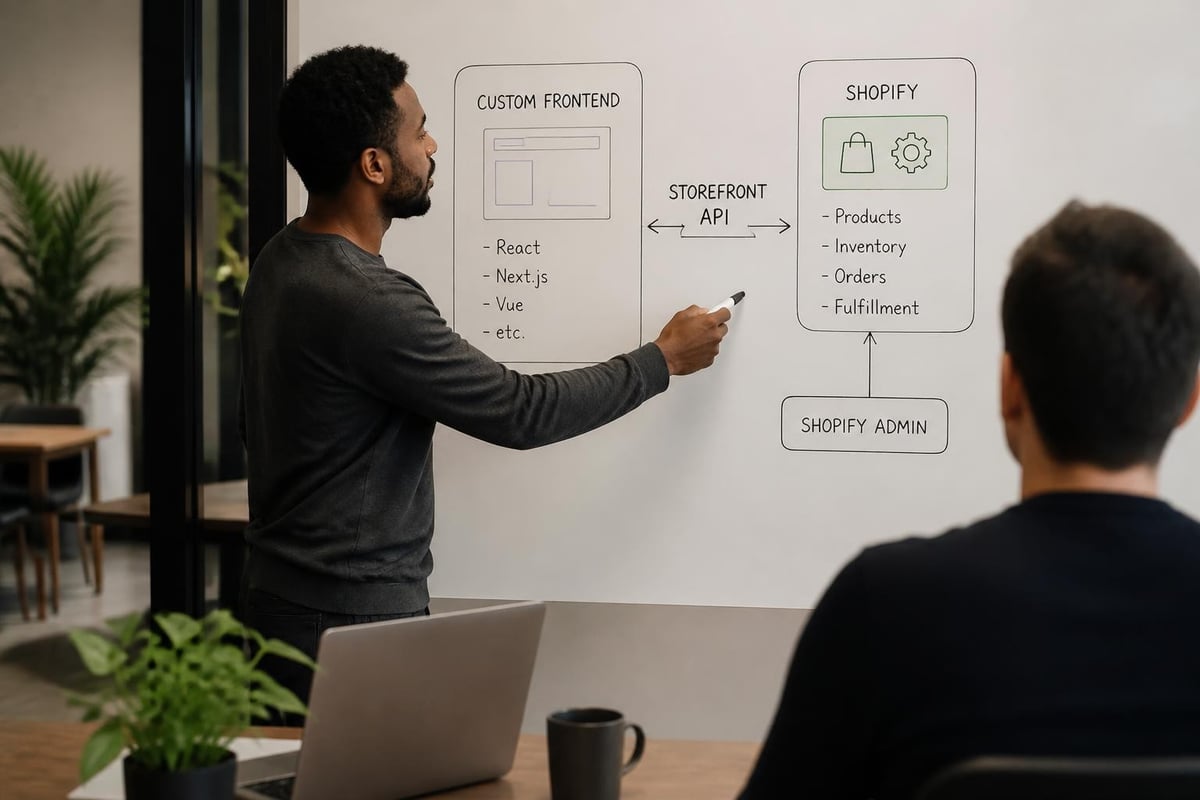
Shopify headless commerce refers to an architectural approach where the frontend presentation layer (the "head") is decoupled from the backend commerce functionality (the "body"). Instead of using Shopify's standard theme templates to display products and process transactions, brands build custom frontends using their preferred technologies whilst leveraging Shopify's robust commerce infrastructure through APIs.
This separation creates remarkable flexibility. Your frontend could be a React application, a Next.js site, a mobile app, or even multiple interfaces serving different customer segments simultaneously.
The Technical Foundation
At its core, headless commerce on Shopify relies on the Storefront API, which provides access to products, collections, customer data, and checkout functionality. Developers query this API to retrieve commerce data and build completely custom user interfaces without the constraints of Liquid templating or theme structures.
Key components include:
- Storefront API: GraphQL-based interface for accessing commerce data
- Custom frontend: Built with frameworks like React, Vue, Next.js, or Hydrogen
- Middleware layer: Optional services handling caching, personalisation, or integrations
- Shopify backend: Managing products, inventory, orders, and fulfilment
The Shopify admin panel remains your control centre for commerce operations. Product management, order processing, inventory tracking, and customer service all function exactly as they would in a traditional Shopify setup. Only the customer-facing experience changes.
Why Brands Choose Headless Architecture
The decision to adopt shopify headless commerce stems from specific business requirements that traditional themes cannot adequately address. Understanding these drivers helps determine whether this approach aligns with your strategic objectives.
Performance and Speed Advantages
Modern JavaScript frameworks enable significantly faster page loads through static site generation, server-side rendering, and intelligent code splitting. Brands reporting 40-60% improvements in Core Web Vitals after transitioning to headless architectures are not uncommon.
Performance benefits include:
- Static page generation: Pre-rendered pages served instantly from CDNs
- Optimised asset delivery: Granular control over image formats, lazy loading, and resource hints
- Reduced JavaScript overhead: Ship only essential code for each page
- Progressive enhancement: Core content loads first, enhanced features follow
These improvements directly impact conversion rates and search rankings, making the technical investment commercially justifiable for high-traffic stores.
Omnichannel Consistency
Retailers operating across web, mobile apps, in-store kiosks, smart devices, and emerging channels benefit enormously from headless architecture. A single commerce backend feeds multiple frontends, ensuring inventory, pricing, and product information remain synchronised across every touchpoint.
Consider a fashion brand that needs:
- A blazingly fast web experience for desktop shoppers
- A native mobile app with offline browsing capabilities
- In-store tablets for endless aisle functionality
- Voice commerce integration for smart speakers
- Social commerce storefronts on Instagram and TikTok
Traditional themes cannot serve these diverse requirements. Shopify headless commerce provides one commerce engine powering all these experiences simultaneously.
| Traditional Shopify | Headless Shopify |
|---|---|
| Single frontend (theme-based) | Multiple custom frontends |
| Limited to Liquid templating | Any frontend framework |
| Theme speed constraints | Optimised performance control |
| Standard UX patterns | Completely bespoke experiences |
| Moderate technical investment | Significant development requirement |
The Hydrogen Framework Revolution
Shopify recognised that building headless storefronts from scratch presented substantial barriers, particularly around checkout, cart management, and commerce-specific components. Their response was Hydrogen, an opinionated framework specifically designed for building custom Shopify storefronts.
What Hydrogen Provides
Hydrogen is built on React and Remix, offering pre-built commerce components that integrate seamlessly with Shopify's Storefront API. Instead of constructing product listings, cart functionality, and checkout flows from first principles, developers can leverage Hydrogen to accelerate build timelines whilst maintaining complete design freedom.
Core features include:
- Ready-made components for products, collections, search, and cart
- Built-in optimisation for images, fonts, and critical resources
- Seamless integration with Oxygen hosting platform
- Server-side rendering for superior performance
- TypeScript support for type-safe development
The framework dramatically reduces the complexity barrier that previously made headless development accessible only to brands with substantial technical resources.
Oxygen Hosting Platform
Complementing Hydrogen is Oxygen, Shopify's global hosting infrastructure specifically optimised for headless storefronts. This platform provides edge-based deployment, automatic scaling, and integrated analytics without requiring separate hosting arrangements or DevOps expertise.
Brands deploying Hydrogen applications to Oxygen benefit from performance optimisation, security updates, and monitoring handled entirely by Shopify, reducing operational overhead whilst maintaining the flexibility advantages of custom development.

When Headless Makes Commercial Sense
Not every Shopify store requires or benefits from headless architecture. The investment in custom development, ongoing maintenance, and technical expertise must deliver proportionate returns. Deciding whether to go headless requires honest assessment of your specific circumstances.
Ideal Candidates for Headless
High-traffic enterprise brands processing thousands of daily transactions with sufficient revenue to justify substantial development investment see the clearest returns. When marginal improvements in conversion rates or average order values translate to six-figure revenue impacts, headless architecture becomes economically compelling.
Multi-channel retailers needing consistent experiences across web, mobile, retail, and emerging platforms find headless essential for maintaining a single source of commerce truth whilst delivering channel-specific interfaces.
Brands with unique UX requirements that standard themes cannot accommodate, such as highly interactive product configurators, subscription-heavy business models, or complex B2B purchasing workflows, often find themselves constrained by traditional architectures.
Content-heavy commerce experiences blending editorial content, interactive tools, and transactional elements benefit from headless approaches that integrate content management systems like Contentful or Sanity with Shopify's commerce capabilities.
When Traditional Themes Suffice
Most growing eCommerce brands operate successfully within Shopify's theme ecosystem. If your store processes under £1 million annually, lacks specific technical requirements that themes cannot address, or has limited development resources, traditional Shopify builds often represent better value.
- Limited technical resources: Headless requires ongoing developer involvement
- Straightforward product catalogues: Standard commerce patterns work perfectly
- Rapid launch timelines: Themes deploy in weeks, headless in months
- Budget constraints: Development costs significantly exceed theme customisation
- Infrequent updates: Headless maintenance requires continuous technical attention
Working with experienced partners like those offering Shopify development services helps assess whether your specific requirements justify the headless investment or whether optimised theme development delivers better returns.
Implementation Considerations and Challenges
Transitioning to shopify headless commerce introduces complexities that extend beyond initial build costs. Successful implementations require careful planning across technical, operational, and commercial dimensions.
Development Investment and Timelines
Building a custom headless storefront typically requires 3-6 months minimum for a basic implementation, extending to 12+ months for complex, multi-channel experiences. Development costs frequently range from £30,000 to £150,000+ depending on scope, functionality, and design complexity.
Budget considerations include:
- Initial frontend build and design
- Backend integrations and middleware
- Testing across devices and browsers
- Content migration and restructuring
- Training for marketing and merchandising teams
- Ongoing maintenance and feature development
These figures dwarf theme-based builds, making headless viable primarily for brands with substantial revenue or specific requirements justifying the investment.
Checkout and App Compatibility
Until recently, headless implementations faced significant limitations around checkout customisation and third-party app compatibility. Shopify's expanded Storefront API capabilities and headless commerce solutions now address many of these constraints, though gaps remain.
Certain Shopify apps designed exclusively for theme integration may not function in headless environments. Review your current app stack carefully, identifying which functionalities require API-based alternatives or custom development to replicate in your headless architecture.
Maintenance and Evolution
Traditional themes receive automatic updates addressing security patches, performance improvements, and new Shopify features. Headless storefronts require active maintenance to incorporate these enhancements, update dependencies, and address emerging security vulnerabilities.
Budget for ongoing development capacity, whether through in-house teams or agency partnerships. Brands without technical resources risk their headless storefronts becoming outdated, vulnerable, or incompatible with new Shopify capabilities.
| Consideration | Impact | Mitigation Strategy |
|---|---|---|
| Development costs | High initial investment | Phased rollout, MVP approach |
| Timeline | 3-6+ months minimum | Start with single channel |
| Ongoing maintenance | Continuous technical requirement | Retained development partner |
| App compatibility | Some apps won't work | API-first tool selection |
| Team skills | Requires technical expertise | Training or specialist hiring |
Technical Approaches and Architecture Patterns
Several distinct approaches exist for implementing shopify headless commerce, each offering different balances between flexibility, complexity, and time-to-market. Understanding these patterns helps align technical decisions with business objectives.
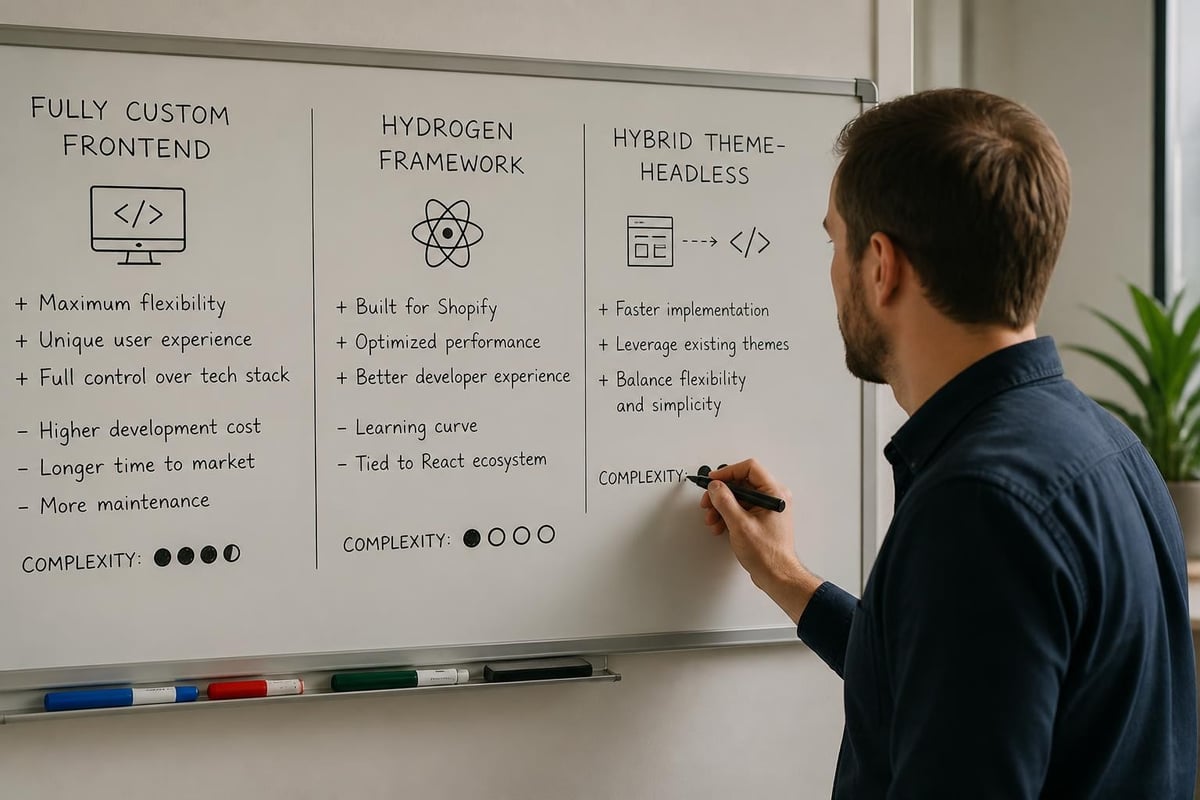
Fully Custom Frontend
Building entirely bespoke frontends using frameworks like Next.js, Nuxt, or Gatsby provides maximum flexibility but demands substantial development investment. This approach suits brands with highly specific design requirements, complex user journeys, or integration needs that frameworks like Hydrogen cannot easily accommodate.
Development teams select their preferred stack, structure, and architecture, interfacing with Shopify purely through the Storefront API. This independence enables sophisticated features but requires deep technical expertise and increases ongoing maintenance complexity.
Hydrogen-Based Development
Adopting Shopify's Hydrogen framework significantly accelerates development whilst maintaining considerable flexibility. Pre-built components handle common commerce patterns, allowing developers to focus on unique brand requirements rather than reinventing fundamental functionality.
Advantages of Hydrogen include:
- Faster development compared to fully custom builds
- Official Shopify support and documentation
- Regular updates aligned with platform evolution
- Integrated hosting through Oxygen platform
- Commerce-optimised performance patterns
Brands seeking headless benefits without extreme technical complexity often find Hydrogen provides an optimal balance.
Hybrid Approaches
Some implementations adopt hybrid models, using traditional Shopify themes for certain sections whilst implementing headless architecture for specific high-value areas. For instance, maintaining theme-based checkout for app compatibility whilst building custom headless product discovery and content experiences.
These approaches reduce complexity and cost compared to full headless whilst addressing specific limitations of traditional themes. However, they introduce architectural complexity requiring careful planning around data synchronisation and user experience continuity.
SEO and Marketing Implications
Moving to shopify headless commerce significantly impacts search visibility, content management, and marketing technology integration. These considerations often receive insufficient attention during planning but critically affect long-term commercial performance.
Search Engine Optimisation
Server-side rendering and static site generation available through modern JavaScript frameworks can dramatically improve SEO compared to client-rendered applications. However, implementation quality matters enormously. Poorly executed headless builds can actually harm search visibility through indexing issues, slow page loads, or broken structured data.
Critical SEO requirements include:
- Server-side rendering or static generation: Ensure crawlers receive fully rendered HTML
- Structured data implementation: Product schema, breadcrumbs, and organisation markup
- XML sitemap generation: Automated, comprehensive, regularly updated
- Canonical URL management: Prevent duplicate content across channels
- Page speed optimisation: Leverage headless performance advantages fully
Partnering with specialists in both headless development and Shopify SEO ensures technical architecture supports rather than hinders organic visibility.
Content Management Integration
Traditional Shopify's content capabilities suit basic blogging but often feel limiting for brands pursuing content-driven commerce strategies. Headless architecture enables integration with sophisticated content management systems like Contentful, Sanity, or Prismic, providing marketing teams with powerful editorial tools.
This separation allows content teams to work independently from commerce operations, publishing rich media experiences, interactive guides, and editorial content that seamlessly incorporates transactional elements without developer involvement for every update.
Marketing Technology Stack
Headless implementations require careful consideration of analytics, personalisation, A/B testing, and marketing automation tools. Client-side tracking implementations may need restructuring to accommodate server-rendered pages, whilst personalisation engines require different integration approaches compared to theme-based setups.
Review your marketing technology requirements early in planning, ensuring chosen tools support headless environments or identifying API-based alternatives that provide necessary functionality.
Real-World Performance and ROI
Quantifying the return on investment from shopify headless commerce requires measuring improvements across multiple dimensions: site speed, conversion rates, average order values, and operational efficiency. Research into headless commerce adoption reveals diverse outcomes depending on implementation quality and strategic alignment.
Measurable Performance Improvements
Leading implementations report substantial gains in Core Web Vitals, with Largest Contentful Paint improvements of 40-60% and Time to Interactive reductions of similar magnitudes. These technical improvements correlate with conversion rate increases averaging 15-30% for well-executed headless builds serving high-traffic audiences.
Typical improvement ranges include:
- Page load speed: 35-55% faster
- Conversion rate: 10-25% increase
- Mobile performance: 45-65% Core Web Vitals improvement
- Development velocity: 20-40% faster feature deployment (after initial build)
However, these benefits accrue primarily to sites processing significant transaction volumes. Lower-traffic stores may see similar percentage improvements but insufficient absolute revenue impact to justify development costs.
Total Cost of Ownership
Beyond initial build expenses, headless architecture affects ongoing operational costs. Development resources for updates, new features, and maintenance typically increase 40-60% compared to theme-based approaches. However, brands operating multiple channels often find consolidated development actually reduces overall technology spending compared to maintaining separate platforms.
Factor these ongoing costs into ROI calculations, ensuring projected revenue improvements sufficiently exceed increased technical investment over realistic timeframes.
Migration Strategy and Planning
Transitioning existing Shopify stores to headless architecture demands methodical planning to minimise disruption, protect SEO equity, and ensure business continuity throughout the process. Successful migrations balance ambition with pragmatic risk management.
Phased Rollout Approaches
Rather than attempting comprehensive relaunches, many brands adopt phased strategies that gradually transition from traditional themes to headless architecture. This might involve:
Phase 1: Build headless product listing and detail pages whilst maintaining theme-based checkout and account areas.
Phase 2: Transition cart and checkout to custom implementation after validating performance and conversion on catalogue pages.
Phase 3: Migrate account management, content pages, and secondary experiences to complete the headless transformation.
This approach reduces risk, enables validation of each stage before proceeding, and allows teams to develop expertise progressively rather than facing overwhelming complexity immediately.
SEO Protection Strategies
Protecting search visibility during headless migration requires meticulous attention to URL structures, redirect mapping, and content preservation. Every existing URL should either maintain identical paths in the new architecture or implement proper 301 redirects to equivalent pages.
Essential migration safeguards:
- Comprehensive URL inventory and redirect mapping
- Structured data preservation across all page types
- XML sitemap continuity and submission
- Search Console monitoring for indexing issues
- Performance monitoring for Core Web Vitals regression
- Staged rollout with traffic comparison between old and new
Working with partners experienced in both technical implementation and search optimisation helps navigate these complexities whilst maintaining organic traffic throughout the transition.
Testing and Validation
Headless implementations introduce complexity requiring rigorous testing across devices, browsers, and user journeys. Automated testing frameworks should validate commerce functionality, whilst manual quality assurance confirms user experience quality across diverse scenarios.
Testing priorities include:
- Cart and checkout functionality across payment methods
- Mobile and tablet experience quality
- Browser compatibility (including older versions)
- Performance under load conditions
- Accessibility compliance (WCAG 2.1 AA minimum)
- Integration testing for third-party services
Budget adequate time for comprehensive testing before launch, as identifying issues post-deployment significantly increases remediation complexity and potential revenue impact.
Future-Proofing Your Commerce Architecture
The eCommerce technology landscape continues evolving rapidly, with emerging channels, changing consumer expectations, and new technical capabilities reshaping what's possible. Shopify headless commerce positions brands to adapt more readily to these ongoing changes compared to monolithic architectures.
Emerging Channel Opportunities
Voice commerce, augmented reality shopping, live commerce, and social storefronts represent emerging opportunities that headless architecture accommodates naturally. Rather than constraining commerce experiences to web browsers, headless approaches enable brands to meet customers wherever they choose to engage.
Building with APIs and modular architecture ensures adding new channels requires frontend development only, leveraging existing commerce infrastructure without platform migrations or substantial backend modifications.
Composable Commerce Evolution
Headless architecture represents one component of broader "composable commerce" trends, where brands assemble best-of-breed services through APIs rather than relying on all-in-one platforms. This approach enables specialisation, with dedicated services for search, personalisation, product recommendations, and customer service integrated through middleware layers.
Shopify's expanding API capabilities and partner ecosystem increasingly support these composable approaches, positioning headless implementations to benefit from continued platform evolution whilst maintaining flexibility to adopt superior alternatives as they emerge.
Balancing Flexibility and Complexity
The ultimate goal isn't headless architecture for its own sake but rather commerce systems that effectively serve your business objectives whilst remaining adaptable to changing requirements. For some brands, this means fully headless implementations. For others, optimised traditional themes or hybrid approaches deliver better value.
Regularly reassess your architecture against evolving business needs, competitive pressures, and available technologies. What makes sense in 2026 may require revision as your brand scales, enters new markets, or pursues different customer segments.
Shopify headless commerce offers transformative potential for brands with specific requirements around performance, omnichannel experiences, or unique user journeys that traditional themes cannot adequately address. However, the substantial investment in development, ongoing maintenance, and technical expertise means this approach suits enterprise-scale operations rather than typical growing eCommerce stores. Whether you're exploring headless possibilities or seeking to optimise your existing Shopify presence, Futur Media brings deep technical expertise and commercial focus to help ambitious UK brands make informed decisions and execute effectively across the full spectrum of Shopify capabilities.



.svg)