
.svg)






%201.avif)
Choosing the right ecommerce website agency can transform your online retail business from an underperforming digital storefront into a revenue-generating machine. With UK ecommerce sales continuing to grow year-on-year, ambitious brands need more than just a templated shop-they need strategic partners who understand conversion psychology, technical performance, and the nuances of platforms like Shopify. Whether you're launching a new store, migrating from an outdated system, or scaling an established brand, working with specialists who live and breathe ecommerce delivers measurably better results than DIY approaches or generalist developers.
What Makes an Ecommerce Website Agency Different
Not all web development firms understand retail. An ecommerce website agency specialises exclusively in building and optimising online stores, bringing depth of knowledge that generalist agencies simply cannot match.
Platform Expertise and Strategic Recommendations
The best agencies don't just build what you ask for-they guide you toward the right foundation. They evaluate your product catalogue, business model, growth plans, and technical requirements before recommending a platform. For most UK brands, Shopify offers the ideal balance of power, ease of use, and scalability, but experienced agencies assess each project individually.
When selecting an ecommerce platform, factors like integrated payment processing, inventory management, marketing tools, and mobile responsiveness all matter. Specialist agencies bring real-world experience from dozens or hundreds of previous builds, understanding which features genuinely drive conversions versus which sound impressive but deliver little ROI.
Key differentiators of specialist ecommerce agencies include:
- Deep understanding of checkout optimisation and cart abandonment psychology
- Experience with product data migrations and catalogue structuring
- Knowledge of ecommerce-specific SEO requirements and technical optimisations
- Familiarity with payment gateway integrations, shipping calculators, and tax compliance
- Proven conversion rate optimisation methodologies based on retail-specific data

Technical Development Beyond Templates
Template-based stores look generic because they are. A professional ecommerce website agency builds custom functionality that matches your specific business requirements rather than forcing you into pre-built limitations.
This might include bespoke product configurators for customisable items, subscription management systems, wholesale portals for B2B customers, or advanced filtering for large catalogues. Custom development also ensures your store performs exceptionally-fast loading speeds, smooth animations, and flawless mobile experiences that keep visitors engaged rather than bouncing to competitors.
Development ApproachTime to LaunchCustomisationPerformanceLong-term ScalabilityDIY Template2-4 weeksVery LimitedVariablePoorTheme Customisation4-8 weeksModerateGoodModerateCustom Build8-16 weeksUnlimitedExcellentExcellent
Core Services Offered by Leading Agencies
The scope of what an ecommerce website agency provides extends far beyond simply launching a store. Comprehensive support covers every stage of your digital retail journey.
Discovery and Strategy Development
Before writing a single line of code, professional agencies invest time understanding your business. This discovery phase examines your target audience, competitive landscape, unique value propositions, and revenue goals. Strategic planning identifies growth opportunities, potential technical challenges, and the roadmap for launching and scaling your store.
Understanding best practices for ecommerce means agencies can benchmark your requirements against proven approaches across thousands of successful stores. This research phase prevents costly mistakes and ensures your budget focuses on features that genuinely impact commercial performance.
- Competitive analysis reviewing direct competitors' strengths and weaknesses
- User persona development defining your ideal customer profiles
- Customer journey mapping identifying every touchpoint from discovery to purchase
- Technical requirements specification documenting all functionality needed
- Project timeline creation establishing realistic milestones and launch dates
Design That Converts
Beautiful design attracts visitors; smart design converts them into customers. Agencies approach ecommerce website design with conversion psychology at the forefront, creating user experiences that guide shoppers effortlessly toward purchase decisions.
This involves strategic placement of calls-to-action, trust signals like reviews and security badges, product photography guidelines, and mobile-first layouts that work flawlessly on every device. Visual hierarchy ensures customers find what they need quickly, whilst persuasive copywriting and social proof overcome purchase hesitation.
Essential design elements that drive conversions:
- Clear, prominent add-to-cart buttons with contrasting colours
- High-quality product imagery with zoom and multiple angle views
- Streamlined navigation with intuitive category structures
- Prominent search functionality with autocomplete suggestions
- Customer reviews and ratings displayed strategically
- Trust badges and security assurances near checkout
- Sticky navigation or floating cart for easy access
Platform Development and Integration
Building robust ecommerce infrastructure requires technical expertise that goes deeper than surface-level customisation. Professional agencies handle complex integrations with inventory management systems, accounting software, email marketing platforms, and customer relationship management tools.
They ensure your store connects seamlessly with the wider technology stack your business depends on. This might include warehouse management systems, dropshipping suppliers, or enterprise resource planning platforms. Getting these integrations right from launch prevents headaches and manual workarounds later.

Migration Services and Platform Switches
Many businesses already have online stores but struggle with outdated platforms or systems that can't scale. An experienced ecommerce website agency manages complex migrations that preserve your search rankings, customer data, and sales momentum throughout the transition.
Data Migration and SEO Preservation
Moving to Shopify or another modern platform involves transferring thousands of products, customer records, order histories, and content pages. Agencies use specialised tools and methodologies to migrate data accurately whilst maintaining the relationships between products, variants, collections, and metadata. Understanding the migration process helps businesses prepare properly and minimise disruption.
Critical migration considerations include:
- Product data: SKUs, descriptions, images, variants, pricing, and inventory levels
- Customer information: Account details, addresses, order history, and saved preferences
- SEO elements: URL structures, redirects, meta data, and search rankings
- Content assets: Blog posts, landing pages, images, and downloadable resources
- Historical data: Past orders, analytics, and customer behaviour patterns
Preserving SEO value during migration requires meticulous redirect mapping, ensuring every old URL points to the correct new location. Agencies audit your existing site structure, identify high-value pages, and implement 301 redirects that maintain search engine authority and prevent broken links that frustrate customers and damage rankings.
Testing and Quality Assurance
Before launching a migrated or newly built store, thorough testing catches issues that could cost sales. Comprehensive quality assurance processes check every function across multiple devices, browsers, and scenarios.
This includes transaction testing with real payment gateways (in test mode), inventory synchronisation verification, shipping calculation accuracy, tax compliance, and user journey testing from discovery through checkout and order confirmation. Professional agencies maintain detailed testing checklists covering hundreds of potential issues.
Testing CategoryKey CheckpointsCommon Issues PreventedFunctionalityCart, checkout, accountsAbandoned transactionsPerformancePage speed, image optimisationHigh bounce ratesMobileTouch targets, responsive layoutMobile conversion lossBrowser CompatibilityChrome, Safari, Firefox, EdgeDisplay and function errorsPayment ProcessingGateway integration, securityFailed transactions
Ongoing Optimisation and Growth Support
Launching your store marks the beginning, not the end, of your relationship with a quality ecommerce website agency. Continuous improvement through data-driven optimisation generates significantly better returns than one-off projects.
Conversion Rate Optimisation Programs
Even small improvements to conversion rates compound dramatically over time. An agency focused on performance uses analytics, heatmaps, session recordings, and A/B testing to identify friction points in your customer journey and systematically improve them.
For brands wanting to maximise revenue from existing traffic, conversion rate optimisation delivers faster ROI than increasing advertising spend. By testing variations of product pages, checkout flows, navigation structures, and promotional messaging, agencies identify what actually works for your specific audience rather than relying on generic best practices.
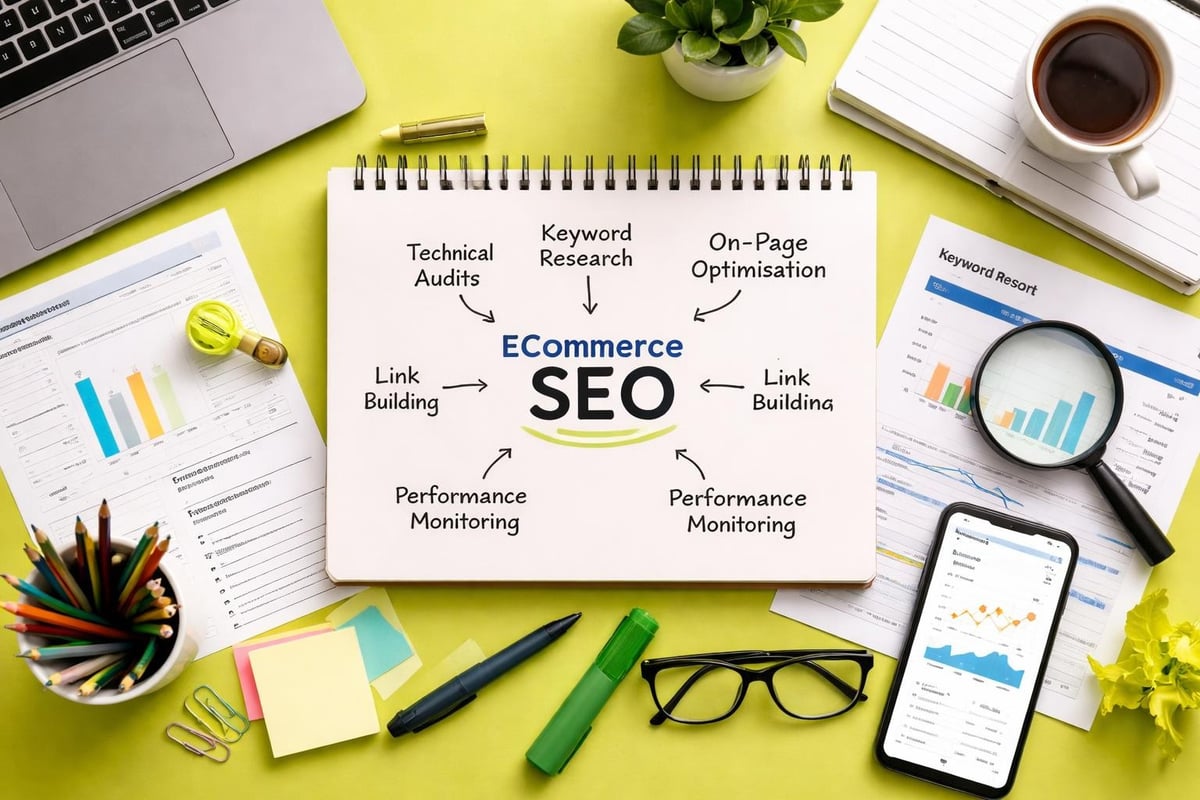
Search Engine Optimisation for Ecommerce
Getting found in Google requires more than occasionally adding keywords. Ecommerce SEO involves technical optimisation, content strategy, link building, and ongoing refinement based on search algorithm updates and competitive changes.
Professional agencies understand the unique challenges of ecommerce SEO-managing duplicate content across product variants, optimising category pages for competitive keywords, building authority through content marketing, and maintaining fast site speeds as catalogues grow. This specialised knowledge separates agencies who understand retail from those who simply know general SEO principles.
Choosing the Right Agency Partner
Not all ecommerce website agencies deliver equal results. Selecting the right partner requires evaluating their expertise, approach, and alignment with your business goals.
Portfolio and Case Study Analysis
Examine previous work closely. Look beyond attractive designs to understand business results-did they improve conversion rates, increase average order values, or reduce cart abandonment? Case studies should demonstrate measurable commercial impact rather than just aesthetic achievements.
Reviewing work from leading ecommerce development companies provides benchmarks for what excellent work looks like. Pay attention to stores in similar industries or with comparable complexity to your own requirements.
Technical Capabilities and Certifications
Platform partnerships and certifications indicate genuine expertise. Shopify Partner agencies, for example, have direct access to Shopify's support teams, beta features, and training resources. This insider access translates into better solutions and faster problem resolution for clients.
Beyond official partnerships, assess whether the agency stays current with ecommerce technology trends, understands headless commerce architectures, works with modern development frameworks, and follows web performance best practices established by organisations like Google.
Questions to ask potential agency partners:
- How many ecommerce stores have you launched in the past 12 months?
- What's your typical client retention rate and project timeline?
- Which platforms do you specialise in and why?
- How do you approach conversion optimisation and performance testing?
- What ongoing support and maintenance packages do you offer?
- Can you provide references from clients in similar industries?
Process, Communication, and Collaboration
The best technical skills mean little if an agency can't communicate clearly or work collaboratively. Understand their project management methodology, communication frequency, reporting structures, and how they handle changes or challenges during builds.
When choosing a website builder or development partner, workflow compatibility matters as much as technical capability. Agencies should provide transparent timelines, regular progress updates, and clear documentation that empowers your team to manage the store confidently after launch.
Investment Considerations and ROI
Ecommerce website agency costs vary significantly based on project scope, platform choice, customisation requirements, and the agency's expertise level. Understanding what drives pricing helps set realistic budgets and expectations.
Project Cost Factors
Simple Shopify stores using premium themes with light customisation might cost £5,000-£15,000, whilst fully custom builds with advanced functionality, integrations, and bespoke design easily reach £30,000-£100,000+. The investment level should align with your revenue goals and competitive positioning.
Primary cost drivers include:
- Platform selection: Shopify, BigCommerce, WooCommerce each have different licensing and development costs
- Design complexity: Custom versus template-based, number of page types, animation requirements
- Functionality requirements: Product configurators, subscriptions, wholesaler portals, advanced search
- Integration needs: ERP, CRM, inventory management, accounting systems
- Content migration: Size of existing catalogue, data cleaning requirements
- Ongoing services: SEO, CRO, support retainers, marketing services
Calculating Return on Investment
Smart businesses evaluate agency costs against potential revenue increases rather than viewing them as pure expenses. A store generating £500,000 annually that improves conversion rate from 1.5% to 2.5% through professional optimisation generates £333,000 additional revenue-making even significant agency investment profitable within months.
Annual RevenueConversion IncreaseAdditional RevenueAgency InvestmentPayback Period£200,0000.5%£66,667£15,0002.7 months£500,0001.0%£333,333£30,0001.1 months£1,000,0000.75%£500,000£50,0001.2 months
Platform Selection Guidance
Whilst multiple ecommerce platforms exist, choosing the right foundation impacts everything from development costs to long-term scalability. An experienced ecommerce website agency guides this critical decision based on your specific requirements.
Why Shopify Dominates UK Ecommerce
Shopify powers over 4 million stores globally and continues gaining market share amongst UK retailers for compelling reasons. The platform balances ease of use with powerful functionality, offers exceptional performance and security, provides extensive app integrations, and scales seamlessly from startup to enterprise.
For agencies and clients alike, Shopify's structured approach and excellent documentation enable faster development cycles and lower maintenance overhead compared to open-source alternatives. The platform handles PCI compliance, security updates, and infrastructure management, allowing businesses to focus on selling rather than server administration.
When Alternative Platforms Make Sense
Certain business models suit different platforms better. B2B wholesalers with complex pricing tiers might benefit from BigCommerce's built-in features. Businesses already invested in WordPress infrastructure sometimes prefer WooCommerce despite its higher maintenance requirements. Enterprise brands with unique requirements might need fully custom solutions.
Evaluating ecommerce tools and platforms helps identify which technology best matches your operational needs, technical resources, and growth trajectory. Honest agencies recommend platforms based on your situation rather than their preferred technology stack.
Technical Excellence and Performance
Site speed, mobile responsiveness, and technical SEO aren't optional extras-they directly impact revenue. Every second of load time costs conversions, whilst mobile now accounts for over 70% of ecommerce traffic in the UK.
Performance Optimisation Strategies
Professional agencies implement comprehensive performance optimisation covering image compression, lazy loading, code minification, content delivery networks, and caching strategies. They understand that fast sites rank better in search results, convert more visitors, and provide superior user experiences that build brand loyalty.
Modern web performance requirements demand technical expertise that extends beyond basic development. Core Web Vitals-Google's performance metrics-directly influence search rankings, making speed optimisation a commercial necessity rather than technical nicety.
Security and Compliance
Handling customer payment information requires robust security measures and compliance with data protection regulations. Ecommerce website agencies ensure SSL certificates, secure payment gateways, GDPR compliance, and regular security updates protect both your business and your customers.
Professional builds include security best practices like two-factor authentication, regular backups, fraud detection systems, and secure hosting environments. These protections prevent costly breaches whilst building customer trust that translates into higher conversion rates.
The Agency Selection Process
Finding the right ecommerce website agency partner involves structured evaluation rather than simply choosing the lowest quote or most impressive portfolio.
Request for Proposal Development
Create detailed briefs outlining your business objectives, technical requirements, budget parameters, and timeline expectations. Comprehensive RFPs enable agencies to provide accurate proposals whilst demonstrating whether they truly understand your needs.
Include information about your target audience, competitive positioning, existing technology stack, growth plans, and specific functionality requirements. The more context you provide, the better agencies can tailor their approach and pricing.
- Business overview: Company background, products, target market, unique selling points
- Project objectives: Specific goals like increasing conversion, expanding internationally, or improving mobile experience
- Technical requirements: Platform preferences, essential features, integration needs
- Design expectations: Brand guidelines, reference sites, aesthetic preferences
- Timeline constraints: Launch deadlines, seasonal considerations, campaign dependencies
- Budget parameters: Realistic ranges enabling appropriate proposals
Evaluation Criteria and Decision Making
Score proposals against weighted criteria reflecting what matters most to your business. Technical capability, relevant experience, cultural fit, communication quality, and commercial terms all deserve consideration beyond just price.
Schedule detailed discussions with shortlisted agencies, asking probing questions about their approach, potential challenges, and how they handle common ecommerce obstacles. Reference checks with previous clients provide invaluable insights into working relationships and delivered results.
Red flags to watch for include:
- Vague timelines or reluctance to commit to milestones
- Generic proposals lacking specific strategy for your situation
- Promises of unrealistic results or guaranteed rankings
- Inability to explain technical decisions in understandable terms
- Poor communication or delayed responses during sales process
- No clear process for handling changes or issues
- Reluctance to provide references or case studies
Building a successful ecommerce store requires specialist expertise that combines technical development, conversion psychology, and ongoing optimisation. Partnering with professionals who understand retail delivers measurably better results than DIY approaches or generalist developers. If you're ready to launch, migrate, or optimise your online store with a team that lives and breathes Shopify, Futur Media brings Cardiff-based expertise to ambitious UK brands seeking high-performing ecommerce that drives real commercial growth.



.svg)