
.svg)





%201.avif)
Choosing the right eCommerce platform shapes every aspect of your online business, from how quickly you can launch to how effectively you can scale. The shopify vs woocommerce debate remains one of the most relevant decisions for UK brands in 2026, with each platform offering distinct advantages depending on your technical expertise, budget, and growth ambitions. Shopify delivers an all-in-one hosted solution with built-in reliability and support, whilst WooCommerce provides open-source flexibility through WordPress at the cost of increased technical responsibility. Understanding these fundamental differences helps you select the platform that aligns with your business model, resources, and long-term strategy.
Platform Architecture and Hosting
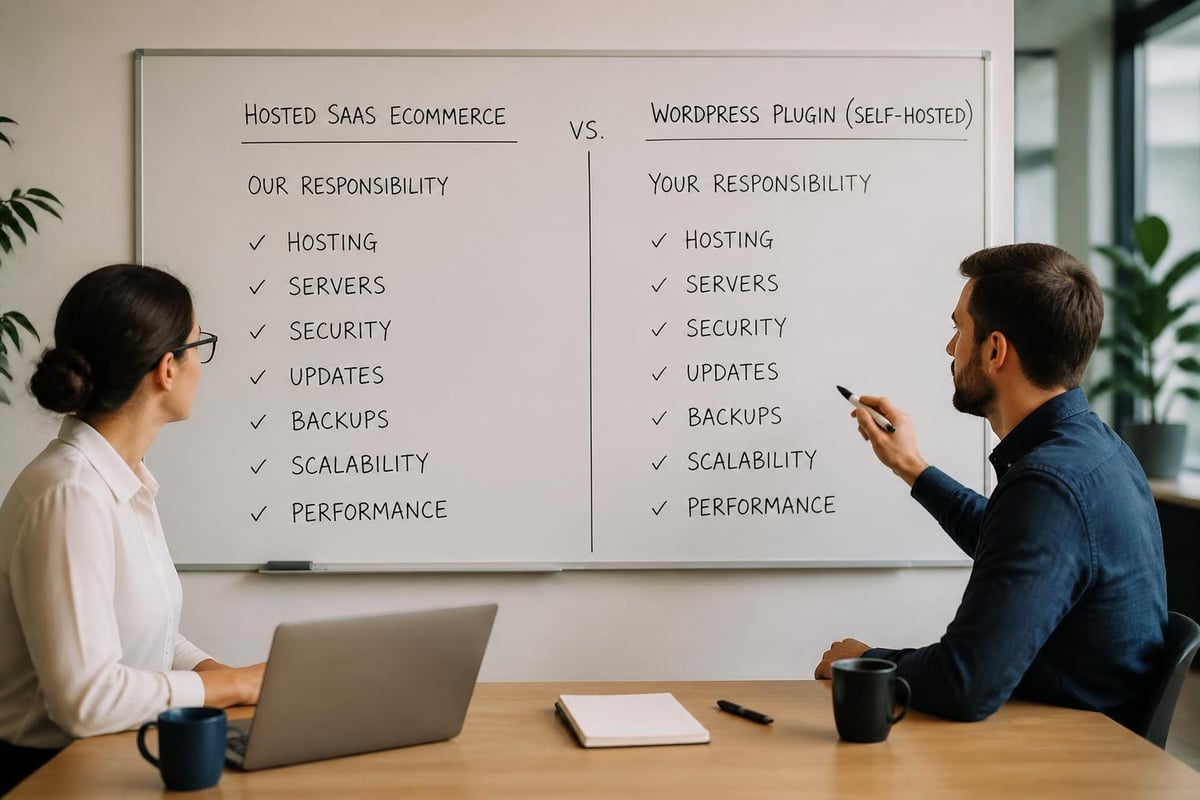
Shopify operates as a fully hosted Software-as-a-Service (SaaS) platform, meaning the infrastructure, security, and technical maintenance are handled entirely by Shopify's team. You pay a monthly subscription fee that includes hosting, SSL certificates, platform updates, and core security features.
WooCommerce takes a fundamentally different approach as a free WordPress plugin that transforms your WordPress site into an eCommerce store. You maintain complete control over your hosting environment, but you're also responsible for selecting a hosting provider, managing server resources, implementing security measures, and handling all technical updates.
Key hosting considerations:
- Shopify provides predictable performance with enterprise-level infrastructure
- WooCommerce performance depends entirely on your hosting provider choice
- Shopify includes automatic backups and security patches
- WooCommerce requires manual security monitoring and backup solutions
- Shopify scales automatically during traffic spikes
- WooCommerce scaling requires hosting upgrades and optimisation
This architectural difference impacts everything from your monthly costs to your technical requirements. This comprehensive platform comparison explores how these fundamental structures affect day-to-day operations for store owners.
Setup Complexity and Time to Launch
Getting Started with Shopify
Shopify's onboarding process guides you through store creation with pre-built templates and intuitive setup wizards. Most merchants can launch a functional store within days, selecting from professional themes and configuring payment processing through Shopify's streamlined interface.
The platform handles technical configuration automatically, from SSL implementation to CDN distribution. You focus on product uploads, branding customisation, and marketing strategy rather than server configuration or plugin compatibility.
WooCommerce Installation Requirements
WooCommerce requires several preliminary steps before you can begin building your store:
- Purchase hosting from a WordPress-compatible provider
- Install WordPress on your domain
- Configure basic WordPress settings and security
- Install and activate the WooCommerce plugin
- Select and install a compatible WordPress theme
- Configure payment gateways through additional plugins
- Implement security measures and backup solutions
This process demands more technical knowledge but provides granular control over every aspect of your store's foundation. If you're considering making the switch, understanding the WooCommerce to Shopify migration process can help you evaluate the transition.
| Factor | Shopify | WooCommerce |
|---|---|---|
| Setup Time | 1-3 days | 1-2 weeks |
| Technical Skills Required | Minimal | Moderate to Advanced |
| Initial Configuration | Guided wizards | Manual setup |
| SSL Certificate | Included automatically | Requires separate purchase/setup |
| Payment Processing | Built-in Shopify Payments | Requires gateway plugins |
Design Flexibility and Customisation
Shopify offers over 100 professionally designed themes through its Theme Store, with options ranging from free to £180+ for premium designs. These themes are optimised for mobile commerce and built with conversion-focused features. Customisation happens through Shopify's visual editor or by editing Liquid, Shopify's templating language.
The platform's section-based approach allows merchants to rearrange page layouts without touching code, making it accessible for non-technical users whilst still offering developers the flexibility to build bespoke solutions through Shopify Development services.
WooCommerce Theme Ecosystem
WooCommerce integrates with thousands of WordPress themes, providing virtually unlimited design possibilities. You can select from free themes in the WordPress repository or purchase premium themes from marketplaces like ThemeForest or Elegant Themes.
Design considerations:
- WooCommerce themes vary significantly in quality and eCommerce optimisation
- Theme compatibility with WooCommerce updates requires ongoing verification
- Customisation typically requires PHP, CSS, and WordPress knowledge
- Page builders like Elementor or Divi add visual editing capabilities
- Complete design freedom comes with increased maintenance responsibility
The shopify vs woocommerce design debate ultimately centres on whether you value curated, commerce-focused options or unlimited flexibility with associated technical overhead.
Cost Structure and Total Ownership
Shopify Pricing Breakdown
Shopify's transparent pricing includes several plans:
- Basic Shopify: £25/month with essential features
- Shopify: £65/month with professional reports and lower transaction fees
- Advanced Shopify: £384/month with advanced reporting and lowest transaction fees
- Shopify Plus: Custom pricing from £2,000/month for enterprise brands
Additional costs include:
- Theme purchases (free to £180+)
- Apps and extensions (many offer free tiers, premium range from £5-£500+/month)
- Transaction fees if not using Shopify Payments (0.5-2% depending on plan)
WooCommerce True Costs
Whilst WooCommerce itself is free, running a professional store incurs several expenses:
- Hosting: £5-£200+/month depending on traffic and performance requirements
- Domain: £10-£15/year
- SSL Certificate: £0-£100/year (often included with hosting)
- Premium Theme: £30-£100 one-time or annual licensing
- Essential Plugins: £50-£500+/year for payment gateways, security, backups, and functionality
- Development: Ongoing costs for customisation and troubleshooting
This detailed cost analysis demonstrates how WooCommerce's total cost of ownership often exceeds initial expectations once you factor in all necessary components for a professional store.

Performance and Technical Optimisation
Shopify manages performance optimisation at the platform level, delivering fast load times through global CDN distribution, automatic image optimisation, and enterprise-grade infrastructure. The platform maintains consistent performance regardless of traffic spikes, with built-in redundancy and failover systems.
WooCommerce performance depends entirely on:
- Your hosting provider's infrastructure quality
- Server resource allocation and configuration
- Caching implementation and optimisation
- Image optimisation plugins and settings
- Database optimisation and maintenance
- Number and quality of installed plugins
A well-optimised WooCommerce store can match or exceed Shopify performance, but achieving this requires technical expertise in WordPress optimisation, caching strategies, and ongoing monitoring. Poor hosting or plugin conflicts can significantly degrade site speed, directly impacting conversion rates.
For brands prioritising performance without technical complexity, Shopify delivers predictable results. WooCommerce offers performance potential but requires active management to realise it.
Apps, Extensions and Functionality
Shopify App Store
Shopify's curated App Store contains over 8,000 applications covering marketing automation, inventory management, customer service, subscriptions, and specialised functionality. Apps undergo Shopify's review process, ensuring baseline quality and security standards.
Popular categories include:
- Email marketing and SMS campaigns
- Subscription and membership management
- Advanced product options and customisation
- Multi-channel selling integrations
- Analytics and conversion optimisation
- Customer reviews and social proof
Most apps offer tiered pricing with free starter plans and premium features at monthly subscription rates. This creates predictable, scalable costs as your business grows.
WordPress Plugin Ecosystem
WooCommerce taps into WordPress's massive plugin ecosystem with over 58,000 plugins available. This provides unmatched functionality potential but requires careful plugin selection and compatibility management.
Key considerations:
- Plugin quality varies dramatically without centralised review standards
- Multiple plugins can create conflicts and performance issues
- Security vulnerabilities in abandoned plugins pose risks
- Updates may break functionality requiring developer intervention
- Free alternatives exist for most premium Shopify apps
The shopify vs woocommerce functionality debate centres on curated reliability versus unlimited possibility with increased complexity.
Payment Processing and Transaction Fees
Shopify Payments provides integrated payment processing with no additional transaction fees on top of standard credit card rates (1.5-2% depending on your plan). Using third-party payment gateways incurs additional transaction fees of 0.5-2% per order.
Supported payment methods include:
- Credit and debit cards
- Digital wallets (Apple Pay, Google Pay)
- Buy now, pay later services (Klarna, Shop Pay Instalments)
- Local payment methods for international markets
WooCommerce doesn't charge transaction fees but requires payment gateway integration through plugins. Popular options like WooCommerce Payments, Stripe, and PayPal have their own processing fees (typically 1.5-2.9% + 20p per transaction) plus potential monthly fees for advanced features.
| Aspect | Shopify | WooCommerce |
|---|---|---|
| Platform Transaction Fees | 0% (with Shopify Payments) or 0.5-2% (third-party) | 0% platform fee |
| Payment Gateway Setup | Built-in or one-click integration | Requires plugin installation |
| Processing Fees | From 1.5% + 20p | From 1.5% + 20p (gateway dependent) |
| PCI Compliance | Handled by Shopify | Your responsibility |
Scalability and Growth Potential
Shopify's infrastructure automatically scales to handle growth, from early-stage stores to enterprise brands processing millions in annual revenue. The platform handled over £444 billion in global merchant sales in 2025, demonstrating proven scalability.
Growth path considerations:
Shopify provides clear upgrade paths from Basic to Shopify to Advanced to Shopify Plus, with each tier offering enhanced features, lower transaction fees, and increased customisation options. The platform maintains consistent performance regardless of catalogue size or traffic volume.
WooCommerce scaling requires proactive planning and technical intervention. As your store grows, you'll need to upgrade hosting resources, optimise database queries, implement advanced caching, and potentially migrate to more robust infrastructure. Large catalogues (10,000+ products) or high traffic volumes (100,000+ monthly visitors) demand specialist WordPress hosting and ongoing performance optimisation.
Both platforms support international expansion, multi-currency selling, and complex product catalogues. The difference lies in whether scaling requires technical intervention (WooCommerce) or happens automatically through plan upgrades (Shopify).

Support and Resources
Shopify Support Structure
Shopify provides 24/7 customer support through multiple channels:
- Live chat support for urgent issues
- Email support with typical response within 24 hours
- Phone support for Shopify and Advanced plans
- Comprehensive Help Centre with articles and tutorials
- Active community forums
- Shopify Academy for free eCommerce education
Higher-tier plans receive priority support with faster response times. Shopify Plus merchants receive dedicated account management and technical support teams.
WooCommerce Support Reality
WooCommerce operates on a community-driven support model. The free plugin includes access to WordPress.org forums where community members provide assistance. Official WooCommerce support is only available for WooCommerce.com extensions and requires active subscriptions.
Support typically comes from:
- WordPress community forums (volunteer assistance)
- Theme and plugin developer support channels
- Your hosting provider's technical support
- Hired WordPress developers for custom issues
- WooCommerce documentation and guides
This distributed support model means resolving technical issues often requires identifying which component (theme, plugin, hosting, or WooCommerce core) is causing problems and contacting the appropriate support channel.
Security and Maintenance
Shopify handles all security measures at the platform level, including PCI DSS compliance for payment processing, DDoS protection, fraud analysis, and automatic security patches. Your store remains secure without requiring active monitoring or manual updates.
The platform maintains Level 1 PCI DSS certification, the highest level of payment security compliance. Regular security audits and penetration testing ensure ongoing protection against emerging threats.
WooCommerce security responsibilities:
- Installing and configuring security plugins
- Implementing SSL certificates correctly
- Managing WordPress, theme, and plugin updates
- Monitoring for security vulnerabilities
- Configuring firewall rules
- Implementing backup and disaster recovery
- Maintaining PCI compliance if storing payment data
Neglecting these responsibilities can result in data breaches, malware infections, or payment processing violations. Many WooCommerce store owners hire ongoing support services when migrating to Shopify to eliminate these security burdens.
SEO Capabilities and Limitations
Both platforms support fundamental SEO requirements including customisable meta titles, descriptions, URL structures, and sitemaps. The shopify vs woocommerce SEO comparison reveals different approaches to search optimisation.
Shopify SEO Features
Shopify provides built-in SEO functionality:
- Automatic sitemap generation
- Canonical URL tags to prevent duplicate content
- Customisable title tags and meta descriptions
- Alt text for images
- 301 redirects through the admin interface
- Mobile-responsive themes
- Fast loading speeds through global CDN
Limitations include automatic URL structures for some page types and limited blog functionality compared to WordPress. However, strategic Shopify SEO implementation can achieve excellent organic rankings for competitive keywords.
WooCommerce SEO Advantages
WooCommerce inherits WordPress's powerful SEO capabilities:
- Complete control over URL structures
- Advanced content management for blogs and landing pages
- SEO plugins like Yoast or Rank Math offering granular optimisation
- Flexible taxonomy and category structures
- Schema markup implementation through plugins
- Extensive content marketing possibilities
WordPress's blogging heritage makes WooCommerce particularly strong for content-driven SEO strategies. However, performance issues from poorly optimised plugins can negate these advantages by increasing page load times.
Migration Considerations
Moving between platforms represents a significant undertaking requiring careful planning to preserve SEO rankings, customer data, and order history. The Shopify migration process involves several critical steps regardless of your source platform.
Migration complexity factors:
- Product catalogue size and complexity
- Customer database volume
- Order history preservation requirements
- SEO redirect mapping
- Payment gateway reconfiguration
- Theme redesign or conversion
- App and plugin replacement
Professional Shopify migrations ensure data integrity, maintain search rankings through proper redirect implementation, and minimise downtime during the transition. Many UK brands successfully migrate from WooCommerce to Shopify annually, attracted by reduced technical burden and improved scalability.
Migrating from Shopify to WooCommerce is less common but occurs when brands require specific WordPress functionality or prefer self-hosted control. This direction typically increases technical complexity and ongoing maintenance requirements.
Which Platform Suits Your Business?
Choose Shopify When:
- You want to launch quickly without technical expertise
- Predictable monthly costs suit your budget model
- Automatic updates and security appeal to your team
- 24/7 support provides peace of mind
- Scaling without technical intervention is important
- You're focused on selling rather than server management
Choose WooCommerce When:
- You're comfortable managing WordPress and hosting
- Complete platform control is a priority
- You're building a content-heavy site with eCommerce components
- Your budget allows for technical resources or development time
- You need specific WordPress plugins or functionality
- You already operate on WordPress infrastructure
The shopify vs woocommerce decision ultimately reflects your technical capacity, growth ambitions, and preferred balance between control and convenience. Neither platform is objectively superior; each excels for different business models and operational preferences.
For UK brands seeking professional eCommerce solutions without technical complexity, Shopify's all-in-one approach delivers faster time-to-market and reduced operational burden. Brands with technical teams and specific customisation requirements may find WooCommerce's flexibility worth the increased complexity.
Real-World Performance in 2026
Current platform statistics provide context for the shopify vs woocommerce landscape. Shopify powers over 4.4 million active stores globally, processing significant transaction volume through proven infrastructure. WooCommerce runs on approximately 6.6 million websites, representing roughly 36% of all online stores according to recent market data.
Key performance indicators:
Both platforms demonstrate capability at enterprise scale, with major brands operating successfully on each. Performance differences typically emerge from implementation quality rather than platform limitations.
Shopify's managed infrastructure ensures consistent baseline performance, whilst WooCommerce performance varies based on hosting quality and optimisation efforts. Well-implemented WooCommerce stores can achieve excellent speeds, but this requires active technical management.
The reliability difference becomes most apparent during high-traffic periods. Shopify's auto-scaling handles sudden traffic spikes (Black Friday, viral social media) without manual intervention. WooCommerce requires proactive capacity planning and potential emergency hosting upgrades to manage unexpected traffic increases.
International Selling and Multi-Currency
Both platforms support international expansion, though with different implementation approaches. Shopify offers built-in multi-currency functionality, allowing customers to browse and purchase in their local currency. The platform handles currency conversion, displays appropriate payment methods by region, and manages international tax calculations through integrated tools.
Shopify international features:
- Multiple currency support across 133 currencies
- Geolocation-based automatic currency selection
- International domain structure support
- Multi-language capabilities through apps
- Cross-border tax calculation tools
- Regional payment method integration
WooCommerce achieves international functionality through plugins like WooCommerce Multilingual, WPML, and currency switcher extensions. This provides flexibility but requires configuring multiple components to create a cohesive international experience.
Tax compliance grows increasingly complex for international sellers, with varying VAT requirements across UK and EU markets. Shopify's partnership with tax automation services simplifies compliance, whilst WooCommerce requires manual configuration or third-party tax plugins to handle international tax calculations accurately.
Content Management and Marketing
WordPress's heritage as a content management system gives WooCommerce natural advantages for content marketing strategies. The platform excels at blog management, content organisation, and SEO-driven content creation. Brands building content-heavy sites with eCommerce components often find WordPress's robust publishing tools valuable.
Shopify's blogging functionality covers essential needs but lacks WordPress's advanced content management features. The platform focuses primarily on commerce, with content tools designed to support product marketing rather than complex editorial workflows.
Marketing tool comparison:
- Shopify integrates seamlessly with email marketing platforms, social commerce, and advertising tools
- WooCommerce connects with marketing plugins but may require additional configuration
- Shopify provides built-in analytics and conversion tracking
- WooCommerce relies on Google Analytics integration and additional reporting plugins
- Both platforms support abandoned cart recovery, though Shopify includes this natively whilst WooCommerce requires plugins
For brands prioritising content marketing alongside eCommerce, WooCommerce offers more sophisticated publishing capabilities. For merchants focused primarily on product sales and conversion optimisation, Shopify's commerce-first approach typically proves more efficient.
Choosing between Shopify and WooCommerce depends on your technical resources, growth plans, and operational priorities. Shopify delivers faster launches, automatic scaling, and reduced technical burden, whilst WooCommerce offers complete control at the cost of increased complexity. If you're ready to build a high-performing eCommerce store with expert guidance on platform selection, migration, or optimisation, Futur Media specialises in helping ambitious UK brands succeed on Shopify through strategic design, development, and conversion-focused builds.



.svg)