
.svg)






%201.avif)
Understanding Shopify's pricing structure is essential for any UK brand considering launching or migrating to the platform. Whilst the headline subscription fees are straightforward, the true cost of running a Shopify store extends far beyond the monthly plan price. This shopify pricing and costs guide breaks down every expense you'll encounter, from core platform fees to additional costs like apps, themes, transaction charges, and payment processing. Whether you're launching your first store or evaluating whether Shopify represents good value for your growing business, knowing the complete financial picture helps you budget accurately and avoid surprises.
Shopify Subscription Plans Explained
Shopify offers several pricing tiers designed to accommodate businesses at different stages of growth. Each plan includes core ecommerce functionality, but the features, staff accounts, and reporting capabilities increase as you move up the tiers.
Basic Plan: £25 Per Month
The Basic plan suits new stores and small businesses testing the ecommerce waters. For £25 monthly, you receive unlimited product listings, two staff accounts, and basic reporting. The plan includes all essential selling features: abandoned cart recovery, discount codes, and manual order creation.
Transaction fees on this tier are highest:
- 2.0% when using external payment gateways
- Online credit card rates: 2.2% + 20p per transaction
- In-person card rates: 1.7% + 0p
This entry-level option works well for brands processing fewer than 100 orders monthly or those validating a business concept before scaling.
Shopify Plan: £69 Per Month
The mid-tier Shopify plan represents the sweet spot for most growing UK brands. At £69 monthly, you gain five staff accounts, professional reporting, and lower transaction fees that offset the higher subscription cost once you reach moderate sales volumes.
Fee structure includes:
- 1.0% when using third-party payment providers
- Online credit card rates: 1.9% + 20p per transaction
- In-person card rates: 1.6% + 0p
Additional features like gift cards and professional reports make this tier ideal for established stores processing 100-500 orders monthly. Many brands find that the reduced transaction fees justify the upgrade from Basic once monthly revenue exceeds £5,000.
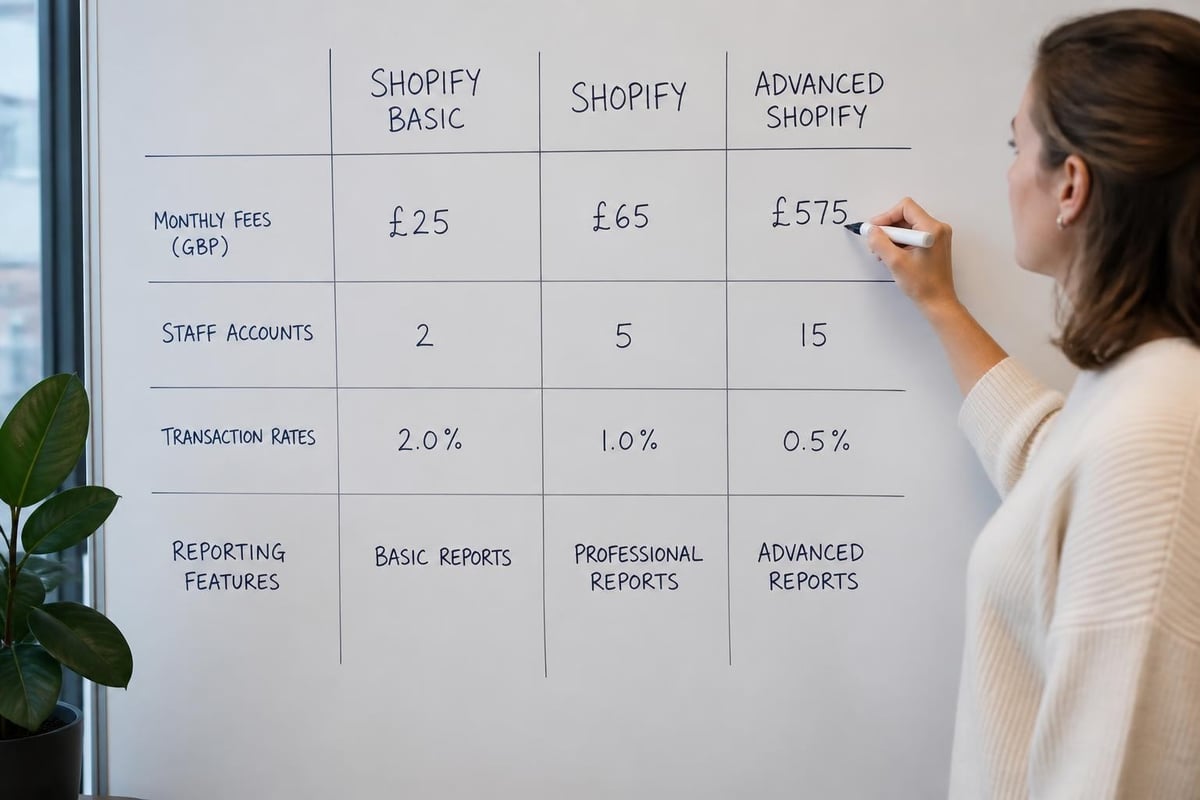
Advanced Plan: £299 Per Month
Advanced Shopify targets high-volume merchants requiring sophisticated reporting and the lowest transaction fees. The £299 monthly investment includes 15 staff accounts, advanced report builder, and third-party calculated shipping rates.
| Feature | Basic | Shopify | Advanced |
|---|---|---|---|
| Monthly cost | £25 | £69 | £299 |
| Staff accounts | 2 | 5 | 15 |
| Third-party fees | 2.0% | 1.0% | 0.5% |
| Online card rate | 2.2% + 20p | 1.9% + 20p | 1.6% + 20p |
| Reports | Basic | Professional | Advanced |
This tier makes financial sense for stores processing over 1,000 orders monthly or generating £50,000+ in monthly revenue. The 0.5% transaction fee when using external gateways represents significant savings at scale.
Shopify Plus: Enterprise-Level Pricing
Shopify Plus operates on custom pricing, typically starting around £1,800 monthly. This enterprise solution targets brands exceeding £800,000 in annual revenue or requiring advanced customisation, automation, and dedicated support.
Plus benefits include:
- Unlimited staff accounts
- Dedicated success manager
- Exclusive checkout customisation
- Shopify Flow automation
- Script editor for custom functionality
- Priority support with 99.99% uptime
The platform becomes cost-effective when your business demands higher API limits, wholesale channels, or multi-store management. Many ambitious UK brands considering Shopify Plus find the investment worthwhile once operational complexity exceeds what standard plans can handle efficiently.
Transaction Fees and Payment Processing
Understanding transaction fees is crucial when calculating true Shopify costs. These charges vary based on your chosen plan and payment method, significantly impacting profit margins.
Shopify Payments vs Third-Party Gateways
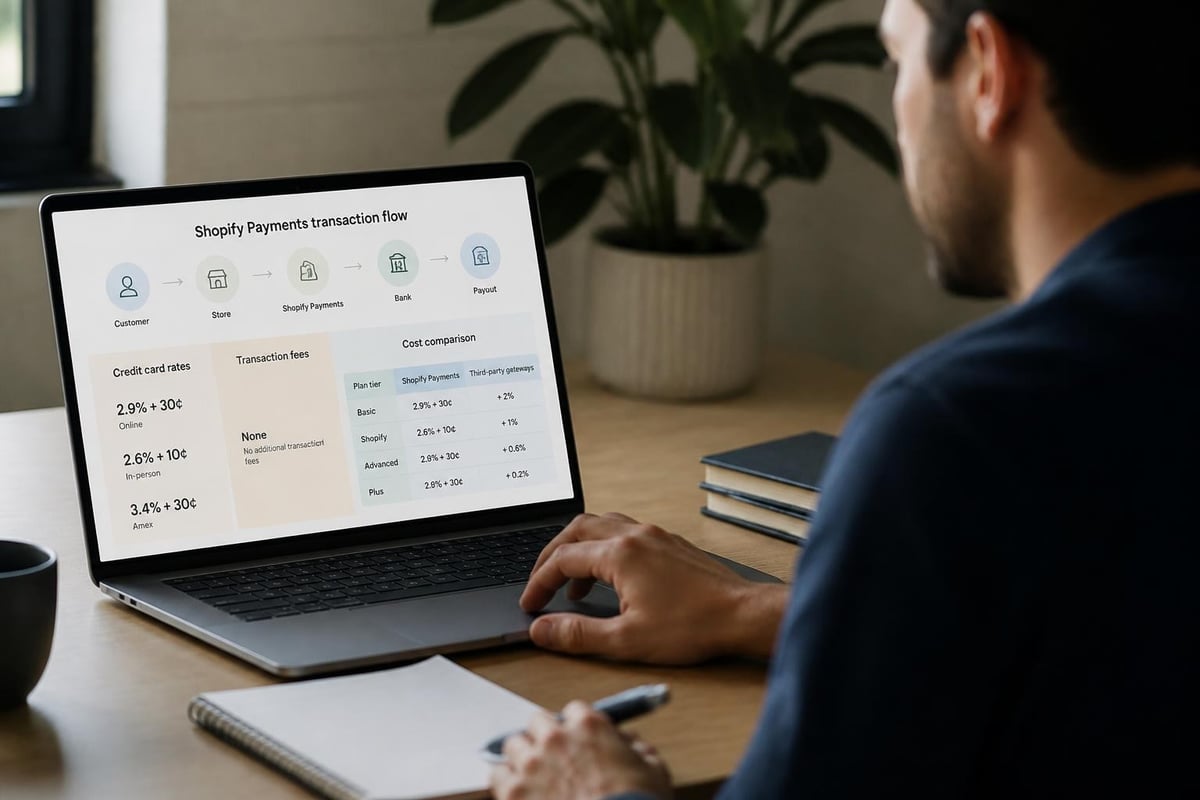
Using Shopify Payments eliminates the additional transaction fee charged on third-party gateways. However, you still pay credit card processing rates that vary by plan tier.
With Shopify Payments (no transaction fees):
- Basic: 2.2% + 20p online, 1.7% in-person
- Shopify: 1.9% + 20p online, 1.6% in-person
- Advanced: 1.6% + 20p online, 1.5% in-person
Using external gateways like PayPal or Stripe:
Add the transaction fee (2.0%, 1.0%, or 0.5% depending on plan) on top of whatever the gateway charges. This dual-fee structure quickly erodes margins, making Shopify Payments the economical choice for most UK merchants.
Some brands require specific payment providers for business reasons, but understanding the fee implications helps you make informed decisions about payment infrastructure.
Apps and Extensions: The Hidden Cost Centre
Whilst Shopify's core platform is robust, most stores require additional apps to unlock desired functionality. These subscription costs accumulate quickly, often exceeding your base plan price.
Essential App Categories and Typical Costs
Email marketing and automation:
- Klaviyo: £20-£300+ monthly (based on contacts)
- Omnisend: £13-£380+ monthly
- Mailchimp: Free-£235+ monthly
Reviews and social proof:
- Judge.me: Free-£12 monthly
- Loox: £8-£250+ monthly
- Yotpo: £20-£300+ monthly
Subscriptions and recurring revenue:
- Recharge: £50-£300+ monthly
- Bold Subscriptions: £35+ monthly
- Appstle: £8-£100+ monthly
Inventory and fulfilment:
- ShipStation: £7-£180+ monthly
- Stocky: £25 monthly (Shopify native)
- BackOrder: £5-£40 monthly
A typical growing UK store runs 8-15 apps, resulting in £150-£500 additional monthly costs. Budget conservatively when planning your shopify pricing and costs guide calculations, as app expenses often surprise new merchants.
When setting up your Shopify store, evaluate each app's necessity. Many stores install apps reactively without periodically reviewing whether they deliver sufficient ROI to justify ongoing costs.
Themes and Design Investment
Your store's visual presentation directly impacts conversion rates, making theme selection a critical decision with varying cost implications.
Free vs Premium Themes
Shopify offers 12 free themes with multiple style variations, providing solid foundations for budget-conscious brands. These themes are maintained by Shopify, ensuring compatibility with platform updates and reasonable performance.
Premium themes from the Shopify Theme Store range from £120-£300 as one-time purchases. These typically offer more customisation options, additional sections, and refined aesthetics compared to free alternatives.
Custom development represents the highest investment:
- Theme customisation: £1,500-£5,000
- Bespoke theme build: £8,000-£25,000+
- Full rebrand with custom features: £15,000-£50,000+
Working with specialists in Shopify web design ensures your design investment translates into measurable conversion improvements rather than just aesthetics. Many brands underestimate how much design quality affects revenue, focusing excessively on reducing upfront costs whilst ignoring lost sales from poor user experience.
| Theme Type | Cost Range | Best For |
|---|---|---|
| Free Shopify themes | £0 | Testing, very tight budgets |
| Premium themes | £120-£300 | Small-medium stores, quick launch |
| Customised premium | £1,500-£5,000 | Growing brands wanting uniqueness |
| Bespoke build | £8,000-£50,000+ | Established brands, complex needs |
Domain Names and SSL Certificates
Every Shopify store requires a domain name to establish professional credibility. Shopify includes SSL certificates at no additional cost, providing security for customer transactions.
Domain Costs
You can purchase domains directly through Shopify (approximately £11-£14 annually for standard .co.uk or .com extensions) or use existing domains from providers like GoDaddy, Namecheap, or 123-Reg.
Premium or exact-match domains purchased on secondary markets range from hundreds to thousands of pounds. Whilst an exceptional domain offers branding advantages, most UK stores succeed perfectly well with straightforward, brandable domains in the £10-£50 annual range.
Shopify automatically provisions SSL certificates for all stores, including custom domains. This security feature, which competitors sometimes charge £50-£200 annually for, is included in your subscription cost.
Sales Channel and Point of Sale Expenses
Expanding beyond your online store into additional sales channels introduces varying costs depending on your approach.
Multi-Channel Selling
Shopify integrates with numerous sales channels, most at no additional platform cost:
- Facebook and Instagram Shops: Free integration
- Amazon: Amazon's seller fees apply
- eBay: eBay's listing and final value fees apply
- Google Shopping: Free listings in organic results, paid for Shopping ads
Shopify POS Costs
Physical retail requires Shopify POS, available in two tiers:
POS Lite (included in all plans):
- Basic point of sale functionality
- In-person card rates apply
- Limited staff permissions
- Basic reporting
POS Pro (£73 per location monthly):
- Advanced inventory management
- Unlimited staff with PIN codes
- Enhanced reporting
- Smart grid for faster checkout
Hardware costs for card readers, receipt printers, and barcode scanners range from £50-£500 depending on your requirements. The Shopify Tap & Chip card reader costs approximately £49 as a one-time purchase.
Professional Services and Development
Beyond software costs, most serious ecommerce businesses invest in professional expertise to maximise their Shopify investment.
Migration Services
Moving from platforms like WooCommerce, Magento, or other systems to Shopify requires careful planning to preserve SEO value, customer data, and order history. Professional Shopify migration services typically cost £2,000-£15,000 depending on store complexity, product volume, and customisation requirements.
Migration considerations include:
- Product and variant transfers
- Customer data and order history
- URL redirects to maintain SEO
- Theme setup and customisation
- Payment gateway configuration
- Third-party integration setup
Ongoing Optimisation and Support
Conversion rate optimisation, performance improvements, and strategic development represent ongoing investments that compound returns over time. Many growing brands allocate £500-£3,000 monthly for professional support, development, and CRO initiatives.
This might include A/B testing programmes, checkout optimisation, speed improvements, or feature development to improve customer experience and increase average order values. Working with specialists in Shopify development ensures technical projects are executed properly without creating technical debt that hampers future growth.
Realistic Monthly Cost Examples
Understanding theoretical pricing helps less than seeing realistic total costs for businesses at different stages. These examples reflect typical UK Shopify stores in 2026.
Startup Store: £100-£250 Monthly
- Plan: Basic (£25)
- Apps: Email marketing free tier, basic reviews app (£10)
- Transaction volume: 50 orders at £40 average = £2,000 revenue
- Payment processing: £90 (2.2% + 20p per transaction)
- Total monthly: £125 + one-time theme (£180)
This budget suits businesses validating concepts or operating as side projects before scaling.
Growing Store: £400-£800 Monthly
- Plan: Shopify (£69)
- Apps: Email platform, reviews, abandoned cart, analytics (£150)
- Transaction volume: 300 orders at £60 average = £18,000 revenue
- Payment processing: £402 (1.9% + 20p per transaction)
- Total monthly: £621
Most established UK stores fall into this category, balancing functionality with controlled costs whilst generating meaningful revenue.
Established Store: £1,500-£4,000 Monthly
- Plan: Advanced or Shopify Plus (£299-£1,800)
- Apps: Comprehensive stack including subscriptions, advanced email, inventory management (£400-£800)
- Transaction volume: 1,500 orders at £80 average = £120,000 revenue
- Payment processing: £2,220 (1.6% + 20p per transaction)
- Professional support: Development, CRO, strategic consultancy (£1,000-£2,000)
- Total monthly: £3,919-£6,820
High-volume stores invest heavily in optimisation because small percentage improvements yield significant absolute revenue gains. At this stage, conversion rate optimisation becomes essential for maintaining competitive advantage.
Calculating Your True Cost of Ownership
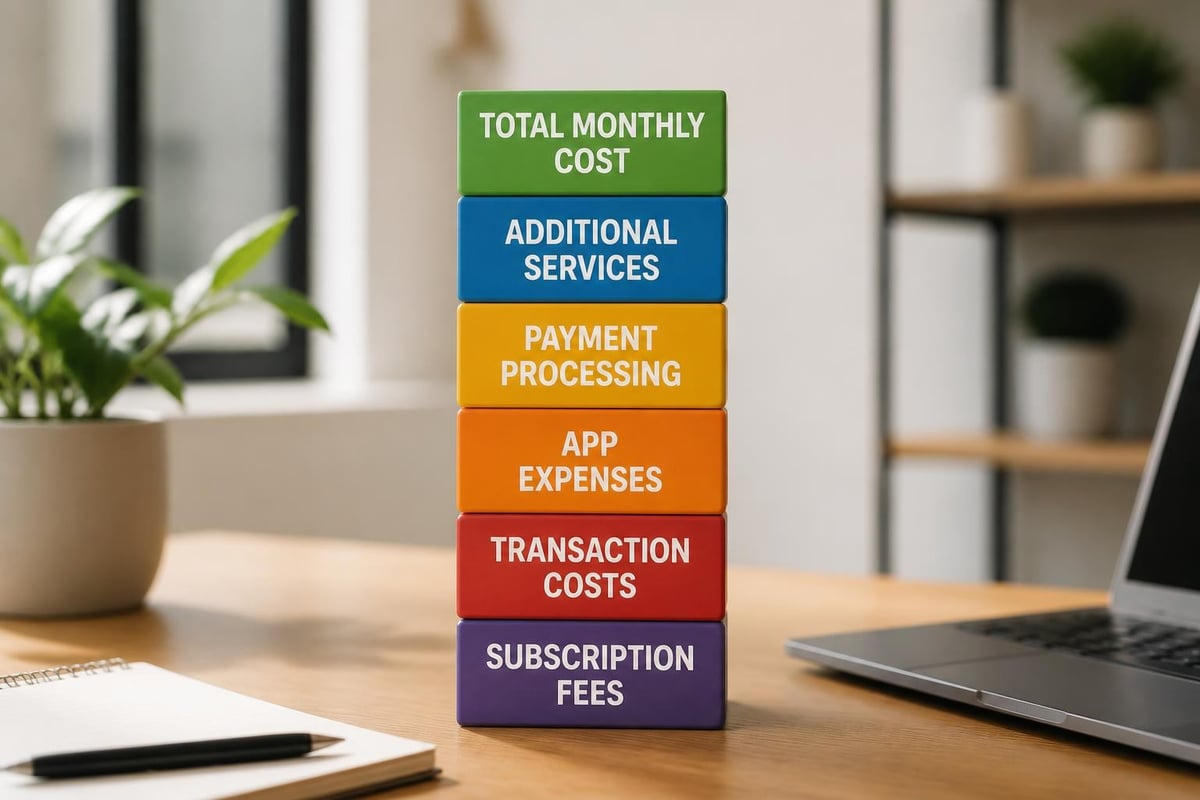
Creating an accurate budget requires accounting for all cost components rather than focusing solely on subscription fees. Comprehensive pricing breakdowns help UK merchants avoid budget shortfalls that hamper growth.
Essential calculation components:
- Monthly subscription fee for appropriate plan tier
- Payment processing costs based on projected revenue
- Essential apps required for your business model
- Design and development investment (amortised monthly)
- Content creation (photography, copywriting)
- Marketing and advertising budget
- Professional services for optimisation and support
A realistic total cost of ownership for a growing UK Shopify store typically runs 3-8% of monthly revenue once you factor in all expenses. Stores optimising aggressively push this percentage down over time through improved conversion rates and operational efficiency.
Comparing Shopify Costs to Alternatives
Shopify's pricing becomes clearer when compared against alternative ecommerce platforms available to UK merchants.
WooCommerce (WordPress)
Whilst WordPress and WooCommerce are technically free, realistic costs include:
- Quality hosting: £20-£100+ monthly
- SSL certificate: £0-£50 annually (unless included in hosting)
- Premium theme: £50-£150 one-time
- Essential plugins: £100-£300 annually
- Security and backups: £50-£200 annually
- Developer maintenance: £50-£200+ monthly
Total WooCommerce costs often rival Shopify whilst requiring more technical expertise and ongoing maintenance. Many brands migrate from WooCommerce to Shopify seeking managed infrastructure and reduced technical overhead.
BigCommerce
BigCommerce's pricing structure differs slightly from Shopify:
- Standard: £25.37 monthly (£50,000 annual sales threshold)
- Plus: £63.42 monthly (£180,000 threshold)
- Pro: £253.66 monthly (£400,000 threshold)
BigCommerce includes more native features but charges based on annual revenue rather than just functionality, potentially making it more expensive as you scale.
Custom-Built Solutions
Bespoke ecommerce platforms start around £30,000-£100,000+ for development, with ongoing hosting, security, and maintenance costs of £500-£3,000+ monthly. This approach suits only very specific business requirements that platforms cannot accommodate.
| Platform | Entry Cost | Transaction Fees | Scaling Cost | Technical Overhead |
|---|---|---|---|---|
| Shopify | £25/month | 1.9-2.2% + 20p | Predictable | Very low |
| WooCommerce | £20-£100/month | Payment gateway only | Variable | High |
| BigCommerce | £25.37/month | 1.9-2.2% + 20p | Revenue-based | Low |
| Custom | £30,000+ | Payment gateway only | High | Very high |
Cost Optimisation Strategies
Smart Shopify merchants continuously evaluate expenses to ensure each pound spent delivers appropriate return on investment.
App Audit and Consolidation
Review installed apps quarterly, removing unused tools and seeking consolidated solutions. Many apps overlap functionality, creating unnecessary costs. For instance, comprehensive email platforms like Klaviyo often eliminate needs for separate abandoned cart apps.
Plan Tier Evaluation
Monitor whether your current plan tier remains optimal as sales volumes fluctuate. Calculate the break-even point where reduced transaction fees on higher tiers offset increased subscription costs. Brands frequently discover that upgrading saves money once monthly processing volumes exceed certain thresholds.
Payment Gateway Selection
For most UK merchants, Shopify Payments offers the most economical processing rates. Calculate whether specialised gateways charging additional transaction fees genuinely deliver sufficient value through features like delayed capture or instalments.
Strategic Development Investment
Rather than accumulating numerous apps solving individual problems, consider custom development creating tailored solutions without ongoing subscription costs. A £3,000 custom feature replacing three £30 monthly apps pays for itself within 34 months whilst potentially delivering superior functionality.
Long-Term Financial Planning
Shopify costs evolve as your business grows, requiring forward-thinking financial planning to avoid constraints limiting expansion.
Budgeting for Growth
Allocate 5-10% of revenue toward platform improvements, optimisation, and development. This reinvestment funds conversion improvements, customer experience enhancements, and technical capabilities supporting sustainable growth.
Growth-stage investments typically include:
- Conversion rate optimisation programmes
- Advanced personalisation and segmentation
- Loyalty and retention systems
- Subscription or membership models
- International expansion capabilities
- Enhanced automation reducing operational costs
Understanding ROI on Platform Investment
Every pound spent on your Shopify store should generate measurable returns through increased revenue, reduced costs, or improved efficiency. Track metrics like customer acquisition cost, lifetime value, and conversion rate to ensure platform investments drive business objectives rather than just adding features.
The most successful UK ecommerce brands view their Shopify investment as revenue-generating infrastructure rather than pure expense. Optimising conversion rates by just 0.5% often generates returns far exceeding the cost of professional optimisation services.
This comprehensive shopify pricing and costs guide demonstrates that whilst Shopify's subscription fees are transparent, budgeting accurately requires accounting for transaction fees, apps, design, and ongoing optimisation. Understanding these costs helps UK brands make informed decisions about their ecommerce infrastructure and allocate resources effectively. If you're evaluating Shopify for your business or seeking to optimise an existing store's performance and costs, Futur Media specialises in helping ambitious UK brands build high-performing Shopify stores that balance investment with measurable commercial results.



.svg)