





Shopify Black Icon
BigCommerce to Shopify Migration

BigCommerce to Shopify Migration for Growing Ecommerce Brands

Move from BigCommerce to Shopify without losing the work you have already put in. We migrate your products, customers, orders, SEO and redirects carefully, while creating a store that is easier to manage, better supported and designed to grow with your business.
Shopify full logo
A pattern of dots
A mobile phone mock up of a shopify website
A laptop mock up of a shopify store designed for ride bike wales
A lady applying cream to her arm
A mobile phone mock up of a shopify website
A laptop mock up of a shopify store designed for ride bike wales
A lady applying cream to her arm
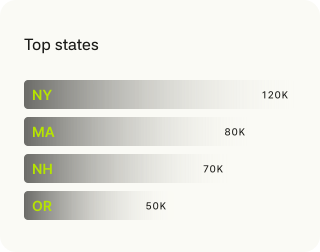
A display of a widget with stats
A mobile phone mock up of a shopify website
A laptop mock up of a shopify store designed for ride bike wales
A lady applying cream to her arm
A display of a widget with stats
Why Shopify?

Why Move from BigCommerce to Shopify?

BigCommerce is a capable hosted platform, but many growing brands find themselves fighting plan limits, a smaller app ecosystem and slower design iteration. Shopify offers a larger ecosystem, a stronger checkout and a platform your team can move faster on.

Start Your Migration

No More Sales-Based Plan Jumps

BigCommerce plans are tied to annual sales thresholds, so your costs can jump as you grow. Shopify pricing stays predictable, letting you scale revenue without being forced onto a higher tier.

A Bigger Ecosystem

Shopify's App Store and partner network are far larger than BigCommerce's, giving you more choice and better-supported tools for reviews, subscriptions, loyalty, email and everything in between.

Faster Design & Iteration

Shopify's theme architecture and design tooling make it quicker to build, test and improve your storefront than working within BigCommerce's Stencil framework — so your store keeps evolving.

Easier to Manage Day to Day

From product updates to order management, Shopify's admin is cleaner and simpler than BigCommerce's, making everyday store operations easier for your team as you grow.

Better Checkout Experience

Shopify's checkout — with Shop Pay and one-click purchasing — is widely regarded as one of the highest-converting in ecommerce, giving your store a stronger conversion foundation than BigCommerce's.
BigCommerce V Shopify

BigCommerce vs Shopify: Which Platform is Right for Your Business?

BigCommerce and Shopify are both fully hosted platforms, which makes this a closer comparison than WooCommerce or Magento. Both can run a serious ecommerce business — but they differ meaningfully on pricing structure, ecosystem size, checkout conversion and how fast your team can move. Here is an honest breakdown.

Cost & Maintenance

BigCommerce charges no additional transaction fees on any plan and works with a wide range of payment gateways — a genuine advantage. The catch is that plans are tied to your trailing twelve-month sales: cross a revenue threshold and you are automatically moved to a more expensive tier, so your platform cost rises with growth whether or not you need more features.
Shopify Green Icon
Shopify's pricing is flat per plan — you upgrade when you want more capability, not because you sold more. Using Shopify Payments there are no extra transaction fees; third-party gateways do incur a fee, which is worth factoring in if you rely on a specific payment provider. Verdict: BigCommerce wins on gateway flexibility, Shopify on cost predictability as you scale.

Ease of Management

BigCommerce packs more functionality in natively — product options, customer groups and B2B features often need no app at all. The trade-off is an admin that feels denser and more technical, and day-to-day tasks like bulk edits and content changes tend to take more clicks and more training.
Shopify Green Icon
Shopify is designed to be run by non-technical teams. Product updates, order management, discounts and content are all handled through a clean, consistent admin — and the mobile app is strong enough to genuinely run the store from. Verdict: BigCommerce for out-of-the-box depth, Shopify for ease and speed of daily operation.

Performance

As a hosted platform, BigCommerce handles infrastructure, CDN and security for you — performance is solid and you will not be patching servers. Real-world storefront speed depends heavily on your Stencil theme and any customisation layered on top.
Shopify Green Icon
Shopify also manages hosting, CDN and caching centrally, backed by one of the largest commerce infrastructures in the world — Black Friday scale traffic is routine. Online Store 2.0 themes are performance-optimised by default. Verdict: close to a draw on raw performance; Shopify edges it on infrastructure scale and theme optimisation.

Checkout and Conversion

BigCommerce offers an open, customisable checkout and supports a wide range of gateways without penalty. What it lacks is an equivalent to Shop Pay — there is no accelerated wallet with tens of millions of stored customer profiles ready to one-click through your checkout.
Shopify Green Icon
Shopify's checkout is widely regarded as the highest-converting in ecommerce. Shop Pay's one-click purchasing has been shown in Shopify's published research to lift checkout conversion meaningfully versus guest checkout. Verdict: Shopify, clearly — for most stores this single difference pays for the migration.

Apps and Integrations

BigCommerce's marketplace has around a thousand apps. More is built into the platform natively, so you may need fewer apps — but when you do need one, there is less choice, and popular tools sometimes support BigCommerce as an afterthought.
Shopify Green Icon
Shopify's App Store has thousands of apps, and it is the first platform virtually every ecommerce tool builds for — reviews, subscriptions, loyalty, email, support. Best-in-class tools like Recharge, Okendo, Gorgias and LoyaltyLion treat Shopify as home turf. Verdict: Shopify, decisively, on ecosystem depth.

SEO

BigCommerce gives you full control over URL structure — a real SEO advantage, and one reason migrations away from it must be planned carefully, since Shopify's URL patterns are fixed and every URL will change.
Shopify Green Icon
Shopify enforces its own URL structure (/products/, /collections/) but handles the technical fundamentals — sitemaps, canonical tags, structured data, redirects — reliably out of the box. Verdict: BigCommerce on URL flexibility; in practice a properly executed 301 redirect map closes the gap, which is exactly what our migration process delivers.

Scalability

BigCommerce scales technically — Enterprise plans and multi-storefront are genuinely capable, especially for B2B. The constraint is commercial: rising plan costs tied to sales, and a smaller pool of agencies, developers and tools around you as your needs grow.
Shopify Green Icon
Shopify scales from first sale to Shopify Plus with the largest merchant community, partner network and talent pool in ecommerce — whatever you need next, someone has already built it. Verdict: Shopify for most growing DTC brands; BigCommerce remains a fair shout for complex B2B catalogues.

Choose BigCommerce

If you rely on a specific payment gateway where avoiding transaction fees matters more than checkout conversion, or you run a complex B2B catalogue that leans on BigCommerce's native wholesale features.

Choose Shopify

If you want the strongest checkout in ecommerce, the biggest app and partner ecosystem, predictable pricing, and a platform your team can move fast on without specialist help.
About Futur

Built for ambitious brands ready to move beyond BigCommerce

Many BigCommerce stores reach a point where the platform starts to hold them back — plan costs climbing with every sales milestone, fewer apps to choose from, and a storefront that is slower to iterate on.

We help brands make the move to Shopify properly — combining migration, design and conversion thinking to deliver a store that is easier to manage and built for growth.
Start Your Migration
Cyclist riding a black and gold Trek road bike on a paved road at sunset.
Abstract black and white wavy striped 3D shape surrounded by floating spheres on a green gradient background with a white wireframe grid.
Our Approach

Futur is a specialist Shopify agency built for brands that want more from their ecommerce platform.
We help businesses move from BigCommerce to Shopify with a migration process that is carefully planned, technically sound and commercially focused.

As a small, focused agency, we work closely with our clients to deliver migrations that protect what matters, improve the store experience and create a stronger foundation for future growth.

Migration planned properly

We map products, SEO, redirects and store structure before the move begins.

Important data preserved

Products, customers and order history are migrated with care and accuracy.

Built with growth in mind

We do not just replicate your old setup — we improve it for Shopify.

Close support throughout

You work directly with a specialist team from planning through to launch.
LET’S TALK
Got a Shopify project in mind?

Whether you're launching a new store, migrating from another platform, or looking to grow an existing one — we'd love to hear about it.

5
We recently partnered with Futur to develop our new website, and the experience has been excellent. Their deep technical knowledge and strategic understanding of e-commerce and the Shopify platform gave us complete confidence throughout the entire process. If you are looking for a skilled developer who truly understands how to build a high-performing online store, I highly recommend Futur

— Stuart Davies
Founder of Ride Bikes Wales
Ridebikes logo with a stylized dragon head above the text.
Ready to talk? Let’s start with a hello.
Full Name
Email
Message
We’ll reply within 24–48h.

By sending, you accept our Privacy Policy.
Thank you! Your submission has been received!
Oops! Something went wrong while submitting the form.
No items found.
A cinematic shot of a coffee pouch of campervan coffee co in a subscription box
Minimalist black campervan icon with windows, wheels, and door.
Campervan Coffee CO
We rebuilt the store on a custom Shopify theme, migrated all order history, and integrated Recharge for subscriptions.
6.68%
Conversion Rate
27%
Subscriptions
Our Process

Our BigCommerce to Shopify Migration Process

Every migration is planned carefully to minimise disruption, protect performance and make the move to Shopify as smooth as possible.

Discovery & Migration Planning

We audit your current BigCommerce store — products, customer groups, apps, URL structure and SEO — then create a migration plan tailored to your business, including a full URL redirect map.

Migration & Store Build

We migrate your products, customers and key data into Shopify, while refining the structure, design and overall user experience of the new store.

Launch & Growth

Before launch, we test the store, redirects and integrations thoroughly. Once live, we support the transition and help ensure everything is running smoothly.

Ready to Move to Shopify?

Whether you need a straightforward migration or a more complete redesign alongside it, we can help you make the move with confidence.
Shopify full logo
FAQ

BigCommerce to Shopify Migration FAQs

How long does a BigCommerce to Shopify migration take?

Most BigCommerce to Shopify migrations take between 4 and 8 weeks from kick-off to launch. The timeline depends on the size of your catalogue, how much you use BigCommerce-specific features like customer groups or multi-storefront, and whether you want a redesign alongside the migration or a like-for-like move. Your BigCommerce store stays live and trading throughout.

Will I lose my SEO rankings when migrating from BigCommerce to Shopify?

Not if the migration is handled correctly — but BigCommerce migrations need particular care here. Because BigCommerce lets you fully customise URLs and Shopify uses fixed URL structures, almost every URL on your site will change. We map every existing URL to its Shopify equivalent with one-to-one 301 redirects, transfer your metadata and structured data, and test everything before launch so search engines treat the new store as a continuation of your existing site.

What data can be migrated from BigCommerce to Shopify?

We migrate your full product catalogue including variants, options, images, descriptions and pricing, along with customer records, customer groups, order history and your store structure. We also transfer key SEO data and set up redirects from every old URL. Some BigCommerce-specific configuration — like price lists or B2B settings — needs remapping to Shopify equivalents rather than a direct copy, and we plan that with you during the audit.

Will my customers need to reset their passwords after the migration?

Yes — this is a standard part of any BigCommerce to Shopify migration and applies regardless of who carries out the work. Passwords are stored as encrypted hashes in BigCommerce and cannot be transferred to Shopify for security reasons. Shopify handles this smoothly: customers are prompted to set a new password on their first login, and we help you plan the communication so it causes minimal friction.

Do I need to replace my BigCommerce apps and built-in features on Shopify?

Some of what BigCommerce does natively — advanced product options, customer groups, basic B2B — is handled on Shopify by apps or Shopify Plus features, so the migration includes mapping each feature you actually use to its best Shopify equivalent. In most cases the Shopify option is better supported and more actively developed; the App Store alternatives for reviews, subscriptions, loyalty and email are the strongest in ecommerce. We audit this during discovery so there are no surprises after launch.

How much does a BigCommerce to Shopify migration cost?

BigCommerce to Shopify migrations with Futur Media start from £2,500 for a standard migration covering products, customers, orders and full 301 redirect mapping. Complex migrations — large catalogues, multi-storefront setups, B2B features or custom data — start from £6,000. Every project is quoted at a fixed price after a migration audit, so there are no surprises.

Is migrating to Shopify worth it for AI commerce and future visibility?

Increasingly, yes. Shopify stores get native infrastructure for AI commerce channels — including ChatGPT product discovery and Perplexity Shopping — without additional setup. BigCommerce stores can work towards similar visibility, but it requires more manual structured data work and is not built into the platform in the same way. If AI-driven shopping matters to your growth plans, Shopify currently offers the more direct route.

What is the difference between using a migration app and hiring an agency?

Migration apps automate the transfer of basic data — products, customers and orders — but they do not handle redirects, SEO preservation, design, feature mapping or post-launch testing. For BigCommerce moves this matters more than usual, because custom URL structures and native features like customer groups need careful manual mapping to survive the move. An agency migration covers the full picture: data, SEO, design, integrations and launch support.

Our Services
Close