
.svg)






%201.avif)
The landscape of business-to-business commerce has fundamentally transformed over the past five years. What once relied on phone calls, faxed orders, and face-to-face meetings now demands sophisticated digital infrastructure that can handle complex pricing matrices, multi-level approvals, and seamless integration with enterprise resource planning systems. B2B ecommerce web development has evolved from a nice-to-have feature into an essential competitive requirement for wholesalers, manufacturers, and distributors looking to retain market share and attract a new generation of digital-first procurement professionals.
Understanding B2B Ecommerce Web Development Requirements
Building a successful B2B ecommerce platform requires a fundamentally different approach compared to consumer-facing stores. The technical architecture must accommodate business workflows that simply don't exist in B2C environments.
Account-Based Pricing and Customer Groups
B2B transactions rarely involve standard pricing. Your web development project must support multiple pricing tiers based on customer segments, purchase volume, contract terms, and historical relationships. This means implementing custom pricing logic that displays different rates to different logged-in users without exposing your entire pricing structure.
Key pricing features include:
- Volume-based discounting that updates dynamically as cart quantities change
- Customer-specific catalogue access with hidden products for certain account types
- Contract pricing that overrides standard rates for specific time periods
- Request-for-quote functionality for custom orders or bulk purchases
The database architecture behind these features requires careful planning. Each customer record must link to pricing rules, approved products, payment terms, and credit limits. Unlike B2C stores where a single price table suffices, B2B ecommerce website development demands sophisticated relational structures that maintain performance even with thousands of SKUs and hundreds of customer accounts.

Complex Approval Workflows
Many B2B purchases require internal approval before completion. Your platform must accommodate multi-step approval processes where junior staff can build carts but senior managers must authorise purchases above certain thresholds.
This workflow functionality extends beyond simple user roles. The system needs to send notifications, track approval status, allow delegated authority, and maintain audit trails. When developing these features, consider how they'll integrate with your customers' existing procurement software and approval hierarchies.
Platform Selection for B2B Ecommerce Development
Choosing the right foundation for your b2b ecommerce web development project significantly impacts long-term success, maintenance costs, and scalability potential.
| Platform Type | Best For | Key Advantages | Limitations |
|---|---|---|---|
| Shopify Plus | Mid-market B2B with growth ambitions | Fast deployment, reliable infrastructure, strong app ecosystem | Monthly costs, some customisation constraints |
| Custom Development | Enterprise with unique requirements | Complete flexibility, proprietary features | High initial cost, ongoing maintenance burden |
| Magento Commerce | Large catalogues, complex operations | Powerful out-of-box B2B features | Requires significant technical resources |
| Hybrid Solutions | Businesses with specific legacy needs | Integrates with existing systems | Complexity in maintenance and updates |
Shopify has made considerable investments in B2B functionality since 2024, making it increasingly viable for wholesale operations. The platform now offers native support for customer-specific pricing, wholesale channels, and purchase order payments. For UK businesses seeking faster time-to-market with lower technical overhead, Shopify Plus represents a pragmatic choice that doesn't sacrifice professional capability.
Technical Stack Considerations
Your development team's technology choices ripple through every aspect of your platform's performance, security, and maintainability. Modern b2b ecommerce web development typically involves headless architectures that separate the front-end presentation layer from back-end commerce logic.
Headless commerce advantages:
- Superior page load speeds through static site generation
- Flexibility to create unique user experiences without platform constraints
- Easier integration with mobile apps, point-of-sale systems, and other touchpoints
- Better performance under high traffic loads during busy ordering periods
However, headless approaches increase development complexity and require more sophisticated technical skills. Evaluate whether your internal team or development partner has experience with frameworks like Next.js, Gatsby, or Nuxt.js before committing to this architecture.
The best digital agency websites demonstrate how modern development approaches create fast, engaging experiences without sacrificing functionality.
Essential Features in B2B Ecommerce Platforms
Successful B2B platforms share common functionality that addresses specific business buyer needs. These features distinguish professional wholesale systems from adapted consumer stores.
Quick Order and Reordering Functionality
Business buyers know exactly what they need. They don't browse recreationally. Your platform must facilitate rapid ordering through multiple methods:
- SKU-based quick order forms where buyers paste product codes and quantities
- CSV upload functionality for bulk orders from spreadsheets
- One-click reordering from previous purchase history
- Saved cart templates for recurring purchases
- Product lists organised by project or location
Research from mobile-responsive B2B platforms shows that streamlined ordering processes directly correlate with increased order frequency and customer retention. Buyers appreciate interfaces that respect their time and expertise.
Integration with Business Systems
Your ecommerce platform cannot operate in isolation. It must exchange data seamlessly with existing business infrastructure.

Critical integration points include:
- ERP systems for inventory levels, pricing updates, and order fulfilment
- Accounting software for invoicing, payment reconciliation, and financial reporting
- CRM platforms for customer data, sales history, and relationship management
- Warehouse management systems for stock allocation and shipping coordination
- Payment gateways that support purchase orders, net terms, and credit accounts
The technical approach to these integrations varies. Some platforms offer pre-built connectors whilst others require custom API development. During your b2b ecommerce web development planning, map every system that needs to share data and identify the optimal integration method for each connection.
Working with experienced Shopify development specialists ensures these integrations are built correctly from the start, avoiding costly rework when data synchronisation issues emerge post-launch.
User Experience Design for Business Buyers
B2B user experience design balances efficiency with comprehensive information provision. Business buyers make considered decisions based on detailed specifications, compliance documentation, and total cost calculations.
Information Architecture for Large Catalogues
Wholesalers and distributors often manage catalogues with tens of thousands of SKUs. Your information architecture must help buyers navigate this complexity through multiple pathways:
- Hierarchical category structures that mirror industry standards
- Faceted search with filters for technical specifications, certifications, and compatibility
- Advanced search functionality including partial SKU matching and synonym recognition
- Cross-reference tools that convert competitor part numbers to your equivalents
Table-based product displays work effectively in B2B contexts. Unlike consumer stores that emphasise large product images, business buyers often prefer dense information displays that show specifications, availability, and pricing across multiple variants simultaneously.
Mobile Responsiveness for Field Buyers
The stereotype of B2B buyers working exclusively from office desktops no longer reflects reality. Tradespeople, site managers, and field service technicians increasingly place orders from mobile devices whilst on-site. A case study from Altius Technical Services demonstrated how mobile optimisation contributed to a 212% increase in online revenue.
Mobile B2B experiences require different design decisions than consumer apps:
- Larger touch targets for users wearing gloves or working in challenging conditions
- Offline functionality that caches product data and queues orders when connectivity drops
- Voice search for hands-free product lookup
- Barcode scanning for quick product identification in warehouse environments
- Click-to-call functionality for immediate support access
Your development team should test the platform with actual field users in realistic conditions, not just in office environments with fast WiFi connections.
Conversion Optimisation for B2B Platforms
Conversion rate optimisation takes different forms in B2B contexts. Traditional consumer metrics like impulse purchases and emotional triggers give way to trust signals, comprehensive information, and friction reduction in purchasing workflows.
Trust and Credibility Elements
Business buyers risk their professional reputation with every vendor selection. Your platform must establish credibility through multiple signals:
| Trust Element | Implementation | Impact on Conversion |
|---|---|---|
| Certifications | Display industry certifications, quality standards, and compliance badges | Reduces perceived risk |
| Technical Documentation | Provide spec sheets, safety data, CAD drawings | Enables informed decisions |
| Case Studies | Show real applications in similar industries | Demonstrates relevant experience |
| Transparent Stock Levels | Display accurate availability data | Prevents order disappointment |
| Delivery Timescales | Provide specific lead times by postcode | Aids project planning |
The strategic design practices for B2B websites emphasise that trust-building elements should integrate naturally throughout the user journey, not concentrate on a single "about us" page.
Performance optimisation plays an underappreciated role in B2B conversion. Business buyers demonstrate less patience for slow-loading pages than consumer shoppers. Investment in Shopify CRO services can identify technical bottlenecks and user experience friction points that suppress conversion rates.
Streamlining the Checkout Process
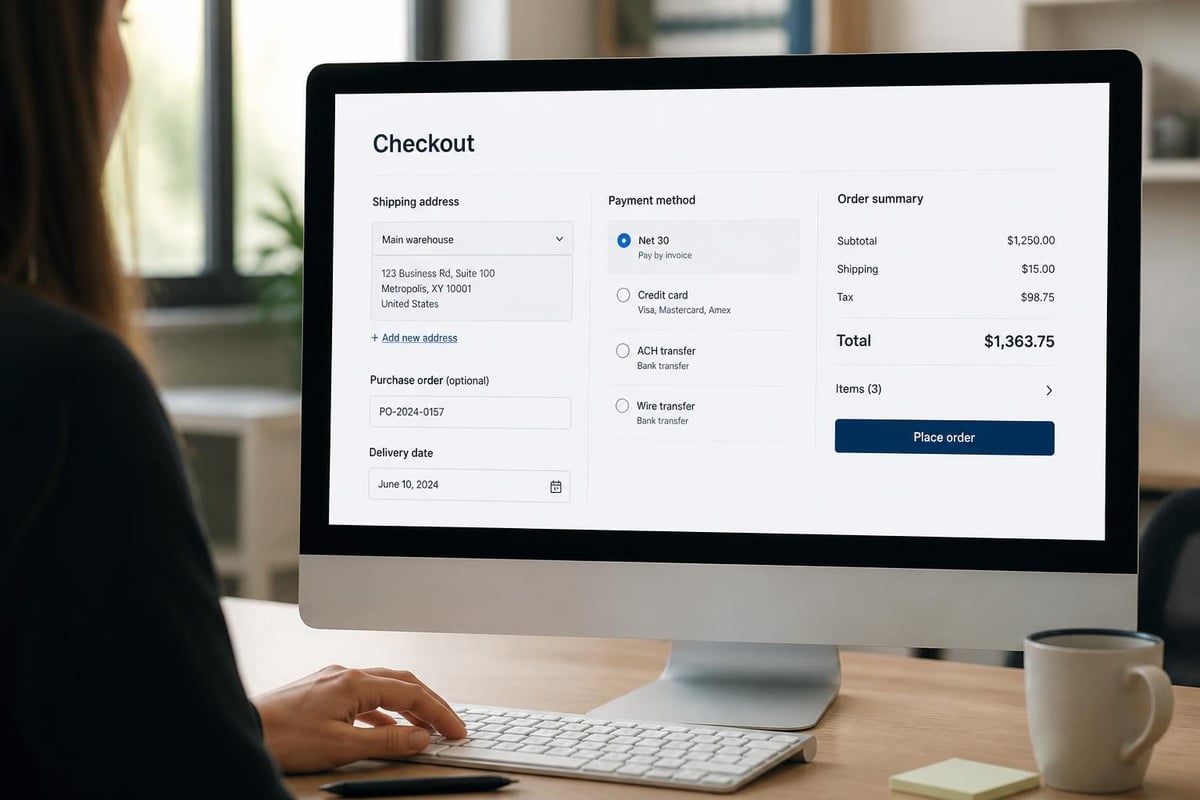
B2B checkout requires additional fields and validation that don't exist in consumer flows, but that doesn't justify unnecessary complexity.
Checkout optimisation strategies:
- Save multiple delivery addresses with labels (Head Office, Workshop, Site 3)
- Pre-populate purchase order numbers based on customer patterns
- Offer express checkout for repeat customers with saved payment methods
- Provide delivery date selection with realistic lead times
- Enable order splitting for partial shipments to different locations
- Calculate delivery costs accurately before final submission
Each additional form field reduces completion rates. Audit every piece of information you collect and verify it's genuinely necessary. Can you obtain it from integrated systems? Can you request it post-purchase for non-essential data?
Security and Compliance Considerations
B2B platforms handle sensitive business information, customer data, and often significant transaction values. Security cannot be an afterthought in your development process.
Data Protection and Privacy
Your platform must comply with UK GDPR requirements whilst handling business contact information. This involves implementing proper consent mechanisms, data retention policies, and customer rights to access or delete information.
Security requirements include:
- SSL certificates for all pages, not just checkout
- Two-factor authentication for accounts with high credit limits
- Role-based access control within customer accounts
- Regular security audits and penetration testing
- PCI compliance for payment processing
- Secure API endpoints with proper authentication
- Protection against common vulnerabilities (SQL injection, XSS, CSRF)
Consider implementing IP whitelisting for customers who want to restrict account access to specific office locations. Some industries require additional compliance standards beyond general ecommerce security.
Payment Security and Terms
B2B payment methods differ significantly from consumer transactions. Your platform must accommodate purchase orders, net payment terms, and credit accounts whilst maintaining financial security.
Development must support payment workflows where orders are placed without immediate payment. This requires credit limit checking, terms enforcement, and integration with accounting systems for invoice generation. Some customers require specific invoice formats or payment notification procedures that necessitate customisation beyond standard platform capabilities.
Performance and Scalability Planning
B2B platforms face unique performance challenges. Large product catalogues, complex pricing calculations, and data-heavy integrations can create bottlenecks that damage user experience.
Database Optimisation
Your product database must return filtered search results instantly even with extensive catalogues. This requires careful index design, query optimisation, and potentially search-specific technologies like Elasticsearch or Algolia.
Database performance strategies:
- Implement caching layers for frequently accessed pricing and product data
- Use database indexing on commonly filtered attributes
- Partition large tables by customer segment or product category
- Schedule resource-intensive operations (price updates, inventory syncs) during low-traffic periods
- Monitor query performance and optimise slow-running database calls
Modern approaches to B2B ecommerce development incorporate predictive analytics and machine learning to anticipate customer needs, as demonstrated by research into predictive buying systems that significantly increase order rates through intelligent recommendations.
Handling Peak Load Scenarios
Unlike consumer retail with predictable seasonal peaks, B2B platforms may experience sudden traffic spikes when large customers place orders or when industry events drive planning activity.
Your infrastructure must scale to accommodate these peaks without performance degradation. Cloud-based hosting with auto-scaling capabilities provides flexibility that traditional fixed-capacity servers cannot match. Load testing should simulate realistic scenarios including multiple simultaneous users from the same customer account accessing large product lists whilst the system processes background integration tasks.
Content Strategy for B2B Ecommerce
Content serves different purposes in B2B contexts. Beyond product descriptions, your platform needs educational resources, technical documentation, and tools that support the buyer's decision-making process.
Product Information Management
Comprehensive, accurate product information directly impacts conversion rates and reduces returns. Your content strategy must address:
- Technical specifications in standardised formats
- Compatibility information and cross-references
- Application guides and usage instructions
- Compliance certificates and safety documentation
- High-quality images from multiple angles
- Video demonstrations where appropriate
Many B2B products require detailed specification documents that buyers download for project planning or compliance purposes. Your platform should track these downloads as valuable conversion signals indicating serious purchase intent.
Educational Content and Resources
Business buyers conduct extensive research before making purchasing decisions. Providing valuable content positions your platform as a knowledgeable partner rather than just a transaction facilitator.
Consider developing:
- Industry-specific buying guides
- Product comparison tools
- Calculation utilities (coverage estimators, load calculators, sizing tools)
- Installation instructions and best practices
- Maintenance schedules and troubleshooting guides
- Regulatory compliance information
This content serves dual purposes: supporting customer success whilst improving search visibility. Strategic implementation of Shopify SEO principles ensures this valuable content attracts organic traffic from business buyers researching solutions.
Migration and Platform Transitions
Many B2B ecommerce web development projects involve migrating from legacy systems, outdated platforms, or manual processes. These transitions carry significant risk that requires careful planning.
Data Migration Planning
Your existing customer data, product catalogue, order history, and pricing structures represent years of business relationships. Migration must preserve this information accurately whilst improving its structure and accessibility.
Migration priorities include:
- Customer account data with complete relationship history
- Product catalogue including specifications, images, and categories
- Historical order data for reordering functionality
- Saved carts and wish lists
- Custom pricing agreements and contract terms
- Content and documentation
Establish clear data quality standards before migration. Clean your source data rather than importing inconsistencies into your new platform. Map legacy fields to new structures, identifying where manual intervention or business rule updates are necessary.
The services offered by experienced agencies often include comprehensive migration support that minimises business disruption and data loss risks.
Maintaining Business Continuity
B2B customers depend on consistent access to ordering systems. Downtime during migration can damage relationships and lose revenue. Your transition plan must minimise disruption.
Strategies for seamless transitions:
- Parallel running periods where both old and new systems operate simultaneously
- Phased customer migration starting with willing early adopters
- Comprehensive user training before full launch
- Dedicated support resources during transition periods
- Rollback capabilities if critical issues emerge
Communication with customers throughout the migration builds confidence and reduces resistance to change. Explain benefits they'll experience whilst acknowledging the learning curve involved in adapting to new workflows.
Future-Proofing Your B2B Platform
Technology evolution doesn't stop at launch. Your platform must adapt to changing customer expectations, emerging technologies, and evolving business requirements.
API-First Architecture
Building with APIs as the foundation creates flexibility for future expansion. This approach enables you to add new touchpoints, integrate emerging tools, and adapt to changing business models without rebuilding core functionality.
An API-first approach supports:
- Mobile app development using the same backend services
- Integration with customer procurement portals
- Connection to marketplaces and third-party sales channels
- Custom interfaces for specific customer segments
- Automated ordering through IoT devices or inventory management systems
Modern research into explainable B2B systems emphasises the importance of transparent, well-documented APIs that enable effective communication between systems and stakeholders.
Continuous Improvement Processes
Successful B2B platforms evolve based on user feedback, performance data, and changing business requirements. Establish processes for ongoing optimisation:
- Regular analysis of user behaviour and conversion funnels
- Systematic collection of customer feedback
- A/B testing of interface changes and new features
- Performance monitoring and optimisation
- Security updates and compliance maintenance
- Feature prioritisation based on business impact
Working with a partner that provides ongoing Shopify support ensures your platform remains current, secure, and aligned with business objectives long after initial launch.
Measuring Success in B2B Ecommerce
B2B platform success metrics differ from consumer ecommerce. Focus on measurements that reflect business buyer behaviour and relationship value.
Key Performance Indicators
| Metric | Why It Matters | Target Benchmark |
|---|---|---|
| Average Order Value | Indicates customer confidence and buying patterns | Track quarterly trends |
| Reorder Rate | Shows customer satisfaction and platform utility | Above 60% for established customers |
| Time to Reorder | Efficiency indicator for repeat purchases | Decreasing over time |
| Customer Lifetime Value | Long-term relationship measurement | Increasing year-over-year |
| Quote-to-Order Conversion | Effectiveness of sales process | Industry-dependent |
| Account Activation Rate | New customer onboarding success | Above 75% |
Track these metrics by customer segment to identify which groups find the most value in your platform and where improvements could unlock growth.
Qualitative Feedback Collection
Numbers don't tell the complete story. Systematic collection of qualitative feedback reveals friction points and opportunity areas that analytics alone might miss.
Implement feedback mechanisms including:
- Post-purchase surveys focused on ordering experience
- Periodic customer interviews with high-value accounts
- User testing sessions when developing new features
- Support ticket analysis to identify common issues
- Sales team feedback from customer conversations
This feedback should directly inform your development roadmap, ensuring enhancements address real customer needs rather than theoretical improvements.
Building a successful B2B ecommerce platform requires balancing complex business requirements with user-friendly experiences that respect how business buyers actually work. The investment in proper b2b ecommerce web development pays dividends through increased order frequency, improved customer satisfaction, and operational efficiency that compounds over time. Whether you're launching a new wholesale channel, replacing legacy systems, or enhancing an existing platform, working with specialists who understand both technical requirements and business buyer behaviour ensures your project delivers measurable results. Futur Media helps ambitious UK brands build high-performing ecommerce stores that convert visitors into customers through smart UX, performance-led development, and ongoing optimisation.



.svg)